Black Jason E, Harris Stewart B, Ryan Bridget L, Zou Guangyong, Ratzki-Leewing Alexandria
Department of Family Medicine, Schulich School of Medicine and Dentistry, Western University, London, ON, Canada.
Department of Epidemiology and Biostatistics, Schulich School of Medicine and Dentistry, Western University, London, ON, Canada.
Diabetes Ther. 2023 Aug;14(8):1299-1317. doi: 10.1007/s13300-023-01423-3. Epub 2023 Jun 3.
Second-generation basal insulin analogues have been shown to reduce hypoglycemia in several trials and observational studies of select populations; however, it remains unclear whether these results persist in real-world settings. Using self-reported hypoglycemia events, we assessed whether second-generation basal insulin analogues reduce rates of hypoglycemia events (non-severe/severe; overall/daytime/nocturnal) compared to earlier intermediate/basal insulin analogues among people with insulin-treated type 1 or 2 diabetes.
We used prospectively collected data from the Investigating Novel Predictions of Hypoglycemia Occurrence Using Real-World Models (iNPHORM) panel survey. This US-wide, 1-year internet-based survey assessed hypoglycemia experiences and related sociodemographic and clinical characteristics of people with diabetes (February 2020-March 2021). We estimated population-average rate ratios for hypoglycemia comparing second-generation to earlier intermediate/basal insulin analogues using negative binomial regression, adjusting for confounders. Within-person variability of repeated observations was addressed with generalized estimating equations.
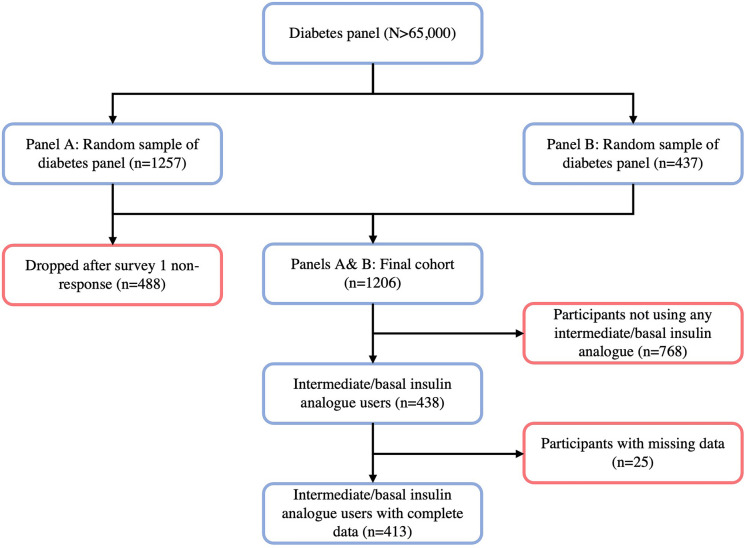
Among iNPHORM participants with complete data, N = 413 used an intermediate/basal insulin analogue for ≥ 1 month during follow-up. After adjusting for baseline and time-updated confounders, average second-generation basal insulin analogue users experienced a 19% (95% CI 3-32%, p = 0.02) lower rate of overall non-severe hypoglycemia and 43% (95% CI 26-56%, p < 0.001) a lower rate of nocturnal non-severe hypoglycemia compared to earlier intermediate/basal insulin users. Overall severe hypoglycemia rates were similar among second-generation and earlier intermediate/basal insulin users (p = 0.35); however, the rate of severe nocturnal hypoglycemia was reduced by 44% (95% CI 10-65%, p = 0.02) among second-generation insulin users compared to earlier intermediate/basal insulin users.
Our real-world results suggest second-generation basal insulin analogues reduce rates of hypoglycemia, especially nocturnal non-severe and severe events. Whenever possible and feasible, clinicians should prioritize prescribing these agents over first-generation basal or intermediate insulin in people with type 1 and 2 diabetes.
在针对特定人群的多项试验和观察性研究中,第二代基础胰岛素类似物已显示出能降低低血糖发生率;然而,在现实环境中这些结果是否依然成立仍不明确。我们利用自我报告的低血糖事件,评估了在接受胰岛素治疗的1型或2型糖尿病患者中,与早期的中效/基础胰岛素类似物相比,第二代基础胰岛素类似物是否能降低低血糖事件(非严重/严重;总体/白天/夜间)的发生率。
我们使用了来自“利用真实世界模型研究低血糖发生的新预测”(iNPHORM)小组调查中前瞻性收集的数据。这项覆盖全美的为期1年的基于互联网的调查评估了糖尿病患者的低血糖经历以及相关的社会人口统计学和临床特征(2020年2月至2021年3月)。我们使用负二项回归估计了第二代与早期中效/基础胰岛素类似物相比低血糖的总体平均发生率比,并对混杂因素进行了调整。使用广义估计方程处理重复观察的个体内变异性。
在iNPHORM中拥有完整数据的参与者中,有N = 413人在随访期间使用中效/基础胰岛素类似物≥1个月。在对基线和随时间更新的混杂因素进行调整后,与早期中效/基础胰岛素使用者相比,第二代基础胰岛素类似物的平均使用者总体非严重低血糖发生率降低了19%(95%置信区间3 - 32%,p = 0.02),夜间非严重低血糖发生率降低了43%(95%置信区间26 - 56%),p < 0.001)。第二代和早期中效/基础胰岛素使用者的总体严重低血糖发生率相似(p = 0.35);然而,与早期中效/基础胰岛素使用者相比,第二代胰岛素使用者的严重夜间低血糖发生率降低了44%(95%置信区间10 - 65%,p = 0.02)。
我们的真实世界研究结果表明,第二代基础胰岛素类似物可降低低血糖发生率,尤其是夜间非严重和严重低血糖事件。只要有可能且可行,临床医生在1型和2型糖尿病患者中应优先处方这些药物,而非第一代基础或中效胰岛素。