Wijaya Winona, Suhaimi Zahirah, Chua Cherlyn Xin'Er, Sunil Rohan Shawn, Kolundžija Sandra, Rohaizat Ahmad Muzakkir Bin, Azmi Norzarifah Binti Md, Hazrin-Chong Nur Hazlin, Lauro Federico M
Asian School of the Environment, Nanyang Technological University, Singapore, Singapore.
Department of Anthropology, University of California Santa Cruz, Santa Cruz, CA, USA.
ISME Commun. 2023 Jun 6;3(1):55. doi: 10.1038/s43705-023-00260-6.
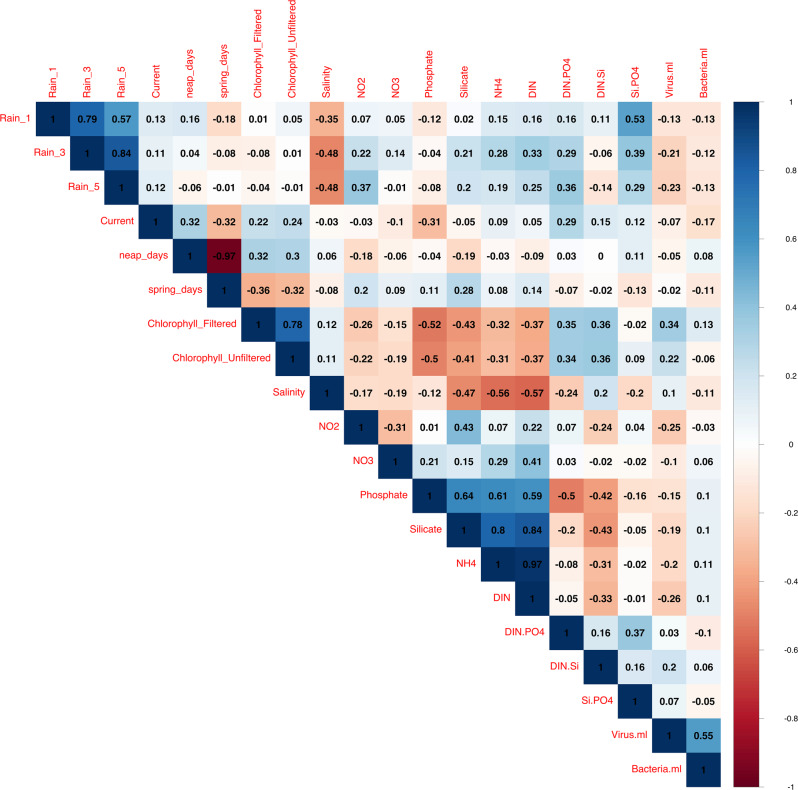
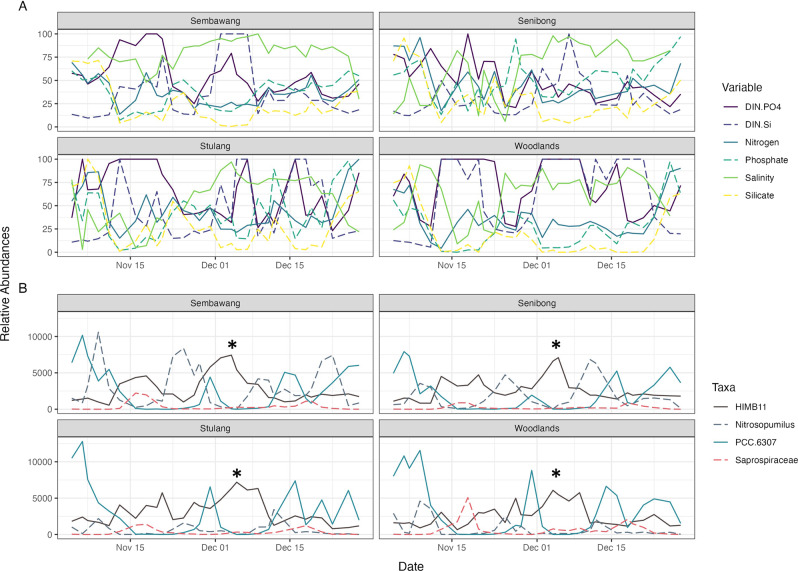
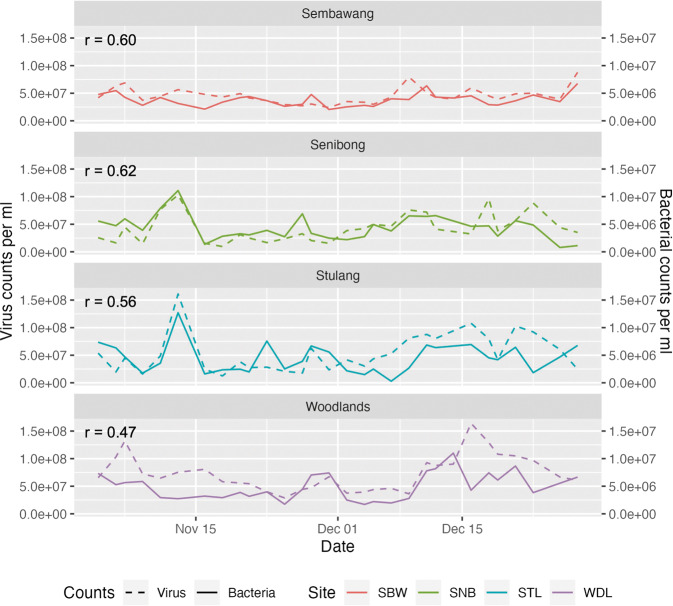
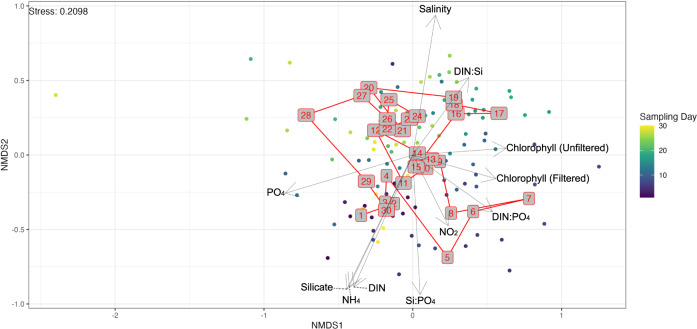
The Johor Strait separates the island of Singapore from Peninsular Malaysia. A 1-kilometer causeway built in the early 1920s in the middle of the strait effectively blocks water flowing to/from either side, resulting in low water turnover rates and build-up of nutrients in the inner Strait. We have previously shown that short-term rather than seasonal environmental changes influence microbial community composition in the Johor Strait. Here, we present a temporally-intensive study that uncovers the factors keeping the microbial populations in check. We sampled the surface water at four sites in the inner Eastern Johor Strait every other day for two months, while measuring various water quality parameters, and analysed 16S amplicon sequences and flow-cytometric counts. We discovered that microbial community succession revolves around a common stable state resulting from frequent pulse disturbances. Among these, sporadic riverine freshwater input and regular tidal currents influence bottom-up controls including the availability of the limiting nutrient nitrogen and its biological release in readily available forms. From the top-down, marine viruses and predatory bacteria limit the proliferation of microbes in the water. Harmful algal blooms, which have been observed historically in these waters, may occur only when there are simultaneous gaps in the top-down and bottom-up controls. This study gains insight into complex interactions between multiple factors contributing to a low-resistance but high-resilience microbial community and speculate about rare events that could lead to the occurrence of an algal bloom.
柔佛海峡将新加坡岛与马来西亚半岛分隔开来。20世纪20年代初在海峡中部修建的一条1公里长的堤道有效地阻挡了水流向两岸的流动,导致海峡内部的水周转率较低,营养物质积累。我们之前已经表明,短期而非季节性的环境变化会影响柔佛海峡的微生物群落组成。在此,我们进行了一项时间密集型研究,揭示了控制微生物种群数量的因素。我们在柔佛海峡东部内部的四个地点每隔一天采集一次地表水样本,持续了两个月,同时测量各种水质参数,并分析了16S扩增子序列和流式细胞计数。我们发现,微生物群落演替围绕着由频繁脉冲干扰导致的一个共同稳定状态展开。其中,零星的河流淡水输入和有规律的潮流影响着自下而上的控制,包括限制性营养物质氮的可用性及其以易于利用的形式的生物释放。自上而下,海洋病毒和捕食性细菌限制了水中微生物的增殖。历史上在这些水域观察到的有害藻华,可能只有在自上而下和自下而上的控制同时出现间隙时才会发生。这项研究深入了解了导致低抗性但高恢复力微生物群落的多种因素之间的复杂相互作用,并推测了可能导致藻华发生的罕见事件。