Long Houfang, Zeng Shuyi, Sun Yunpeng, Liu Cong
Interdisciplinary Research Center on Biology and Chemistry, Shanghai Institute of Organic Chemistry, Chinese Academy of Sciences, Shanghai 201210, China.
University of Chinese Academy of Sciences, Beijing 100049, China.
Biophys Rep. 2022 Feb 28;8(1):42-54. doi: 10.52601/bpr.2022.210032.
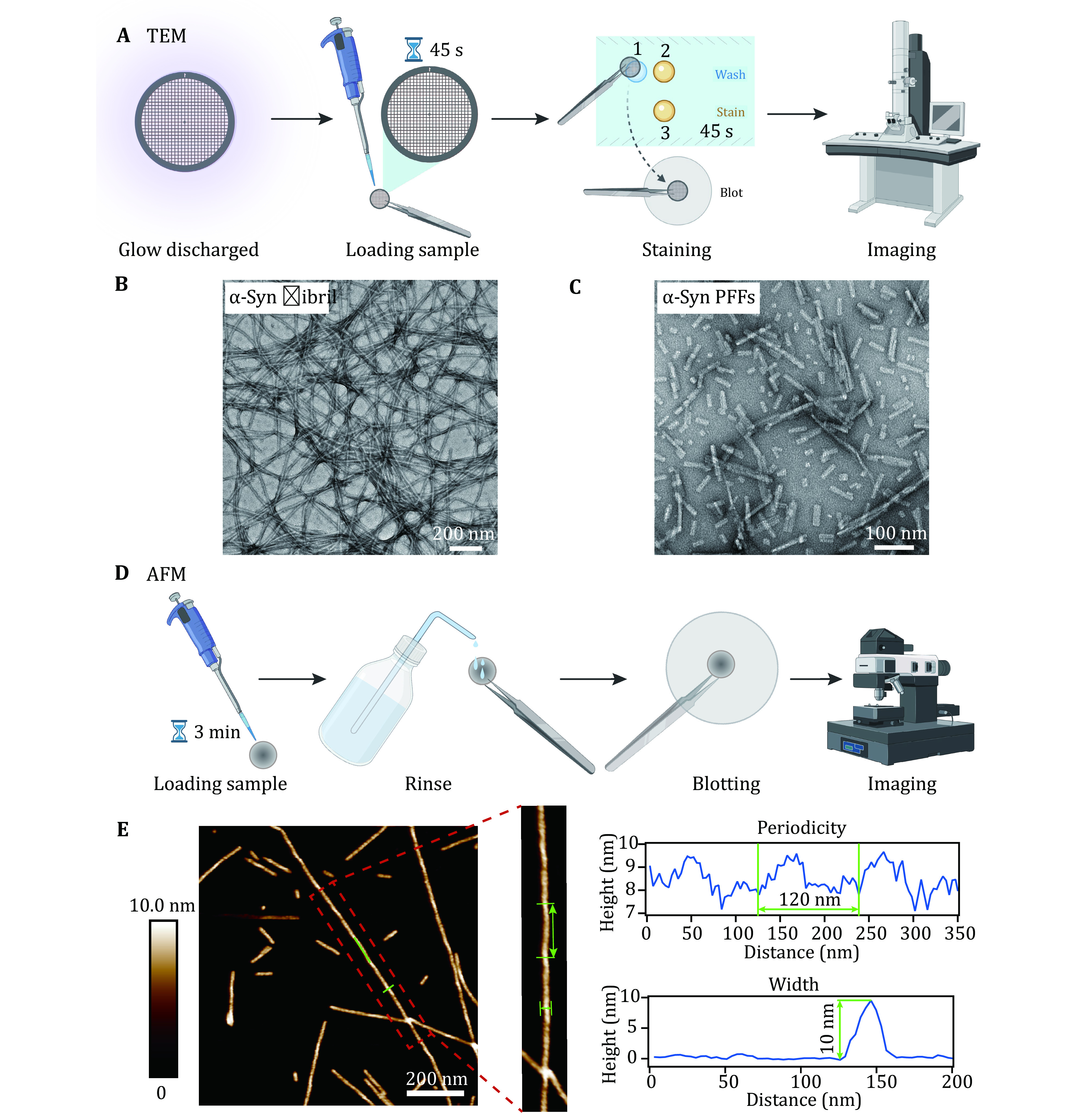
Protein amyloid fibrillation, a process of liquid to solid phase transition, is involved in the pathogenesis of a variety of human diseases. Several amyloid proteins including α-synuclein (α-syn), Tau, amyloid β (Aβ) protein, and TAR DNA-binding protein 43 kDa (TDP-43) form pathological fibrils and deposit in patient brains of different neurodegenerative diseases (NDs) such as Parkinson's disease (PD), Alzheimer's disease (AD) and Amyotrophic lateral sclerosis (ALS). Preparation and characterization of amyloid fibrils are essential for studying the molecular mechanism underlying the dynamic amyloid aggregation and its pathogenesis in diseases. In this protocol, we take PD-associated α-syn as an example, and describe amyloid protein purification and fibrillation approaches. We then introduce biochemical and biophysical characterization of amyloid fibrils by Thioflavin-T (ThT) fluorescence kinetics assay, transmission electron microscopy (TEM), atomic force microscopy (AFM) and multiple fibril stability measurement assays. The approaches described here are applicable to different amyloid proteins, and are of importance for further study on the structure determination of amyloid fibrils and their pathological function in cells and animal models.
蛋白质淀粉样纤维化是一个从液相到固相转变的过程,涉及多种人类疾病的发病机制。包括α-突触核蛋白(α-syn)、 Tau蛋白、淀粉样β(Aβ)蛋白和43 kDa的TAR DNA结合蛋白(TDP-43)在内的几种淀粉样蛋白会形成病理性纤维,并沉积在帕金森病(PD)、阿尔茨海默病(AD)和肌萎缩侧索硬化症(ALS)等不同神经退行性疾病(NDs)患者的大脑中。淀粉样纤维的制备和表征对于研究动态淀粉样聚集及其疾病发病机制的分子机制至关重要。在本方案中,我们以与PD相关的α-syn为例,描述淀粉样蛋白的纯化和纤维化方法。然后,我们通过硫黄素-T(ThT)荧光动力学测定、透射电子显微镜(TEM)、原子力显微镜(AFM)和多种纤维稳定性测量测定法介绍淀粉样纤维的生化和生物物理表征。这里描述的方法适用于不同的淀粉样蛋白,对于进一步研究淀粉样纤维的结构测定及其在细胞和动物模型中的病理功能具有重要意义。