Tarabishi Mohammed M, Almigdad Ahmed K, Ganger Rudolf, Farr Sebastian
Department of Orthopedic Surgery, King Fahad Medical City, Riyadh, Saudi Arabia.
Department of Orthopedic Surgery, Royal Medical Services, Amman, Jordan.
J Child Orthop. 2023 Mar 18;17(3):232-238. doi: 10.1177/18632521231156942. eCollection 2023 Jun.
This study aimed to determine the functional and radiographic outcomes following corrective distal humeral osteotomies for the treatment of supracondylar fracture malunions in children. We hypothesized that such secondary reconstructive procedures could restore a reasonable and near-normal amount of functionality in a large patient cohort at a tertiary referral center.
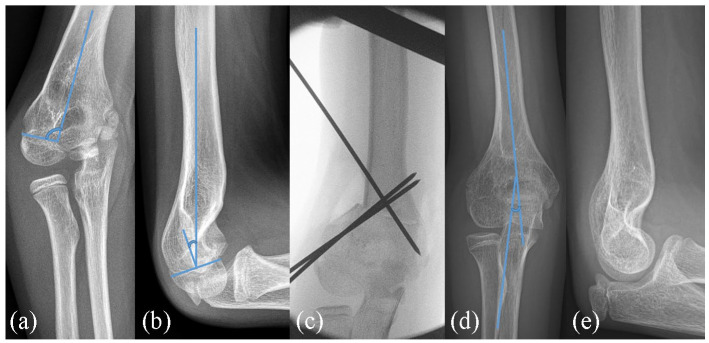
We retrospectively reviewed the clinical and radiological records of 38 children who underwent corrective osteotomy for posttraumatic supracondylar humeral malunion using K-wire fixation. All clinical data were extracted after chart review, including age, sex, dominant side whenever available, follow-up duration, and elbow range of motion preoperatively and at the final visit. Radiographic parameters, including Baumann's angle, humeroulnar angle, humerocondylar angle, and elbow range of motion were evaluated preoperatively, postoperatively, and at the final visit to identify the surgical correction outcomes.
The mean age of the patients at fracture was 5.6 (±2.7) years, and the mean age at surgical intervention was 8.6 (±2.6) years. The mean follow-up period of the current series was 28.2 (±31.1) months. Baumann's angle, humeroulnar angle, and humerocondylar angle were successfully restored to physiological ranges (72.6°, 5.4°, and 36.1°, respectively). Postoperatively, elbow extension improved from -22° (±5.7) to -2.7° (±7.2) versus flexion from 115° (±13.2) to 128.2° (±11.1). Three revision surgeries (8%) were encountered.
Corrective osteotomy of the distal humerus with K-wire fixation is a reliable method to efficiently correct malunion of the distal humerus in different planes, thereby improving elbow range of motion and appearance.
level IV: Retrospective therapeutic study.
本研究旨在确定儿童肱骨髁上骨折畸形愈合行肱骨远端截骨矫正术后的功能和影像学结果。我们假设,在三级转诊中心,此类二次重建手术能够在大量患者队列中恢复合理且接近正常的功能水平。
我们回顾性分析了38例因创伤后肱骨髁上畸形愈合行克氏针固定截骨矫正术的儿童的临床和放射学记录。通过查阅病历提取所有临床数据,包括年龄、性别、优势侧(如有)、随访时间以及术前和末次随访时的肘关节活动范围。术前、术后及末次随访时评估包括鲍曼角、肱尺角、肱髁角和肘关节活动范围在内的影像学参数,以确定手术矫正效果。
患者骨折时的平均年龄为5.6(±2.7)岁,手术干预时的平均年龄为8.6(±2.6)岁。本系列患者的平均随访时间为28.2(±31.1)个月。鲍曼角、肱尺角和肱髁角成功恢复至生理范围(分别为72.6°、5.4°和36.1°)。术后,肘关节伸展从-22°(±5.7)改善至-2.7°(±7.2),屈曲从115°(±13.2)改善至128.2°(±11.1)。出现了3例翻修手术(8%)。
克氏针固定的肱骨远端截骨矫正是有效矫正不同平面肱骨远端畸形愈合的可靠方法,从而改善肘关节活动范围和外观。
IV级:回顾性治疗研究。