Macnab Tara-Mei Povall, Espahbodi Shima, Hogervorst Eef, Thanoon Ahmed, Fernandes Gwen Sascha, Millar Bonnie, Duncan Ashley, Goodwin Maria, Batt Mark, Fuller Colin W, Fuller Gordon, Ferguson Eamonn, Bast Tobias, Doherty Michael, Zhang Weiya
Academic Rheumatology, School of Medicine, Clinical Sciences Building, University of Nottingham, Nottingham City Hospital, Hucknall Road, Nottingham, NG5 1PB, UK.
National Centre for Sport and Exercise Medicine (NCSEM), School of Sport, Exercise and Health Sciences, Loughborough University, Loughborough, UK.
Sports Med Open. 2023 Jun 8;9(1):43. doi: 10.1186/s40798-023-00588-2.
Previous studies based on death certificates have found professional soccer players were more likely to die with neurodegenerative diseases, including dementia. Therefore, this study aimed to investigate whether retired professional male soccer players would perform worse on cognitive tests and be more likely to self-report dementia diagnosis than general population control men.
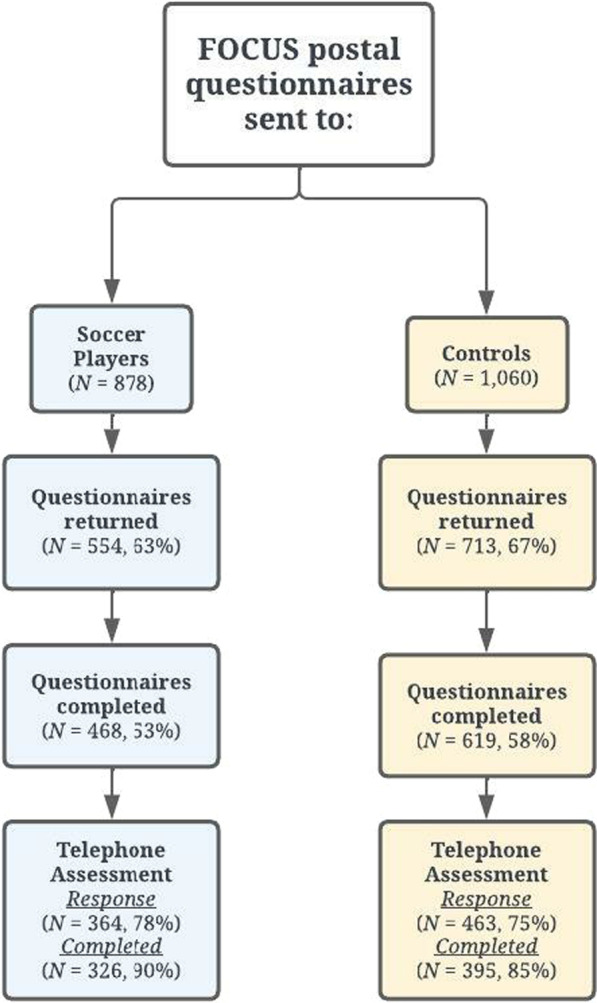
A cross-sectional comparative study was conducted between August 2020 and October 2021 in the United Kingdom (UK). Professional soccer players were recruited through different soccer clubs in England, and general population control men were recruited from the East Midlands in the UK. We obtained self-reported postal questionnaire data on dementia and other neurodegenerative diseases, comorbidities and risk factors from 468 soccer players and 619 general population controls. Of these, 326 soccer players and 395 general population controls underwent telephone assessment for cognitive function.
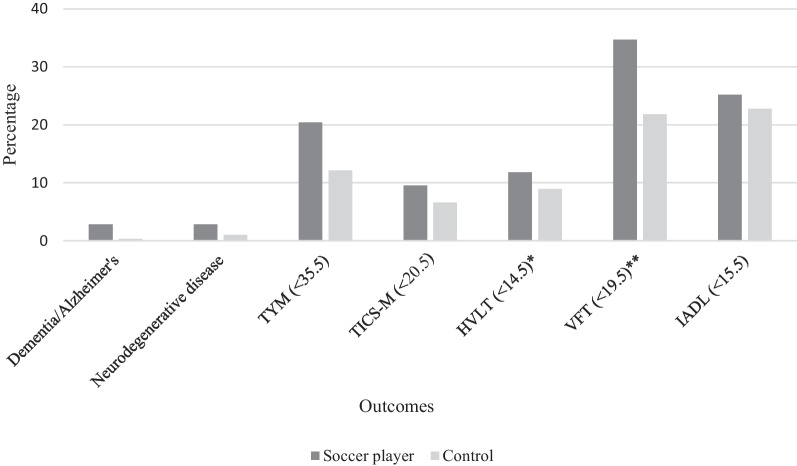
Retired soccer players were approximately twice as likely to score below established dementia screening cut-off scores on the Hopkins Verbal Learning Test (OR 2.06, 95%CI 1.11-3.83) and Verbal Fluency (OR 1.78, 95% CI 1.18-2.68), but not the Test Your Memory, modified Telephone Interview for Cognitive Status, and Instrumental Activities of Daily Living. Analyses were adjusted for age, education, hearing loss, body mass index, stroke, circulatory problems in the legs and concussion. While retired soccer players were younger, had fewer cardiovascular diseases and other morbidities and reported healthier lifestyles, 2.8% of retired soccer players reported medically diagnosed dementia and other neurodegenerative disease compared to 0.9% of controls (OR = 3.46, 95% CI 1.25-9.63) after adjustment for age and possible confounders.
UK male retired soccer players had a higher risk of performing below established cut-off scores of dementia screening tests and were more likely to self-report medically diagnosed dementia and neurodegenerative diseases, despite having better overall physical health and fewer dementia risk factors. Further study is needed to determine specific soccer-related risk factors.
以往基于死亡证明的研究发现,职业足球运动员死于神经退行性疾病(包括痴呆症)的可能性更高。因此,本研究旨在调查退役职业男性足球运动员在认知测试中的表现是否比普通人群对照组男性更差,以及自我报告痴呆症诊断的可能性是否更高。
2020年8月至2021年10月在英国进行了一项横断面比较研究。通过英格兰不同的足球俱乐部招募职业足球运动员,从英国东米德兰兹地区招募普通人群对照组男性。我们从468名足球运动员和619名普通人群对照组中获得了关于痴呆症和其他神经退行性疾病、合并症及风险因素的自我报告邮政问卷数据。其中,326名足球运动员和395名普通人群对照组接受了认知功能的电话评估。
退役足球运动员在霍普金斯言语学习测试(OR 2.06,95%CI 1.11 - 3.83)和言语流畅性测试(OR 1.78,95%CI 1.18 - 2.68)中得分低于既定痴呆筛查临界值的可能性约为普通人群对照组的两倍,但在“测试你的记忆力”、改良认知状态电话访谈和日常生活工具性活动测试中并非如此。分析对年龄、教育程度、听力损失、体重指数、中风、腿部循环问题和脑震荡进行了调整。虽然退役足球运动员更年轻,心血管疾病和其他疾病较少,且报告的生活方式更健康,但在调整年龄和可能的混杂因素后,2.8%的退役足球运动员报告有医学诊断的痴呆症和其他神经退行性疾病,而对照组为0.9%(OR = 3.46,95%CI 1.25 - 9.63)。
英国男性退役足球运动员在痴呆筛查测试中得分低于既定临界值的风险更高,且更有可能自我报告有医学诊断的痴呆症和神经退行性疾病,尽管他们的整体身体健康状况较好且痴呆风险因素较少。需要进一步研究以确定与足球相关的具体风险因素。