
光学相干断层扫描血管造影术显示糖尿病患者微血管的右眼与左眼不对称性。
Right versus left eye asymmetry of microvasculature in diabetes revealed by optical coherence tomography angiography.
机构信息
Department of Ophthalmology, University of California, San Francisco, San Francisco, CA, USA.
Department of Ophthalmology, Zuckerberg San Francisco General Hospital and Trauma Center, San Francisco, CA, USA.
出版信息
Sci Rep. 2023 Jun 8;13(1):9332. doi: 10.1038/s41598-023-36058-8.
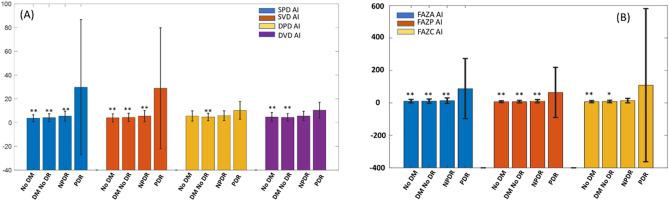
In this study, we explored inter-ocular asymmetry (between the two eyes of the same patient) using optical coherence tomography angiography (OCTA) in patients with diabetes mellitus (DM) at different retinopathy stages. A total of 258 patients were divided into four groups: no DM, DM without diabetic retinopathy (DR), non-proliferative DR (NPDR), and proliferative DR (PDR). Superficial and deep vessel density (SVD, DVD), superficial and deep perfusion density (SPD, DPD), foveal avascular zone (FAZ) area, perimeter and circularity were calculated, and asymmetry index (AI) was used to evaluate the asymmetry of two eyes of the same subject. AIs of SPD, SVD, FAZ area and FAZ perimeter in the PDR group were larger than all other 3 groups (all p < 0.05). The AIs of DPD, DVD, FAZ area and FAZ perimeter in males were larger than in females (p = 0.015, p = 0.023, p = 0.006 and p = 0.017). Hemoglobin A1c (HbA1c) was positively correlated with AI of FAZ perimeter (p = 0.02) and circularity (p = 0.022). In conclusion, PDR patients' eyes were significantly asymmetric in both vascular density and FAZ metrics. Male sex and HbA1c are risk factors that influenced symmetry. This study highlights that right-left asymmetry should be taken into account in DR-related studies, particularly those analyzing microvascular changes with OCTA.
在这项研究中,我们使用光学相干断层扫描血管造影术(OCTA)研究了不同糖尿病视网膜病变(DR)阶段的糖尿病患者的双眼间(同一患者的双眼之间)的眼间不对称性。共纳入 258 名患者,分为四组:无糖尿病、无糖尿病性视网膜病变(DR)的糖尿病(DM)、非增生性 DR(NPDR)和增生性 DR(PDR)。计算了浅层和深层血管密度(SVD、DVD)、浅层和深层灌注密度(SPD、DPD)、中心凹无血管区(FAZ)面积、周长和圆度,并使用不对称指数(AI)评估同一受试者双眼的不对称性。PDR 组的 SPD、SVD、FAZ 面积和 FAZ 周长的 AI 均大于其他 3 组(均 P<0.05)。男性的 DPD、DVD、FAZ 面积和 FAZ 周长的 AI 均大于女性(P=0.015、P=0.023、P=0.006 和 P=0.017)。糖化血红蛋白(HbA1c)与 FAZ 周长的 AI 呈正相关(P=0.02)和 FAZ 圆度(P=0.022)。总之,PDR 患者的血管密度和 FAZ 指标的双眼均明显不对称。性别和 HbA1c 是影响对称性的危险因素。本研究强调,在 DR 相关研究中,尤其是在使用 OCTA 分析微血管变化的研究中,应考虑左右不对称性。
 Zotero 插件