Department of Neurology, Clinical Dementia Center and National Reference Center for CJD Surveillance, University Medical Center, Robert-Koch-Straße 40, Göttingen, 37075, Germany.
German Center for Neurodegenerative Diseases (DZNE), Göttingen, Germany.
Alzheimers Res Ther. 2023 Jun 8;15(1):106. doi: 10.1186/s13195-023-01249-y.
Rapidly progressive forms of Alzheimer's disease (rpAD) are increasingly recognized and may have a prevalence of up to 30% of patients among all patients with Alzheimer's disease (AD). However, insights about risk factors, underlying pathophysiological processes, and clinical characteristics of rpAD remain controversial. This study aimed to gain a comprehensive picture of rpAD and new insights into the clinical manifestation to enable a better interpretation of disease courses in clinical practice as well as in future clinical studies.
Patients (n = 228) from a prospective observational study on AD were selected and categorized into rpAD (n = 67) and non-rpAD (n = 161) disease groups. Patients were recruited through the German Creutzfeldt-Jakob disease surveillance center and the memory outpatient clinic of the Göttingen University Medical Center, representing diverse phenotypes of the AD population. Biomarkers and clinical presentation were assessed using standardized protocols. A drop of ≥ MMSE 6 points within 12 months defined rapid progressors.
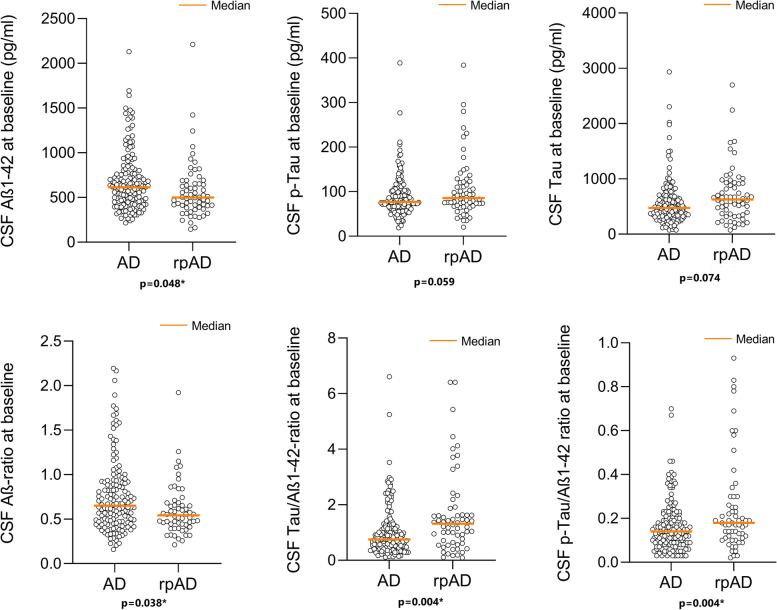
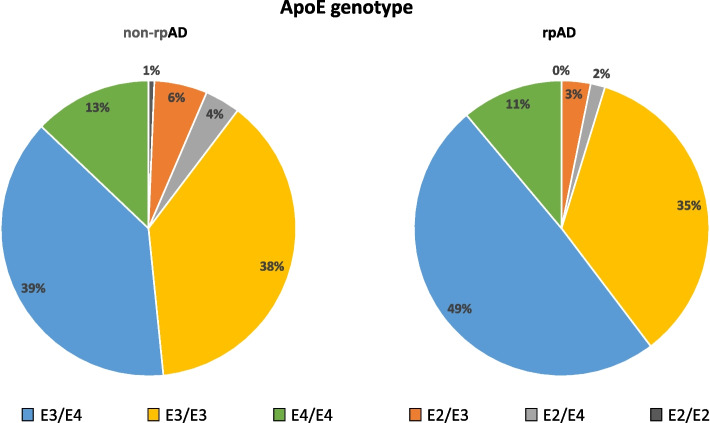
Lower CSF Amyloid beta 1-42 concentrations (p = 0.048), lower Amyloid beta 42/40 ratio (p = 0.038), and higher Tau/Amyloid-beta 1-42 ratio, as well as pTau/Amyloid-beta 1-42 ratio (each p = 0.004) were associated with rpAD. Analyzes in a subset of the cohort (rpAD: n = 12; non-rpAD: n = 31) showed higher CSF NfL levels in rpAD (p = 0.024). Clinically, rpAD showed earlier impairment of functional abilities (p < 0.001) and higher scores on the Unified Parkinson's Disease Rating Scale III (p < 0.001), indicating pronounced extrapyramidal motor symptoms. Furthermore, cognitive profiles (adjusted for overall cognitive performance) indicated marked deficits in semantic (p = 0.008) and phonematic (0.023) verbal fluency tests as well as word list learning (p = 0.007) in rpAD compared to non-rpAD. The distribution of APOE genotypes did not differ significantly between groups.
Our results suggest that rpAD is associated with distinct cognitive profiles, earlier occurrence of non-cognitive symptoms, extrapyramidal motoric disturbance, and lower Amyloid-beta 1-42 concentrations in the CSF. The findings may help to characterize a distinct phenotype of rpAD and estimate prognosis based on clinical characteristics and biomarker results. However, an important future goal should be a unified definition for rpAD to enable targeted study designs and better comparability of the results.
阿尔茨海默病(AD)的快速进展形式(rpAD)越来越受到重视,在所有 AD 患者中,rpAD 的患病率可能高达 30%。然而,关于 rpAD 的风险因素、潜在病理生理过程和临床特征的见解仍存在争议。本研究旨在全面了解 rpAD,并深入了解临床表现,以便更好地解释临床实践和未来临床研究中的疾病进程。
从 AD 的前瞻性观察研究中选择了 228 名患者,并将其分为 rpAD(n=67)和非 rpAD(n=161)疾病组。患者通过德国克雅氏病监测中心和哥廷根大学医学中心的记忆门诊招募,代表了 AD 人群的多种表型。使用标准化方案评估生物标志物和临床表现。12 个月内 MMSE 评分下降≥6 分定义为快速进展者。
rpAD 患者脑脊液中β淀粉样蛋白 1-42 浓度较低(p=0.048),β淀粉样蛋白 42/40 比值较低(p=0.038),Tau/β淀粉样蛋白 1-42 比值和 pTau/β淀粉样蛋白 1-42 比值较高,(均 p=0.004)。在队列的一个亚组(rpAD:n=12;非 rpAD:n=31)中,rpAD 患者脑脊液中 NfL 水平更高(p=0.024)。临床上,rpAD 患者的功能能力更早受损(p<0.001),统一帕金森病评定量表 III 评分更高(p<0.001),表明明显的锥体外系运动症状。此外,认知谱(根据整体认知表现调整)表明,rpAD 患者在语义(p=0.008)和语音流畅性测试(0.023)以及单词列表学习(p=0.007)方面的表现明显较差,而非 rpAD。两组间 APOE 基因型的分布无显著差异。
我们的研究结果表明,rpAD 与明显的认知特征、非认知症状更早发生、锥体外系运动障碍以及脑脊液中β淀粉样蛋白 1-42 浓度降低有关。这些发现可能有助于描述 rpAD 的一个独特表型,并根据临床特征和生物标志物结果估计预后。然而,一个重要的未来目标应该是对 rpAD 进行统一的定义,以实现有针对性的研究设计和更好地比较结果。