Enustun Eray, Deep Amar, Gu Yajie, Nguyen Katrina T, Chaikeeratisak Vorrapon, Armbruster Emily, Ghassemian Majid, Villa Elizabeth, Pogliano Joe, Corbett Kevin D
Department of Molecular Biology, University of California San Diego, La Jolla, CA, USA.
Department of Cellular and Molecular Medicine, University of California San Diego, La Jolla, CA, USA.
bioRxiv. 2023 May 18:2023.05.18.541317. doi: 10.1101/2023.05.18.541317.
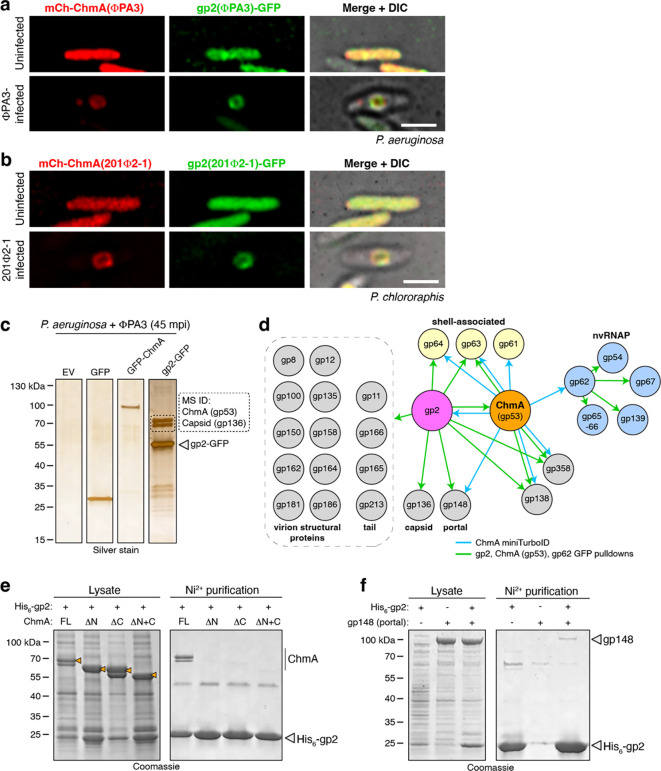
In the arms race between bacteria and bacteriophages (phages), some large-genome jumbo phages have evolved a protein shell that encloses their replicating genome to protect it against DNA-targeting immune factors. By segregating the genome from the host cytoplasm, however, the "phage nucleus" introduces the need to specifically transport mRNA and proteins through the nuclear shell, and to dock capsids on the shell for genome packaging. Here, we use proximity labeling and localization mapping to systematically identify proteins associated with the major nuclear shell protein chimallin (ChmA) and other distinctive structures assembled by these phages. We identify six uncharacterized nuclear shell-associated proteins, one of which directly interacts with self-assembled ChmA. The structure and protein-protein interaction network of this protein, which we term ChmB, suggests that it forms pores in the ChmA lattice that serve as docking sites for capsid genome packaging, and may also participate in mRNA and/or protein transport.
在细菌与噬菌体的军备竞赛中,一些大基因组巨型噬菌体进化出了一种蛋白质外壳,包裹其复制中的基因组,以保护其免受靶向DNA的免疫因子的影响。然而,通过将基因组与宿主细胞质分隔开,“噬菌体细胞核”带来了特异性转运mRNA和蛋白质穿过核壳以及将衣壳对接在核壳上进行基因组包装的需求。在这里,我们使用邻近标记和定位图谱分析来系统地鉴定与主要核壳蛋白奇马林(ChmA)以及这些噬菌体组装的其他独特结构相关的蛋白质。我们鉴定出六种未被表征的核壳相关蛋白,其中一种直接与自组装的ChmA相互作用。我们将这种蛋白命名为ChmB,其结构和蛋白质-蛋白质相互作用网络表明,它在ChmA晶格中形成孔隙,作为衣壳基因组包装的对接位点,并且可能还参与mRNA和/或蛋白质的转运。