Lewis Miranda A, Cortés-Penfield Nicolás W, Ettayebi Khalil, Patil Ketki, Kaur Gurpreet, Neill Frederick H, Atmar Robert L, Ramani Sasirekha, Estes Mary K
Department of Molecular Virology & Microbiology, Baylor College of Medicine, Houston, TX 77030.
Department of Medicine, Infectious Diseases, University of Nebraska Medical Center, Omaha, NE 68198.
bioRxiv. 2023 May 23:2023.05.23.542011. doi: 10.1101/2023.05.23.542011.
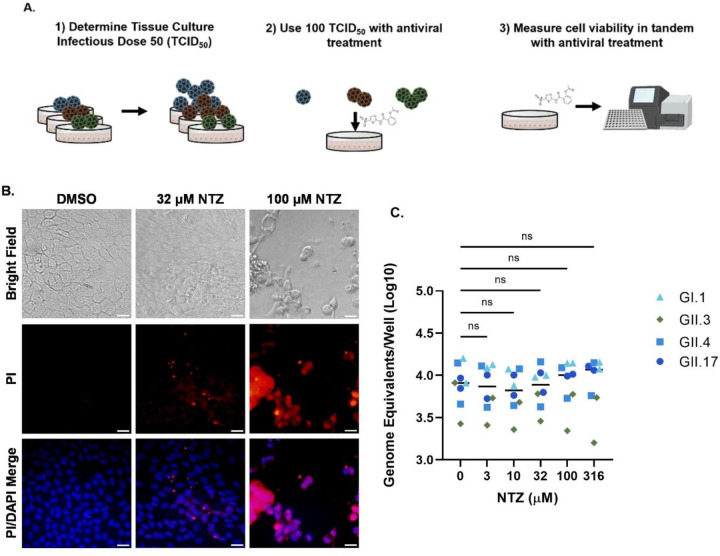
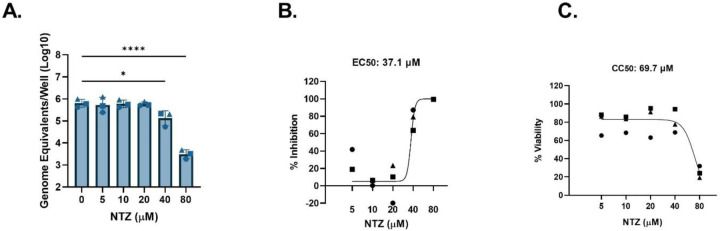
Human noroviruses (HuNoVs) are the leading cause of acute gastroenteritis. In immunocompetent hosts, symptoms usually resolve within three days; however, in immunocompromised persons, HuNoV infection can become persistent, debilitating, and sometimes life-threatening. There are no licensed therapeutics for HuNoV due to a near half-century delay in its cultivation. Treatment for chronic HuNoV infection in immunosuppressed patients anecdotally includes nitazoxanide, a broad-spectrum antimicrobial licensed for treatment of parasite-induced gastroenteritis. Despite its off-label use for chronic HuNoV infection, nitazoxanide has not been clearly demonstrated to be an effective treatment. In this study, we established a standardized pipeline for antiviral testing using multiple human small intestinal enteroid (HIE) lines representing different intestinal segments and evaluated whether nitazoxanide inhibits replication of 5 HuNoV strains . Nitazoxanide did not exhibit high selective antiviral activity against any HuNoV strains tested, indicating it is not an effective antiviral for norovirus infection. HIEs are further demonstrated as a model to serve as a pre-clinical platform to test antivirals against human noroviruses to treat gastrointestinal disease.
人诺如病毒(HuNoVs)是急性胃肠炎的主要病因。在免疫功能正常的宿主中,症状通常在三天内缓解;然而,在免疫功能低下的人群中,HuNoV感染可能会持续存在、使人虚弱,有时甚至危及生命。由于其培养延迟了近半个世纪,目前尚无针对HuNoV的许可治疗方法。免疫抑制患者慢性HuNoV感染的治疗方法据传闻包括硝唑尼特,这是一种被许可用于治疗寄生虫引起的胃肠炎的广谱抗菌药物。尽管其用于慢性HuNoV感染属于超适应症用药,但尚未明确证明硝唑尼特是一种有效的治疗方法。在本研究中,我们建立了一个标准化的抗病毒测试流程,使用代表不同肠段的多种人小肠类器官(HIE)系,并评估硝唑尼特是否能抑制5种HuNoV毒株的复制。硝唑尼特对所测试的任何HuNoV毒株均未表现出高选择性抗病毒活性,表明它不是一种有效的诺如病毒感染抗病毒药物。HIEs进一步被证明是一个可作为临床前平台的模型,用于测试针对人诺如病毒治疗胃肠道疾病的抗病毒药物。