Asmar Imad, Almahmoud Omar, Yaseen Khalid, Jamal Jehad, Omar Ahmad, Naseef Hani, Hasan Shadi
Birzeit University, Palestine.
Department of Nursing, P. O. Box Birzeit 14, Palestine.
Clin Epidemiol Glob Health. 2023 Jul-Aug;22:101330. doi: 10.1016/j.cegh.2023.101330. Epub 2023 Jun 3.
Many countries have begun immunization programs and established protocols to combat pandemics caused by the SARS-CoV-2 virus. Six months after vaccination, the antibody titers produced by the immunization begin to decline, and individuals whose first immunization (either one or two doses) did not provide adequate protection may require a booster dose.
A quantitative cross-sectional survey of 18-year-olds and older was undertaken in the West Bank from June 15 to June 27, 2022. Each participant had 5 mL of blood drawn to be tested for IgG-S, IgG-N, and blood group.
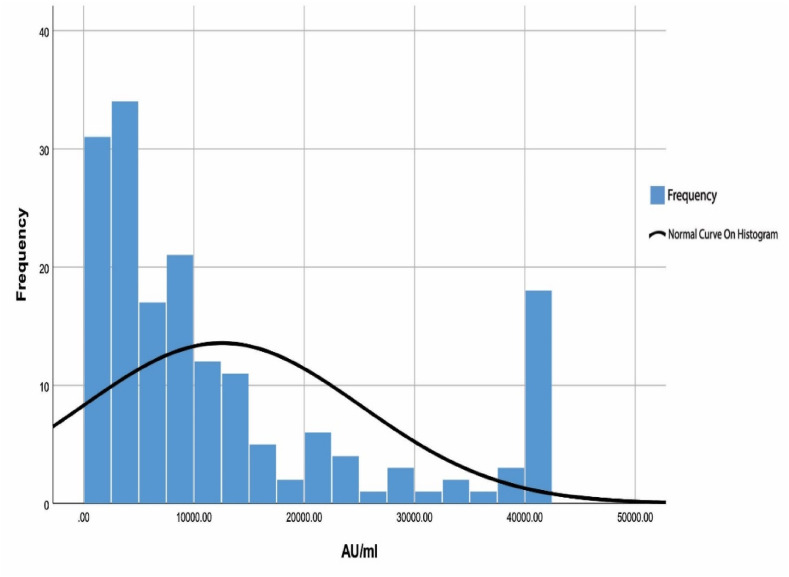
All participants had positive IgG-S results; IgG-S values ranged between 77 and 40,000 AU/ml, with a mean value of 1254 AU/ml. The value of IgG-N ranged from 0 to 139.3 U/ml for all participants, with a mean value of 22.4 U/ml. 64 (37.2%) of the participants demonstrated positive IgG-N screening results, with mean values of 51.2 U/ml. Female participants' mean IgG concentration was higher than male participants. Furthermore, the results revealed that smokers had lower levels of vaccine-induced antibodies than nonsmokers. High significance was found in the time from the last vaccine till the blood sample test (T = 3.848, < .001), and the group between 6 and 9 months was found to have higher mean values than the 9-months group (M = 15952).
Participants vaccinated with a higher number of vaccines tend to have higher IgG-S. To elevate total antibodies, booster doses are essential. Additional researchers are needed to examine the positive correlation between IgG-S and IgG-N.
许多国家已启动免疫计划并制定了应对由严重急性呼吸综合征冠状病毒2(SARS-CoV-2)病毒引起的大流行的方案。接种疫苗六个月后,免疫产生的抗体滴度开始下降,首次免疫(一剂或两剂)未提供充分保护的个体可能需要接种加强针。
2022年6月15日至6月27日在约旦河西岸对18岁及以上人群进行了定量横断面调查。每位参与者抽取5毫升血液,检测IgG-S、IgG-N和血型。
所有参与者的IgG-S检测结果均为阳性;IgG-S值在77至40000 AU/ml之间,平均值为1254 AU/ml。所有参与者的IgG-N值在0至139.3 U/ml之间,平均值为22.4 U/ml。64名(37.2%)参与者的IgG-N筛查结果为阳性,平均值为51.2 U/ml。女性参与者的平均IgG浓度高于男性参与者。此外,结果显示吸烟者的疫苗诱导抗体水平低于非吸烟者。从最后一次接种疫苗到血液样本检测的时间差异具有高度显著性(T = 3.848,P <.001),6至9个月组的平均值高于9个月组(M = 15952)。
接种疫苗次数较多的参与者往往具有较高的IgG-S水平。为提高总抗体水平,加强针必不可少。需要更多研究来检验IgG-S和IgG-N之间的正相关性。