
一项以仿生学为灵感的自由形态合理化研究。
A Study of Free-Form Shape Rationalization Using Biomimicry as Inspiration.
作者信息
Dutta Gaurab Sundar, Meiners Dieter, Merkert Nina
机构信息
Institute of Polymer Materials and Plastics Technology, Clausthal University of Technology, Agricolastr. 6, 38678 Clausthal, Germany.
Institute of Applied Mechanics, Clausthal University of Technology, Arnold-Sommerfeld-Str.6, Room 310, 38678 Clausthal, Germany.
出版信息
Polymers (Basel). 2023 May 26;15(11):2466. doi: 10.3390/polym15112466.
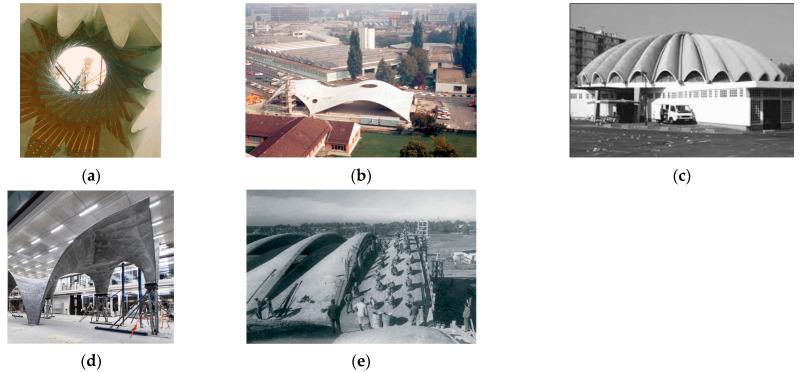
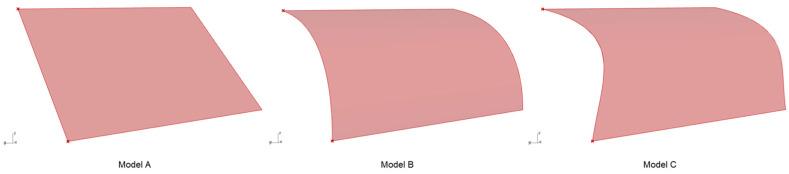
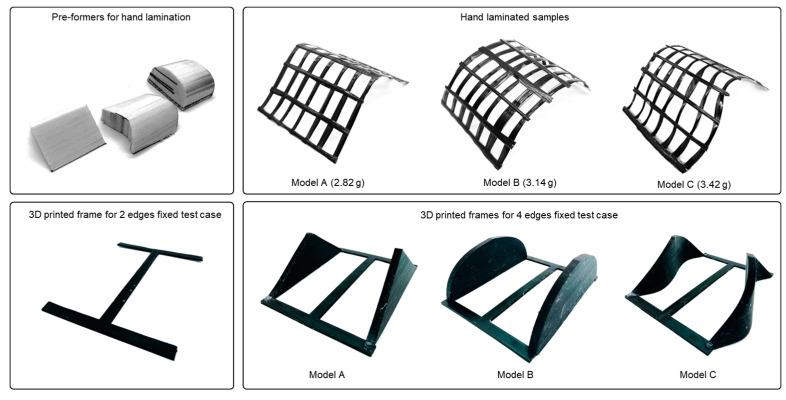
Bridging the gap between the material and geometrical aspects of a structure is critical in lightweight construction. Throughout the history of structural development, shape rationalization has been of prime focus for designers and architects, with biological forms being a major source of inspiration. In this work, an attempt is made to integrate different phases of design, construction, and fabrication under a single framework of parametric modeling with the help of visual programming. The idea is to offer a novel free-form shape rationalization process that can be realized with unidirectional materials. Taking inspiration from the growth of a plant, we established a relationship between form and force, which can be translated into different shapes using mathematical operators. Different prototypes of generated shapes were constructed using a combination of existing manufacturing processes to test the validity of the concept in both isotropic and anisotropic material domains. Moreover, for each material/manufacturing combination, generated geometrical shapes were compared with other equivalent and more conventional geometrical constructions, with compressive load-test results being the qualitative measure for each use case. Eventually, a 6-axis robot emulator was integrated with the setup, and corresponding adjustments were made such that a true free-form geometry could be visualized in a 3D space, thus closing the loop of digital fabrication.
在轻量化建筑中,弥合结构的材料与几何方面之间的差距至关重要。在结构发展的历史进程中,形状合理化一直是设计师和建筑师的首要关注点,生物形态是主要的灵感来源。在这项工作中,借助可视化编程,尝试在参数化建模的单一框架下整合设计、施工和制造的不同阶段。其理念是提供一种新颖的自由形式形状合理化过程,该过程可以用单向材料实现。从植物的生长中获取灵感,我们建立了形状与力之间的关系,这种关系可以使用数学运算符转化为不同的形状。使用现有制造工艺的组合构建生成形状的不同原型,以在各向同性和各向异性材料领域测试该概念的有效性。此外,对于每种材料/制造组合,将生成的几何形状与其他等效且更传统的几何结构进行比较,抗压载荷测试结果作为每个用例的定性衡量标准。最终,将一个6轴机器人模拟器集成到该装置中,并进行相应调整,以便在3D空间中可视化真正的自由形式几何形状,从而完成数字制造的循环。








 Zotero 插件