Department of Pharmacy, CECOS University of IT and Emerging Sciences, Peshawar 25000, Pakistan.
North West Institute of Health Sciences, Peshawar 25000, Pakistan.
Nutrients. 2023 May 30;15(11):2552. doi: 10.3390/nu15112552.
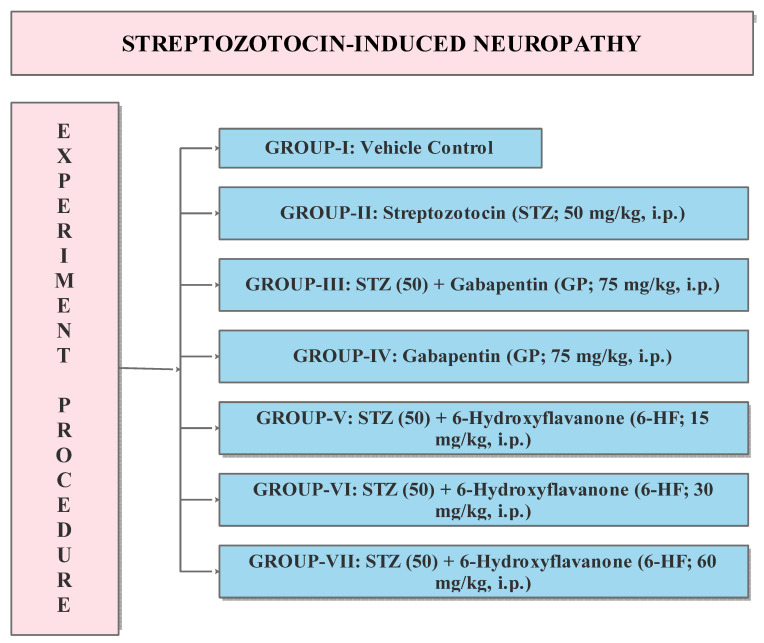
It is evident that inflammation and metabolic syndrome instigated by diabetes mellitus can precipitate diabetes-induced neuropathy (DIN) and pain. In order to find an effective therapeutic method for diabetes-related problems, a multi-target-directed ligand model was used. 6-Hydroxyflavanone (6-HF) carrying anti-inflammatory and anti-neuropathic pain potential due to its quadruplicate mechanisms, targeting cyclooxygenase-2 (COX-2), 5-lipoxygenase (5-LOX), and opioid and GABA-A receptors was investigated. The anti-inflammatory potential of the test drug was confirmed utilizing in silico, in vitro, and in vivo tests. A molecular simulation approach was utilized to observe the interaction of 6-HF with the inflammatory enzyme COX-2 as well as opioid and GABA-A receptors. The same was confirmed via in vitro COX-2 and 5-LOX inhibitory assays. In vivo tests were performed to analyze the thermal anti-nociception in the hot-plate analgesiometer and anti-inflammatory action in the carrageenan-induced paw edema model in rodents. The potential anti-nociceptive effect of 6-HF was evaluated in the DIN model in rats. The Naloxone and Pentylenetetrazole (PTZ) antagonists were used to confirm the underlying mechanism of 6-HF. The molecular modeling studies revealed a favorable interaction of 6-HF with the identified protein molecules. In vitro inhibitory studies revealed that 6-HF inhibited the COX-2 and 5-LOX enzymes significantly. The 6-HF at dosages of 15, 30, and 60 mg/kg substantially reduced heat nociception in a hot plate analgesiometer as well as carrageenan-induced paw edema in rodent models. The authors discovered that 6-HF had anti-nociception properties in a streptozotocin-induced diabetic neuropathy model. According to the findings of this study, 6-HF was demonstrated to diminish inflammation caused by diabetes as well as its anti-nociception effect in DIN.
显然,糖尿病引起的炎症和代谢综合征会引发糖尿病性神经病变(DIN)和疼痛。为了找到治疗糖尿病相关问题的有效方法,使用了一种多靶点导向配体模型。由于具有四重机制,即靶向环氧化酶-2(COX-2)、5-脂氧合酶(5-LOX)以及阿片类和 GABA-A 受体,因此研究了具有抗炎和抗神经病理性疼痛潜力的 6-羟基黄烷酮(6-HF)。利用计算机模拟、体外和体内试验证实了测试药物的抗炎潜力。利用分子模拟方法观察 6-HF 与炎症酶 COX-2 以及阿片类和 GABA-A 受体的相互作用。同样通过体外 COX-2 和 5-LOX 抑制试验进行了确认。在体内试验中,在热板痛觉计中分析热镇痛和在啮齿动物角叉菜胶诱导的爪肿胀模型中分析抗炎作用。在大鼠 DIN 模型中评估了 6-HF 的潜在镇痛作用。使用纳洛酮和戊四唑(PTZ)拮抗剂来确认 6-HF 的潜在作用机制。分子建模研究表明,6-HF 与鉴定出的蛋白质分子具有良好的相互作用。体外抑制研究表明,6-HF 显著抑制 COX-2 和 5-LOX 酶。6-HF 在 15、30 和 60 mg/kg 的剂量下,可显著降低热板痛觉计中的热疼痛以及啮齿动物模型中角叉菜胶诱导的爪肿胀。研究人员发现,6-HF 在链脲佐菌素诱导的糖尿病神经病变模型中具有镇痛作用。根据本研究的结果,6-HF 被证明可减轻糖尿病引起的炎症以及 DIN 中的镇痛作用。