Nutrition and Metabolic Health Research Group, Department of Biochemistry and Biotechnology, Rovira i Virgili University (URV), 43201 Reus, Spain.
Institute of Health Pere Virgili (IISPV), 43204 Reus, Spain.
Nutrients. 2023 Jun 3;15(11):2624. doi: 10.3390/nu15112624.
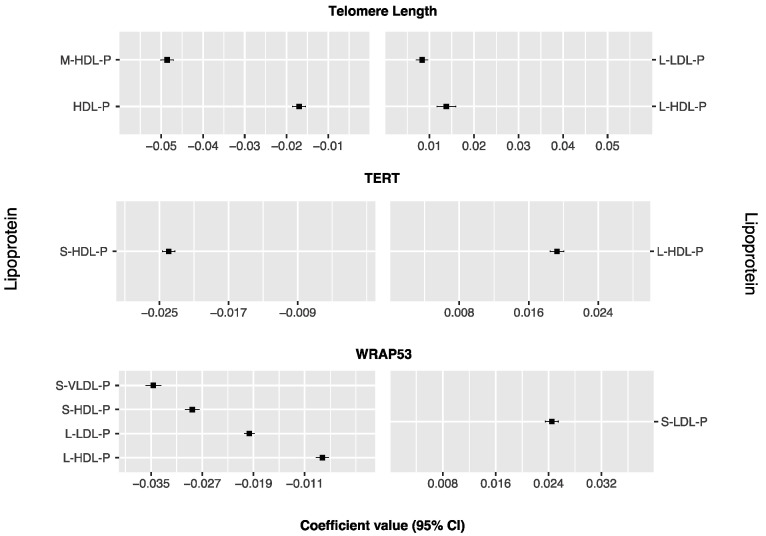
Telomere length (TL) is a well-known marker of age-related diseases. Oxidative stress and inflammation increase the rate of telomere shortening, triggering cellular senescence. Although lipoproteins could have anti-inflammatory and proinflammatory functional properties, the relationship between lipoprotein particles with TL and telomerase activity-related genes has not been investigated much. In this study, we assessed the associations of lipoprotein subfractions with telomere length, , and expression in a total of 54 pre-diabetic subjects from the EPIRDEM study. We regressed TL, , and on 12 lipoprotein subclasses, employing a Gaussian linear regression method with Lasso penalty to determine a lipoprotein profile associated with telomere-related parameters. The covariates included age, sex, body mass index (BMI), dyslipidemia, statin consumption, and physical activity leisure time. We identified a lipoprotein profile composed of four lipoprotein subfractions associated with TL (Pearson r = 0.347, -value = 0.010), two lipoprotein subfractions associated with expression (Pearson r = 0.316, -value = 0.020), and five lipoprotein subfractions associated with expression (Pearson r = 0.379, -value =0.005). After adjusting for known confounding factors, most lipoprotein profiles maintained the association with TL, , and . Overall, medium and small-sized HDL particles were associated with shorter telomeres and lower expression of and . Large HDL particles were associated with longer telomere and lower expression of , but not with . Our results suggest that the lipoprotein profiles are associated with telomere length, , and expression and should be considered when assessing the risk of chronic diseases.
端粒长度(TL)是与年龄相关疾病的已知标志物。氧化应激和炎症会增加端粒缩短的速度,从而引发细胞衰老。虽然脂蛋白可能具有抗炎和促炎的功能特性,但脂蛋白颗粒与 TL 和端粒酶活性相关基因之间的关系尚未得到充分研究。在这项研究中,我们评估了脂蛋白亚组分与总共 54 例来自 EPIRDEM 研究的前驱糖尿病患者的 TL、和表达之间的关系。我们采用具有 Lasso 惩罚的高斯线性回归方法,将 TL、和表达回归到 12 种脂蛋白亚组分上,以确定与端粒相关参数相关的脂蛋白谱。协变量包括年龄、性别、体重指数(BMI)、血脂异常、他汀类药物的使用和休闲时间的体力活动。我们确定了一个由四个脂蛋白亚组分组成的脂蛋白谱,与 TL 相关(Pearson r = 0.347,-值 = 0.010),与表达相关的两个脂蛋白亚组分(Pearson r = 0.316,-值 = 0.020),以及与表达相关的五个脂蛋白亚组分(Pearson r = 0.379,-值 = 0.005)。在调整了已知的混杂因素后,大多数脂蛋白谱仍然与 TL、和表达相关。总体而言,中、小粒径的 HDL 颗粒与较短的端粒和较低的表达相关,而大粒径的 HDL 颗粒与较长的端粒和较低的表达相关,但与无关。我们的研究结果表明,脂蛋白谱与 TL、和表达相关,在评估慢性病风险时应予以考虑。