Department of Dermatology, Second Xiangya Hospital, Central South University, Changsha, China.
Dermatology Department, Dermatology Hospital, Southern Medical University, Guangzhou, China.
An Bras Dermatol. 2023 Sep-Oct;98(5):651-655. doi: 10.1016/j.abd.2022.07.010. Epub 2023 Jun 8.
The authors investigated the expression of IgG4 and IgG in cutaneous Rosai-Dorfman Disease (CRDD) to further improve the understanding of this disease.
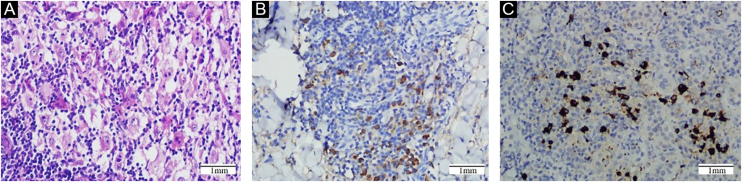
The authors retrospectively reviewed the clinicopathological features of 23 CRDD patients. The authors diagnosed CRDD by the presence of emperipolesis and immunohistochemical (IHC) staining of histiocytes consisting of S-100(+)/CD68(+)/CD1a(-) cells. The expressions of IgG and IgG4 in cutaneous specimens were assessed by IHC (EnVision) and quantitatively calculated by a medical image analysis system.
All 23 patients, including 14 males and 9 females, were confirmed to have CRDD. Their ages ranged from 17 to 68 years (mean 47.91 ± 14.16). The most frequently affected skin regions were the face, followed by the trunk, ears, neck, limbs, and genitals. In 16 of these cases, the disease presented as a single lesion. IHC staining of sections showed that IgG was positive (≥ 10 cells/High-Power Field [HPF]) in 22 cases, while IgG4 was positive (≥ 10 cells/HPF) in 18 cases. Moreover, the IgG4/IgG proportion ranged from 1.7% to 85.7% (mean 29.50 ± 24.67%, median 18.4%) in the 18 cases.
In the majority of studies, as well as in the current study, the design. RDD is a rare disease, so the sample size is small. In the next studies to come, the authors will expand the sample for multi-center verification and in-depth study.
The positive rates of IgG4 and IgG and the IgG4/IgG ratio assessed through IHC staining may be important in understanding the pathogenesis of CRDD.
作者研究了 IgG4 和 IgG 在皮肤 Rosai-Dorfman 病(CRDD)中的表达,以进一步了解这种疾病。
作者回顾性分析了 23 例 CRDD 患者的临床病理特征。作者通过存在吞噬现象和组织细胞的免疫组织化学(IHC)染色(由 S-100(+)/CD68(+)/CD1a(-)细胞组成)来诊断 CRDD。通过免疫组织化学(EnVision)评估皮肤标本中 IgG 和 IgG4 的表达,并通过医学图像分析系统定量计算。
23 例患者均确诊为 CRDD,包括 14 例男性和 9 例女性。年龄 1768 岁,平均 47.91±14.16 岁。最常受累的皮肤部位为面部,其次为躯干、耳朵、颈部、四肢和生殖器。在这 16 例病例中,疾病表现为单个病变。切片的 IHC 染色显示,22 例 IgG 阳性(≥ 10 个细胞/高倍视野),18 例 IgG4 阳性(≥ 10 个细胞/高倍视野)。此外,在 18 例病例中,IgG4/IgG 比例为 1.7%85.7%(平均 29.50±24.67%,中位数 18.4%)。
在大多数研究中,以及在当前研究中,设计是回顾性的。RDD 是一种罕见疾病,因此样本量较小。在未来的研究中,作者将扩大样本进行多中心验证和深入研究。
通过 IHC 染色评估 IgG4 和 IgG 的阳性率和 IgG4/IgG 比值可能对了解 CRDD 的发病机制很重要。