Southeastern Cooperative Wildlife Disease Study, Department of Population Health, College of Veterinary Medicine, University of Georgia, Athens, GA, USA.
Warnell School of Forestry and Natural Resources, University of Georgia, Athens, GA, USA.
Parasit Vectors. 2023 Jun 10;16(1):197. doi: 10.1186/s13071-023-05813-1.
Vector-borne infections pose significant health risks to humans, domestic animals, and wildlife. Domestic dogs (Canis lupus familiaris) in the United States may be infected with and serve as sentinel hosts for several zoonotic vector-borne pathogens. In this study, we analyzed the geographical distribution, risk factors, and co-infections associated with infection with Ehrlichia spp., Anaplasma spp., Borrelia burgdorferi, and Dirofilaria immitis in shelter dogs in the Eastern United States.
From 2016 to 2020, blood samples from 3750 shelter dogs from 19 states were examined with IDEXX SNAP 4Dx Plus tests to determine the seroprevalence of infection with tick-borne pathogens and infection with D. immitis. We assessed the impact of factors including age, sex, intact status, breed group, and location on infection using logistic regression.
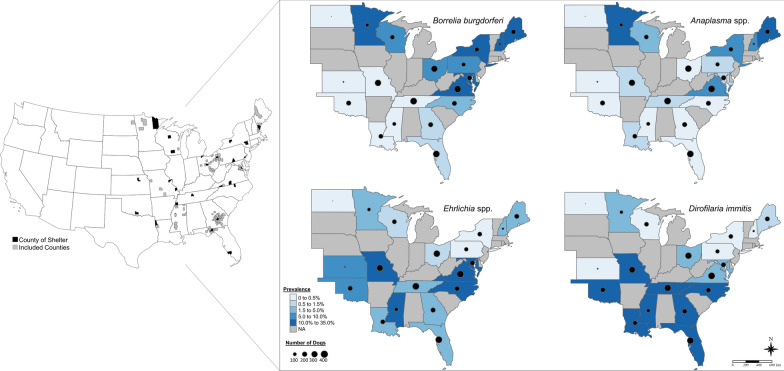
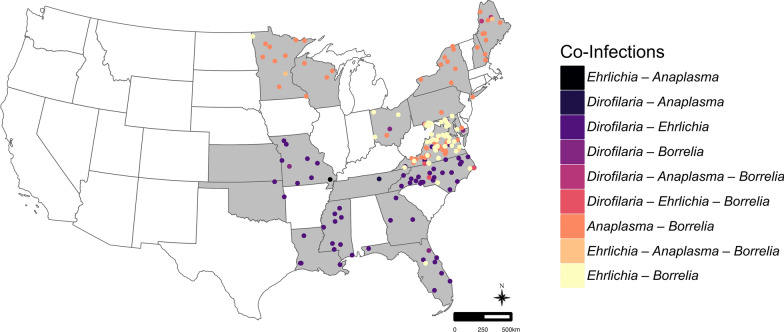
The overall seroprevalence of D. immitis was 11.2% (n = 419/3750), the seroprevalence of Anaplasma spp. was 2.4% (n = 90/3750), the seroprevalence of Ehrlichia spp. was 8.0% (n = 299/3750), and the seroprevalence of B. burgdorferi was 8.9% (n = 332/3750). Regional variation in seroprevalence was noted: D. immitis (17.4%, n = 355/2036) and Ehrlichia spp. (10.7%, n = 217/2036) were highest in the Southeast while seroprevalence for B. burgdorferi (19.3%, n = 143/740) and Anaplasma spp. (5.7%, n = 42/740) were highest in the Northeast. Overall, 4.8% (n = 179/3750) of dogs had co-infections, the most common of which were D. immitis/Ehrlichia spp. (1.6%, n = 59/3750), B. burgdorferi/Anaplasma spp. (1.5%, n = 55/3750), and B. burgdorferi/Ehrlichia spp. (1.2%, n = 46/3750). Risk factors significantly influenced infection across the evaluated pathogens were location and breed group. All evaluated risk factors were significant for the seroprevalence of D. immitis antigens.
Our results demonstrate a regionally variable risk of infection with vector-borne pathogens in shelter dogs throughout the Eastern United States, likely due to varying distributions of vectors. However, as many vectors are undergoing range expansions or other changes in distribution associated with climate and landscape change, continued vector-borne pathogen surveillance is important for maintaining reliable risk assessment.
虫媒传染病对人类、家畜和野生动物构成重大健康威胁。美国的家养犬(Canis lupus familiaris)可能感染多种人畜共患的虫媒病原体,并作为监测宿主。在本研究中,我们分析了美国东部收容所犬感染埃立克体属、无形体属、伯氏疏螺旋体和犬恶丝虫的地理分布、风险因素和合并感染情况。
2016 年至 2020 年,对来自 19 个州的 3750 只收容所犬的血液样本进行 IDEXX SNAP 4Dx Plus 检测,以确定感染蜱传病原体和犬恶丝虫的血清阳性率。我们使用逻辑回归评估了包括年龄、性别、绝育状态、品种组和地理位置在内的因素对感染的影响。
犬恶丝虫的总血清阳性率为 11.2%(n=419/3750),无形体属的血清阳性率为 2.4%(n=90/3750),埃立克体属的血清阳性率为 8.0%(n=299/3750),伯氏疏螺旋体的血清阳性率为 8.9%(n=332/3750)。注意到血清阳性率存在区域差异:东南部的犬恶丝虫(17.4%,n=355/2036)和埃立克体属(10.7%,n=217/2036)最高,东北部的伯氏疏螺旋体(19.3%,n=143/740)和无形体属(5.7%,n=42/740)最高。总体而言,4.8%(n=179/3750)的犬只存在合并感染,最常见的是犬恶丝虫/埃立克体属(1.6%,n=59/3750)、伯氏疏螺旋体/无形体属(1.5%,n=55/3750)和伯氏疏螺旋体/埃立克体属(1.2%,n=46/3750)。在评估的病原体中,位置和品种组是显著影响感染的风险因素。所有评估的风险因素对犬恶丝虫抗原的血清阳性率都有显著影响。
我们的研究结果表明,在美国东部的收容所犬中,虫媒病原体的感染存在区域差异,这可能是由于媒介的分布不同所致。然而,由于许多媒介正在经历与气候和景观变化相关的分布范围扩大或其他变化,因此持续进行虫媒病原体监测对于维持可靠的风险评估非常重要。