Xu Ting, Wang Ruixue, La Qiong, Yonezawa Takahiro, Huang Xinyi, Sun Kun, Song Zhiping, Wang Yuguo, Bartish Igor V, Zhang Wenju, Cheng Shanmei
Institute of Biodiversity Science, School of Life Sciences Fudan University Shanghai China.
College of Life Sciences Northwest Normal University Lanzhou China.
Ecol Evol. 2023 Jun 9;13(6):e10182. doi: 10.1002/ece3.10182. eCollection 2023 Jun.
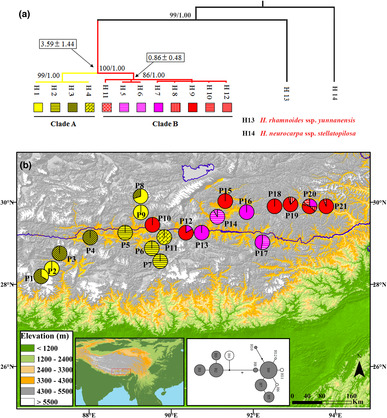
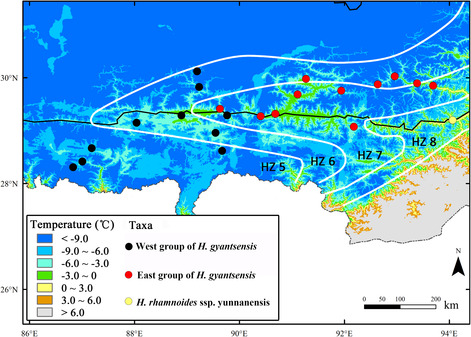
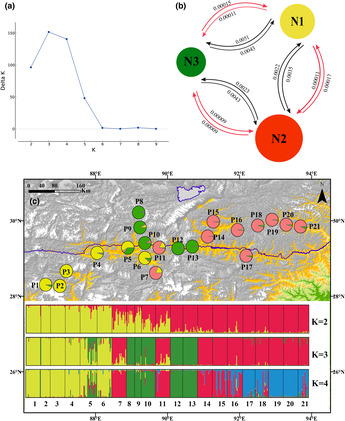
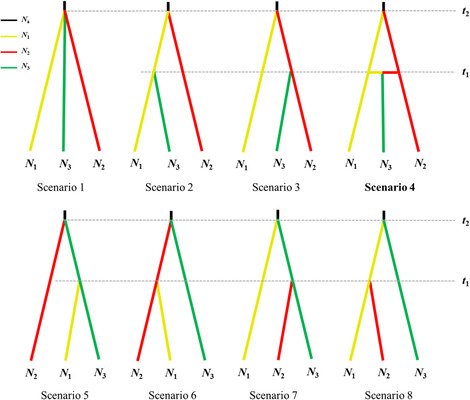
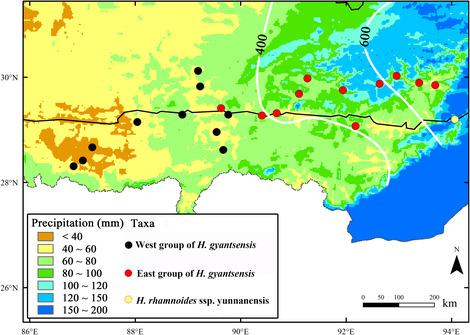
The interaction of recent orographic uplift and climate heterogeneity acted as a key role in the East Himalaya-Hengduan Mountains (EHHM) has been reported in many studies. However, how exactly the interaction promotes clade diversification remains poorly understood. In this study, we both used the chloroplast T-F region and 11 nuclear microsatellite loci to investigate the phylogeographic structure and population dynamics of and estimate what role geological barriers or ecological factors play in the spatial genetic structure. The results showed that this species had a strong east-west phylogeographic structure, with several mixed populations identified from microsatellite data in central location. The intraspecies divergence time was estimated to be about 3.59 Ma, corresponding well with the recent uplift of the Tibetan Plateau. Between the two lineages, there was significant climatic differentiation without geographic barriers. High consistency between lineage divergence, climatic heterogeneity, and Qingzang Movement demonstrated that climatic heterogeneity but not geographic isolation drives the divergence of , and the recent regional uplift of the QTP, as the Himalayas, creates heterogeneous climates by affecting the flow of the Indian monsoon. The east group of experienced population expansion . 0.12 Ma, closely associated with the last interglacial interval. Subsequently, a genetic admixture event between east and west groups happened at 26.90 ka, a period corresponding to the warm inter-glaciation again. These findings highlight the importance of the Quaternary climatic fluctuations in the recent evolutionary history of . Our study will improve the understanding of the history and mechanisms of biodiversity accumulation in the EHHM region.
许多研究报道,近期地形抬升与气候异质性的相互作用在东喜马拉雅-横断山脉(EHHM)中起着关键作用。然而,这种相互作用究竟如何促进分支多样化仍知之甚少。在本研究中,我们使用叶绿体T-F区域和11个核微卫星位点来研究[物种名称未给出]的系统发育地理结构和种群动态,并估计地质屏障或生态因素在空间遗传结构中所起的作用。结果表明,该物种具有强烈的东西向系统发育地理结构,从位于中部的微卫星数据中识别出了几个混合种群。种内分歧时间估计约为359万年,与青藏高原近期的隆升相当吻合。在两个谱系之间,存在显著的气候差异但没有地理屏障。谱系分歧、气候异质性和青藏运动之间的高度一致性表明,气候异质性而非地理隔离驱动了[物种名称未给出]的分歧,而青藏高原(如喜马拉雅山脉)近期的区域隆升通过影响印度季风的流动创造了异质气候。[物种名称未给出]的东部群体在0.12百万年前经历了种群扩张,这与最后一次间冰期密切相关。随后,东西部群体之间在26900年前发生了一次遗传混合事件,这一时期再次对应温暖的间冰期。这些发现突出了第四纪气候波动在[物种名称未给出]近期进化历史中的重要性。我们的研究将增进对EHHM地区生物多样性积累历史和机制的理解。