Mansour Basem, Salem Yomna A, Attallah Khaled M, El-Kawy O A, Ibrahim Ismail T, Abdel-Aziz Naglaa I
Department of Pharmaceutical Chemistry, Faculty of Pharmacy, Delta University for Science and Technology, Gamasa 11152, Dakahlia, Egypt.
Department of Pharmaceutical Chemistry, Faculty of Pharmacy, Sinai University - Kantara Branch, Ismailia 41636, Egypt.
ACS Omega. 2023 May 24;8(22):19351-19366. doi: 10.1021/acsomega.2c08304. eCollection 2023 Jun 6.
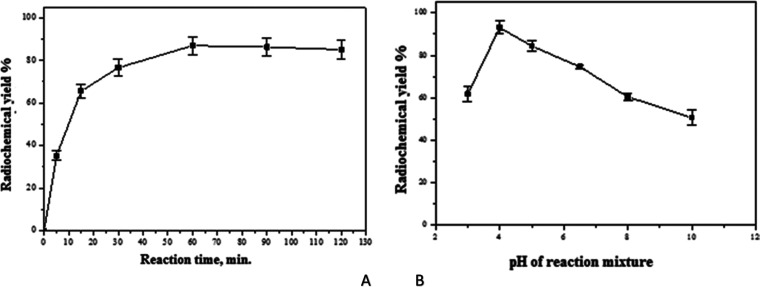
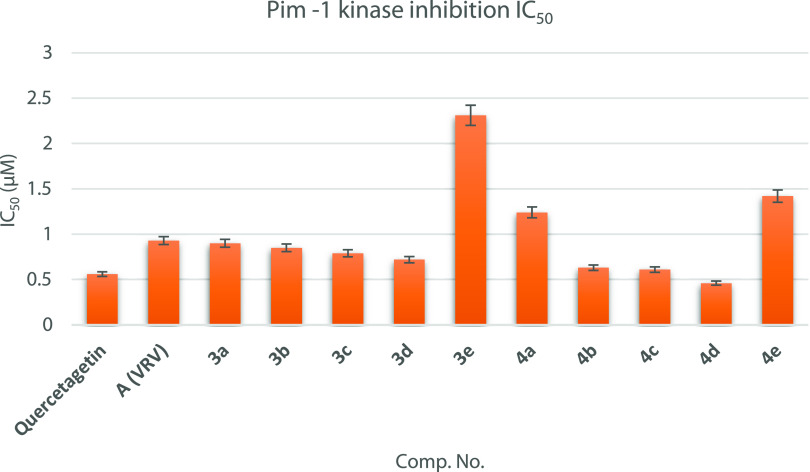
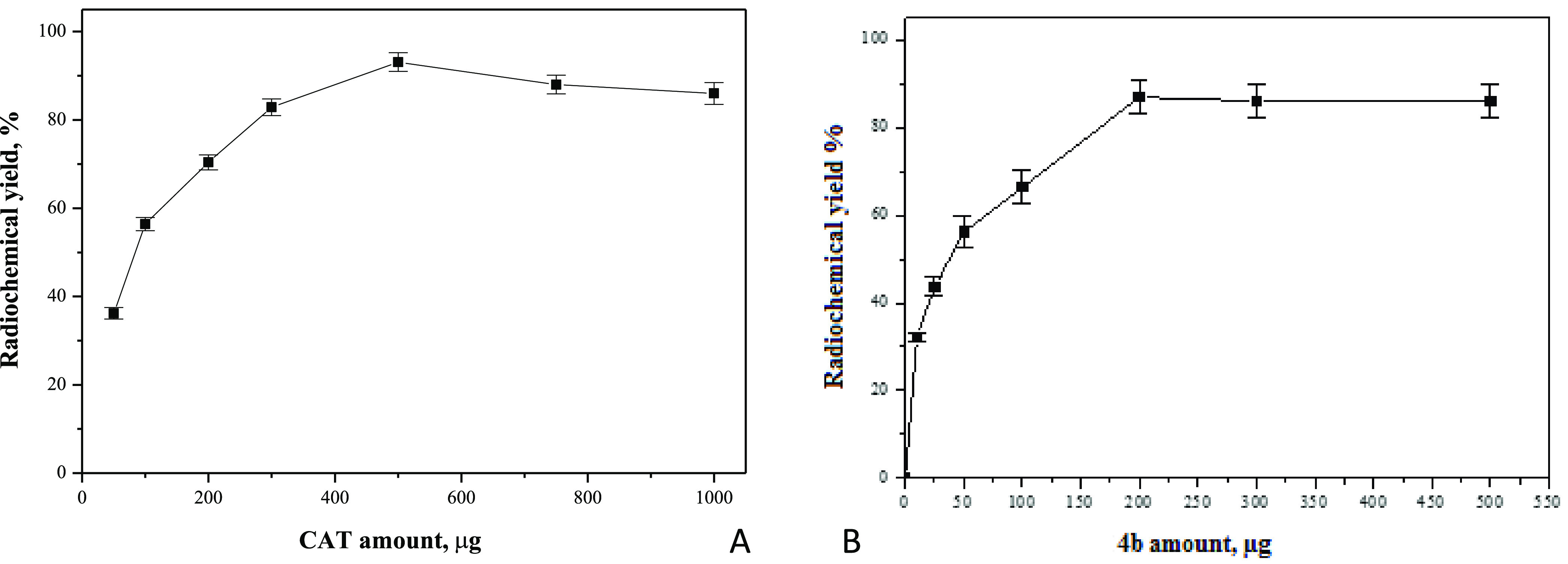
In this study, two new series of 3-cyanopyridinones () and 3-cyanopyridines () were synthesized and evaluated for their cytotoxicity and Pim-1 kinase inhibitory activity adopting 3-[4,5-dimethylthiazol-2-yl]-2,5 diphenyl tetrazolium bromide (MTT) assay and Pim-1 kinase inhibition assay, respectively. Most of the tested compounds revealed promising cytotoxicity against HepG-2, HCT-116, MCF-7, and PC-3 cell lines. Among them, compounds and showed more potent cytotoxicity against the HePG2 cell line with IC = 8.02 ± 0.38 and 6.95 ± 0.34 μM, respectively, than that of the reference 5-FU (IC = 9.42 ± 0.46 μM). Moreover, compound was more potent against HCT-116 (IC = 7.15 ± 0.35 μM) than 5-FU (IC = 8.01 ± 0.39 μM), while compound with IC = 8.35 ± 0.42 μM displayed comparable activity to that of the reference drug. Furthermore, high cytotoxic activity was manifested by compounds and against MCF-7 and PC3 cell lines. Our results have also indicated that compounds , , and elicited remarkable inhibition of Pim-1 kinase; and showed equipotent inhibitory activity to that of the reference quercetagetin. Meanwhile, displayed IC = 0.46 ± 0.02 μM, showed the best inhibitory activity among the tested compounds, and was more potent than quercetagetin (IC = 0.56 ± 0.03 μM). For optimization of the results, docking study of the most potent compounds and in the Pim-1 kinase active site was carried out and compared with both quercetagetin and the reported Pim-1 inhibitor (), and the results were consistent with those of the biological study. Consequently, compounds and are worthy of further investigations toward the discovery of Pim-1 kinase inhibitors as drug candidates for cancer therapy. Compound was successfully radiolabeled with radioiodine-131, and its biodistribution in Ehrlich ascites carcinoma (EAC)-bearing mice showed more observable uptake in tumor sites, and hence, it can be introduced as a new radiolabeled agent for tumor imaging and therapy.
在本研究中,合成了两个新系列的3-氰基吡啶酮()和3-氰基吡啶(),并分别采用3-[4,5-二甲基噻唑-2-基]-2,5-二苯基溴化四氮唑(MTT)法和Pim-1激酶抑制试验评估了它们的细胞毒性和Pim-1激酶抑制活性。大多数受试化合物对HepG-2、HCT-116、MCF-7和PC-3细胞系显示出有前景的细胞毒性。其中,化合物和对HePG2细胞系表现出更强的细胞毒性,IC分别为8.02±0.38和6.95±0.34μM,优于参考药物5-氟尿嘧啶(IC为9.42±0.46μM)。此外,化合物对HCT-116(IC为7.15±0.35μM)的活性比5-氟尿嘧啶(IC为8.01±0.39μM)更强,而IC为8.35±0.42μM的化合物与参考药物表现出相当的活性。此外,化合物和对MCF-7和PC3细胞系表现出高细胞毒性活性。我们的结果还表明,化合物、和对Pim-1激酶有显著抑制作用;和与参考槲皮黄素表现出同等的抑制活性。同时,显示IC为0.46±0.02μM,在受试化合物中表现出最佳抑制活性,且比槲皮黄素(IC为0.56±0.03μM)更强。为优化结果,对最有效的化合物和在Pim-1激酶活性位点进行了对接研究,并与槲皮黄素和报道的Pim-1抑制剂()进行了比较,结果与生物学研究结果一致。因此,化合物和作为癌症治疗候选药物用于发现Pim-1激酶抑制剂值得进一步研究。化合物成功地用放射性碘-131进行了放射性标记,其在荷艾氏腹水癌(EAC)小鼠体内的生物分布显示在肿瘤部位有更明显的摄取,因此,它可作为一种新的放射性标记剂用于肿瘤成像和治疗。