
女性体重指数与乳腺癌预后之间的关系呈U形。
The relationship between women's body mass index and breast cancer outcomes was U-shaped.
作者信息
Wei Wensong, Wei Suosu, Huang Zhen, Zhang Qiuhuan, Liu Fei, Xie Yujie, Wei Jing, Mo Chongde, Zhou Ying, Qin Shengpeng, Zou Quanqing, Yang Jianrong
机构信息
Department of Breast and Thyroid Surgery, Guangxi Academy of Medical Sciences, People's Hospital of Guangxi Zhuang Autonomous Region, Nanning, Guangxi, China.
Department of Scientific Cooperation of Guangxi Academy of Medical Sciences, People's Hospital of Guangxi Zhuang Autonomous Region, Nanning, Guangxi, China.
出版信息
Front Oncol. 2023 May 25;13:1191093. doi: 10.3389/fonc.2023.1191093. eCollection 2023.
BACKGROUND
Several studies have analyzed the relationship between body mass index (BMI) and the prognosis of breast cancer (BC). However, whether their relationship is linear or curvilinear remains unclear. This cohort study examined the specific relationship between BMI and BC outcomes.
METHODS
This retrospective cohort study included 1049 BC patients from March 7, 2013 through December 31, 2019 in a hospital. Kaplan-Meier curves, multivariate Cox proportional models, and restricted cubic spline (RCS) was used to analysis the relationship between BMI and overall survival (OS) and breast cancer-specific survival (BCSS) was analyzed.
RESULTS
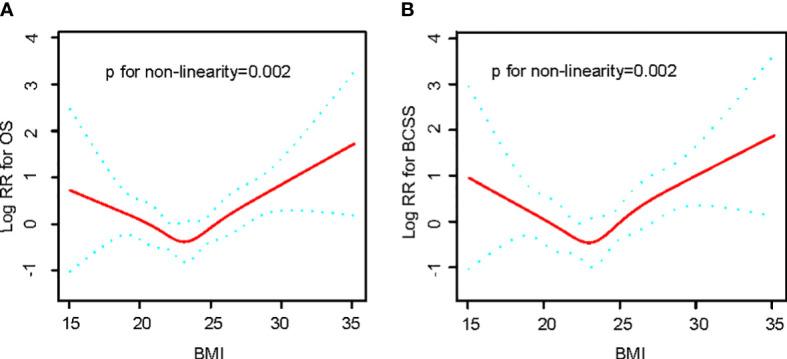
During a median of 4.87 (IQR:3.26-6.84) years of follow-up period, 71 patients (6.77%) died, of which 50 (70.42%) were attributed to BC. RCS analysis revealed a U- shaped relationship between BMI levels and OS and BCSS after adjusting for other variables. The turning points of the U-shaped curves were 23 kg/m2. On the left side of the turning point, the risk of OS (HR, 0.83; 95% CI, 0.70, 0.98) and BCSS (HR, 0.80; 95% CI, 0.65, 0.98) were adversely correlated with BMI. In contrast, to the right of the turning point, the risk of OS (HR, 1.22; 95% CI, 1.10, 1.37) and BCSS (HR, 1.28; 95% CI, 1.13, 1.46) was positively related to BMI. Kaplan-Meier curves and multivariate Cox regression analyses shown consistent results with RCS analyses.
CONCLUSION
BMI was an independent prognostic factor for BC, and had a U-shaped relationship with OS and BCSS. Interventions should be designed to improve patient outcomes based on BMI.
背景
多项研究分析了体重指数(BMI)与乳腺癌(BC)预后之间的关系。然而,它们之间的关系是线性还是曲线关系仍不清楚。这项队列研究探讨了BMI与BC预后之间的具体关系。
方法
这项回顾性队列研究纳入了2013年3月7日至2019年12月31日期间在一家医院的1049例BC患者。采用Kaplan-Meier曲线、多变量Cox比例模型和受限立方样条(RCS)分析BMI与总生存期(OS)以及乳腺癌特异性生存期(BCSS)之间的关系。
结果
在中位随访期4.87(IQR:3.26 - 6.84)年期间,71例患者(6.77%)死亡,其中50例(70.42%)归因于BC。RCS分析显示,在调整其他变量后,BMI水平与OS和BCSS之间呈U形关系。U形曲线的转折点为23kg/m²。在转折点左侧,OS风险(HR,0.83;95%CI,0.70,0.98)和BCSS风险(HR,0.80;95%CI,0.65,0.98)与BMI呈负相关。相反,在转折点右侧,OS风险(HR,1.22;95%CI,1.10,1.37)和BCSS风险(HR,1.28;95%CI,1.13,1.46)与BMI呈正相关。Kaplan-Meier曲线和多变量Cox回归分析结果与RCS分析一致。
结论
BMI是BC的独立预后因素,与OS和BCSS呈U形关系。应根据BMI设计干预措施以改善患者预后。


 Zotero 插件