Chung Il Yong, Lee Jong Won, Lee Ji Sung, Park Yu Rang, Min Yul Ha, Lee Yura, Yoon Tae In, Sohn Guiyun, Lee Sae Byul, Kim Jisun, Kim Hee Jeong, Ko Beom Seok, Son Byung Ho, Ahn Sei Hyun
Department of Surgery, University of Ulsan College of Medicine, Asan Medical Center, Seoul, Republic of Korea.
Clinical Research Center, University of Ulsan College of Medicine, Asan Medical Center, Seoul, Republic of Korea.
PLoS One. 2017 Mar 1;12(3):e0170311. doi: 10.1371/journal.pone.0170311. eCollection 2017.
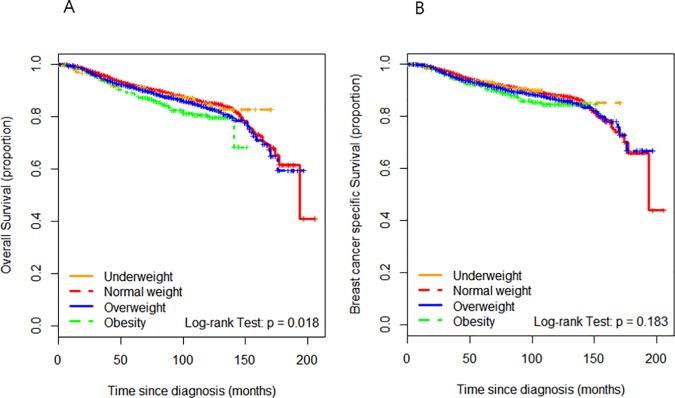
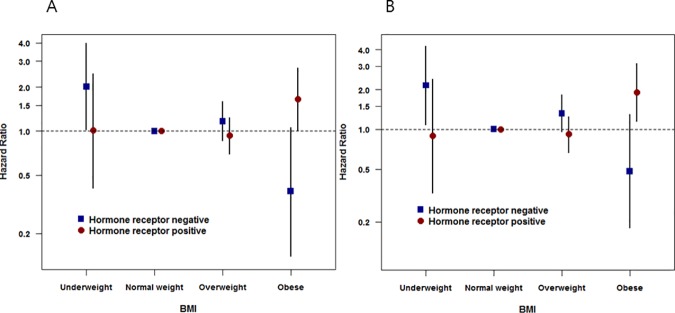
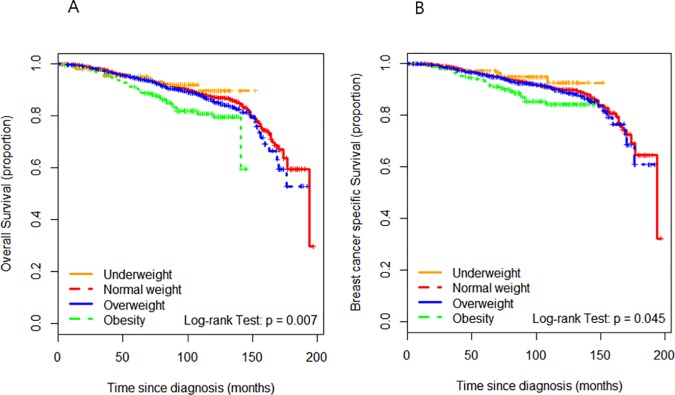
The aim of this study was to determine the relationship between the body mass index (BMI) at a breast cancer diagnosis and various factors including the hormone-receptor, menopause, and lymph-node status, and identify if there is a specific patient subgroup for which the BMI has an effect on the breast cancer prognosis. We retrospectively analyzed the data of 8,742 patients with non-metastatic invasive breast cancer from the research database of Asan Medical Center. The overall survival (OS) and breast-cancer-specific survival (BCSS) outcomes were compared among BMI groups using the Kaplan-Meier method and Cox proportional-hazards regression models with an interaction term. There was a significant interaction between BMI and hormone-receptor status for the OS (P = 0.029), and BCSS (P = 0.013) in lymph-node-positive breast cancers. Obesity in hormone-receptor-positive breast cancer showed a poorer OS (adjusted hazard ratio [HR] = 1.51, 95% confidence interval [CI] = 0.92 to 2.48) and significantly poorer BCSS (HR = 1.80, 95% CI = 1.08 to 2.99). In contrast, a high BMI in hormone-receptor-negative breast cancer revealed a better OS (HR = 0.44, 95% CI = 0.16 to 1.19) and BCSS (HR = 0.53, 95% CI = 0.19 to 1.44). Being underweight (BMI < 18.50 kg/m2) with hormone-receptor-negative breast cancer was associated with a significantly worse OS (HR = 1.98, 95% CI = 1.00-3.95) and BCSS (HR = 2.24, 95% CI = 1.12-4.47). There was no significant interaction found between the BMI and hormone-receptor status in the lymph-node-negative setting, and BMI did not interact with the menopause status in any subgroup. In conclusion, BMI interacts with the hormone-receptor status in a lymph-node-positive setting, thereby playing a role in the prognosis of breast cancer.
本研究的目的是确定乳腺癌诊断时的体重指数(BMI)与包括激素受体、绝经状态和淋巴结状态在内的各种因素之间的关系,并确定是否存在BMI对乳腺癌预后有影响的特定患者亚组。我们回顾性分析了来自峨山医学中心研究数据库的8742例非转移性浸润性乳腺癌患者的数据。使用Kaplan-Meier方法和带有交互项的Cox比例风险回归模型,比较了不同BMI组的总生存期(OS)和乳腺癌特异性生存期(BCSS)。在淋巴结阳性乳腺癌中,BMI与激素受体状态在OS(P = 0.029)和BCSS(P = 0.013)方面存在显著交互作用。激素受体阳性乳腺癌中的肥胖表现出较差的OS(调整后风险比[HR] = 1.51,95%置信区间[CI] = 0.92至2.48)和显著较差的BCSS(HR = 1.80,95%CI = 1.08至2.99)。相比之下,激素受体阴性乳腺癌中的高BMI显示出较好的OS(HR = 0.44,95%CI = 0.16至1.19)和BCSS(HR = 0.53,95%CI = 0.19至1.44)。激素受体阴性乳腺癌且体重过轻(BMI < 18.50 kg/m2)与显著更差的OS(HR = 1.98,95%CI = 1.00 - 3.95)和BCSS(HR = 2.24,95%CI = 1.12 - 4.47)相关。在淋巴结阴性情况下,未发现BMI与激素受体状态之间存在显著交互作用,且在任何亚组中BMI与绝经状态均无交互作用。总之,在淋巴结阳性情况下,BMI与激素受体状态相互作用,从而在乳腺癌预后中发挥作用。