Department of Joint Surgery, The First Affiliated Hospital of Sun Yat-Sen University, Sun Yat-Sen University, Guangzhou, China.
Guangdong Provincial Key Laboratory of Orthopedics and Traumatology, The First Affiliated Hospital of Sun Yat-Sen University, Sun Yat-Sen University, Guangzhou, China.
Osteoporos Int. 2023 Oct;34(10):1719-1727. doi: 10.1007/s00198-023-06807-6. Epub 2023 Jun 12.
It remains unclear whether the relationship between type 2 diabetes mellitus (T2DM) and bone mineral density (BMD) reflects causality in East Asian populations. Herein, a Mendelian randomization study conducted in East Asian population enhances the current clinical cognition that T2DM is not associated with reduction in BMD.
A Mendelian randomization (MR) approach was utilized to investigate the relationship between type 2 diabetes mellitus (T2DM) and bone mineral density (BMD) in East Asian populations.
Genome-wide association study summary data from BioBank Japan were used to identify genetic variants strongly related to T2DM risk (36,614 cases and 155,150 controls) and osteoporosis (7788 cases and 204,665 controls). Heel BMD GWAS data of 1260 East Asian people from ieu open gwas project was considered as a second outcome. Inverse variance-weighted (IVW) analysis was mainly applied; MR-Egger and the weighted median were also used to obtain robust estimates. A series of sensitivity analyses including Cochran's Q test, MR-Egger regression, and leave-one-out analysis were used to detect pleiotropy or heterogeneity.
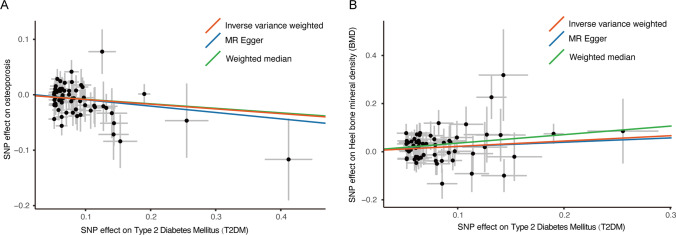
In the main analysis, IVW estimates indicated that T2DM significantly associated with the risk of osteoporosis (odds ratio = 0.92, 95% CI: 0.86-0.99, p = 0.016) and with higher BMD (OR: 1.25, 95% CI: 1.06-1.46, p = 6.49 × 10). Results of comprehensive sensitivity analysis were consistent with the main causality estimate. Horizontal pleiotropy and heterogeneity were absent in our MR study.
T2DM is not associated with reduction in BMD in terms of genetic polymorphism in East Asian populations.
采用孟德尔随机化(MR)方法探讨东亚人群 2 型糖尿病(T2DM)与骨密度(BMD)之间的关系。
利用日本生物银行的全基因组关联研究汇总数据,鉴定与 T2DM 风险(36614 例病例和 155150 例对照)和骨质疏松症(7788 例病例和 204665 例对照)密切相关的遗传变异。ieu 开放 GWAS 项目中来自 1260 位东亚人的足跟 BMD GWAS 数据被认为是第二个结果。主要应用逆方差加权(IVW)分析;还使用 MR-Egger 和加权中位数获得稳健估计。一系列敏感性分析,包括 Cochran's Q 检验、MR-Egger 回归和逐一排除分析,用于检测多效性或异质性。
在主要分析中,IVW 估计表明 T2DM 与骨质疏松症的风险显著相关(优势比=0.92,95%CI:0.86-0.99,p=0.016),与较高的 BMD 相关(OR:1.25,95%CI:1.06-1.46,p=6.49×10)。综合敏感性分析的结果与主要因果关系估计一致。我们的 MR 研究中不存在水平多效性和异质性。
就东亚人群的遗传多态性而言,T2DM 与 BMD 降低无关。