National Collaborative Perinatal Neonatal Network, Department Pediatrics and Adolescent Medicine, American University of Beirut Medical Center, Beirut, Lebanon.
Department Pediatrics and Adolescent Medicine, American University of Beirut, Beirut, Lebanon.
BMJ Open Qual. 2023 Jun;12(2). doi: 10.1136/bmjoq-2022-002129.
Premature and sick neonates in the neonatal intensive care unit (NICU) are in need of central lines placing them at high risk of contracting a central line-associated bloodstream infection (CLABSI). CLABSI extends length of stay to 10-14 days post negative cultures and increases morbidity, use of multiple antibiotics, mortality and hospital cost. To reduce CLABSI rate at the American University of Beirut Medical Center NICU, the National Collaborative Perinatal Neonatal Network developed a quality improvement project to reduce CLABSI rate by 50% over a 1-year period and to sustain reduced CLABSI rate.
Central line insertion and maintenance bundles were implemented for all infants admitted to the NICU necessitating central lines placement. Bundles included hand washing, wearing protective material and sterile drapes during central lines insertion and maintenance.
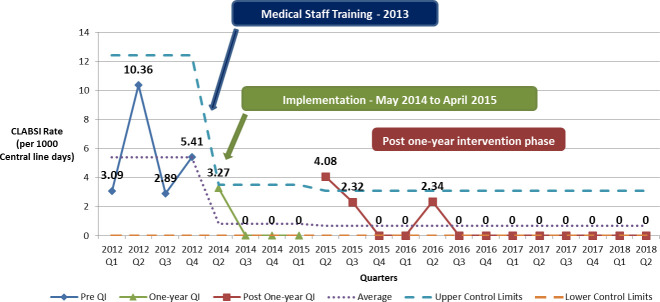
CLABSI rate decreased by 76% from 4.82 (6 infections; 1244 catheter days) to 1.09 (2 infection; 1830 catheter days) per 1000 CL days after 1 year. Following the bundles' success in reducing CLABSI rate, they were incorporated permanently to NICU standard procedure and bundle checklists were added to the medical sheets. CLABSI rate was maintained at 1.15 per 1000 CL days during the second year. It then decreased to 0.66 per 1000 CL days in the third year before reaching zero in the fourth year. In total, zero CLABSI rate was sustained for 23 consecutive months.
Reducing CLABSI rate is necessary to improving newborn quality of care and outcome. Our bundles were successful in drastically reducing and sustaining a low CLABSI rate. It was even successful in achieving a zero CLABSI unit for 2 years.
新生儿重症监护病房(NICU)中早产儿和患病新生儿需要放置中心静脉导管,这使他们面临感染中心静脉导管相关血流感染(CLABSI)的高风险。CLABSI 会延长住院时间 10-14 天,增加发病率、使用多种抗生素、死亡率和医院成本。为了降低贝鲁特美国大学医学中心 NICU 的 CLABSI 发生率,国家围产期新生儿网络合作组织开展了一项质量改进项目,旨在在 1 年内将 CLABSI 发生率降低 50%,并维持降低后的 CLABSI 发生率。
对所有需要放置中心静脉导管的 NICU 住院婴儿实施中心静脉导管插入和维护包。该包包括在插入和维护中心静脉导管时洗手、佩戴防护材料和无菌布帘。
在实施这些措施 1 年后,CLABSI 发生率从每千导管日 4.82(6 例感染;1244 个导管日)降至 1.09(2 例感染;1830 个导管日),降低了 76%。在降低 CLABSI 发生率方面,该措施取得了成功,随后将其永久纳入 NICU 标准程序,并在医疗记录中添加了 CLABSI 包检查清单。第二年 CLABSI 发生率保持在每千导管日 1.15。第三年,CLABSI 发生率降至每千导管日 0.66,第四年降至零。总的来说,连续 23 个月维持了零 CLABSI 发生率。
降低 CLABSI 发生率对于提高新生儿护理质量和结局至关重要。我们的包成功地大幅降低并维持了较低的 CLABSI 发生率,甚至成功地实现了 2 年内 CLABSI 发生率为零的目标。