State Key Laboratory for Mineral Deposits Research, School of Earth Sciences and Engineering and Frontiers Science Center for Critical Earth Material Cycling, Nanjing University, Nanjing, China.
School of Earth Sciences, Life Sciences Building, Tyndall Avenue, University of Bristol, Bristol, UK.
Nat Ecol Evol. 2023 Jul;7(7):1131-1140. doi: 10.1038/s41559-023-02074-0. Epub 2023 Jun 12.
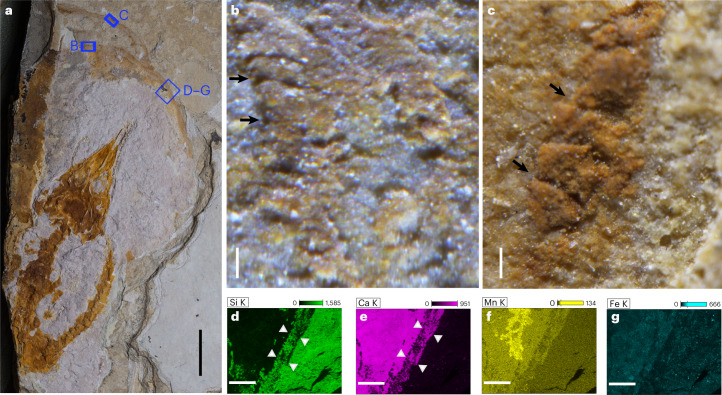
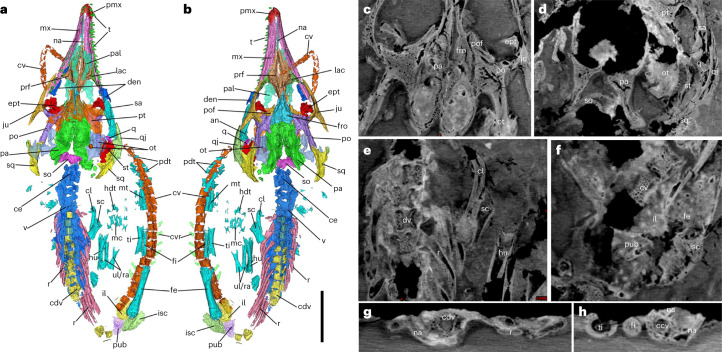
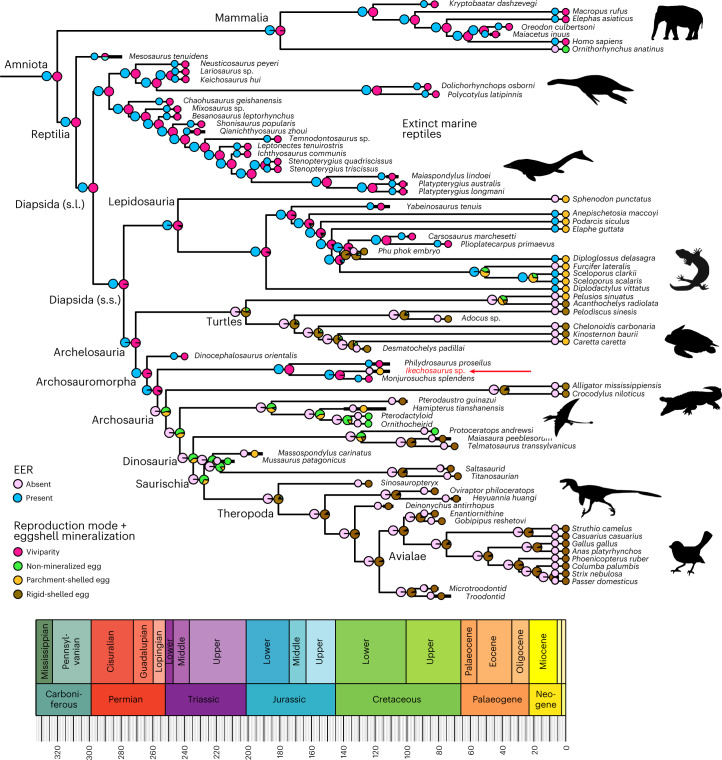
The amniotic egg with its complex fetal membranes was a key innovation in vertebrate evolution that enabled the great diversification of reptiles, birds and mammals. It is debated whether these fetal membranes evolved in eggs on land as an adaptation to the terrestrial environment or to control antagonistic fetal-maternal interaction in association with extended embryo retention (EER). Here we report an oviparous choristodere from the Lower Cretaceous period of northeast China. The ossification sequence of the embryo confirms that choristoderes are basal archosauromorphs. The discovery of oviparity in this assumed viviparous extinct clade, together with existing evidence, suggests that EER was the primitive reproductive mode in basal archosauromorphs. Phylogenetic comparative analyses on extant and extinct amniotes suggest that the first amniote displayed EER (including viviparity).
带有复杂胎膜的羊膜卵是脊椎动物进化中的一项关键创新,使爬行动物、鸟类和哺乳动物得以多样化发展。目前还存在争议,这些胎膜是在陆地上的卵中进化而来,以适应陆地环境,还是与延长胚胎保留(EER)相关,以控制拮抗的胎-母相互作用。本文报道了来自中国东北下白垩统的一种卵生兽孔目动物。胚胎的骨化序列证实,兽孔目是基干的主龙形类。在这个假定的胎生灭绝类群中发现卵生,以及现有的证据表明,EER 是基干主龙形类的原始生殖模式。对现生和已灭绝的羊膜动物的系统发育比较分析表明,第一只羊膜动物表现出 EER(包括胎生)。