University Hospital Birmingham NHS Trust, Birmingham, UK.
Manchester University NHS Foundation Trust, Manchester, UK.
Oncologist. 2023 Aug 3;28(8):e699-e702. doi: 10.1093/oncolo/oyad134.
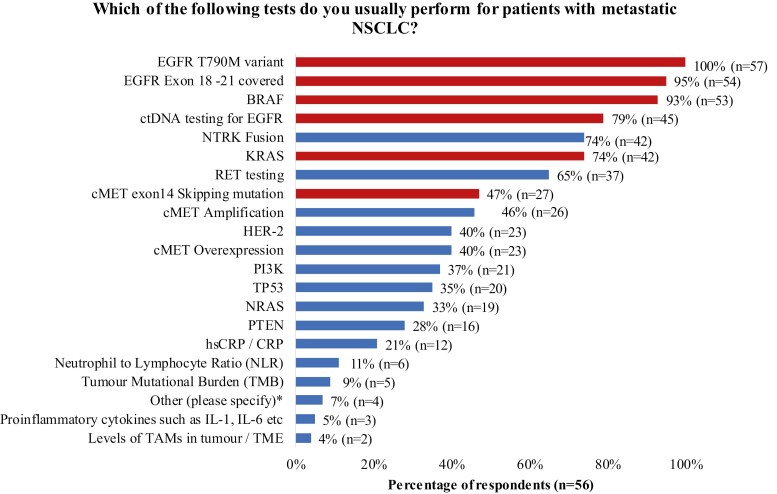
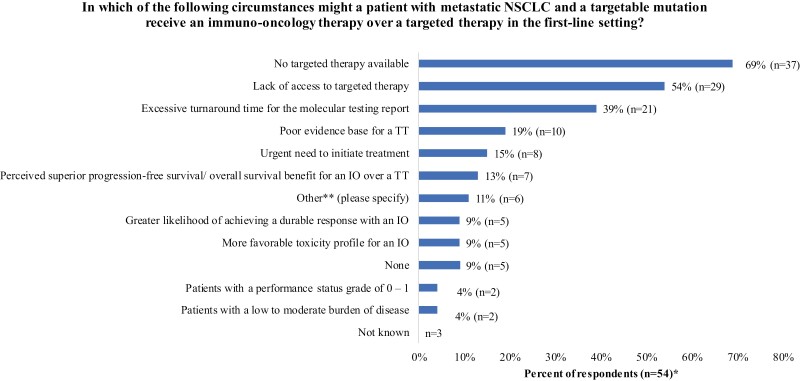
This survey aims to understand the current UK practice for non-small cell lung carcinoma (NSCLC) and identify barriers that may impact patient treatment and outcomes. In March-June 2021, 57 interviews were conducted with healthcare professionals involved in the secondary care management of patients with NSCLC. Most respondents performed genetic testing at onsite and non-genomic laboratory hub (GLH) offsite locations. The most common genetic tests were EGFR T790M variant (100%), EGFR exon 18-21 covered (95%) and BRAF (93%). No targeted therapy (TT) available (69%), lack of access to a TT (54%) or excessive molecular testing turnaround times (39%) were the most common reasons for using an immuno-oncology therapy over a TT in the first-line setting. The survey highlights variation in mutation testing practices across the UK, which may impact treatment decisions and contribute to health outcome inequality.
这项调查旨在了解英国目前在非小细胞肺癌(NSCLC)方面的实践情况,并确定可能影响患者治疗和预后的障碍。2021 年 3 月至 6 月,对参与 NSCLC 二级护理管理的 57 名医疗保健专业人员进行了访谈。大多数受访者在现场和非基因组实验室中心(GLH)的场外地点进行基因检测。最常见的基因检测是 EGFR T790M 变体(100%)、EGFR 外显子 18-21 覆盖(95%)和 BRAF(93%)。最常见的原因是一线治疗中无靶向治疗(TT)可用(69%)、无法获得 TT(54%)或分子检测周转时间过长(39%),因此选择使用免疫肿瘤疗法而非 TT。该调查突出了英国各地突变检测实践的差异,这可能会影响治疗决策,并导致健康结果不平等。