Center on Mindfulness and Integrative Health Intervention Development, University of Utah, Salt Lake City, UT, USA.
College of Social Work, University of Utah, Salt Lake City, UT, USA.
Psychol Med. 2023 Apr;53(5):2085-2094. doi: 10.1017/S0033291721003834. Epub 2021 Oct 14.
Neuropsychopharmacologic effects of long-term opioid therapy (LTOT) in the context of chronic pain may result in subjective anhedonia coupled with decreased attention to natural rewards. Yet, there are no known efficacious treatments for anhedonia and reward deficits associated with chronic opioid use. Mindfulness-Oriented Recovery Enhancement (MORE), a novel behavioral intervention combining training in mindfulness with savoring of natural rewards, may hold promise for treating anhedonia in LTOT.
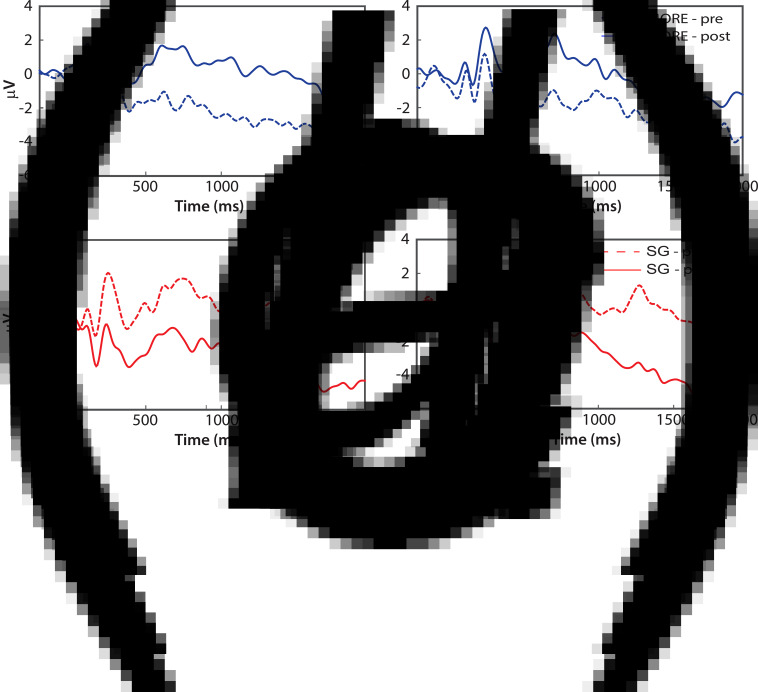
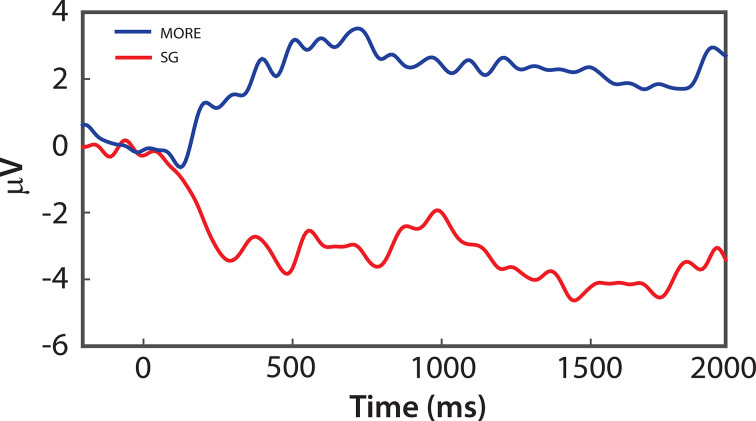
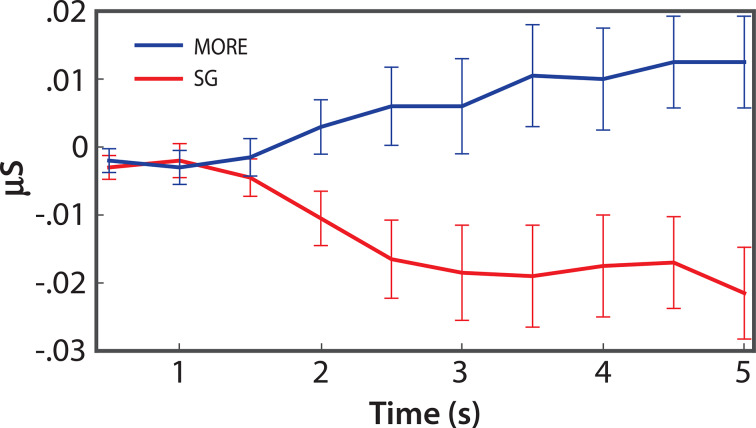
Veterans receiving LTOT ( = 63) for chronic pain were randomized to 8 weeks of MORE or a supportive group (SG) psychotherapy control. Before and after the 8-week treatment groups, we assessed the effects of MORE on the late positive potential (LPP) of the electroencephalogram and skin conductance level (SCL) during viewing and up-regulating responses (i.e. savoring) to natural reward cues. We then examined whether these neurophysiological effects were associated with reductions in subjective anhedonia by 4-month follow-up.
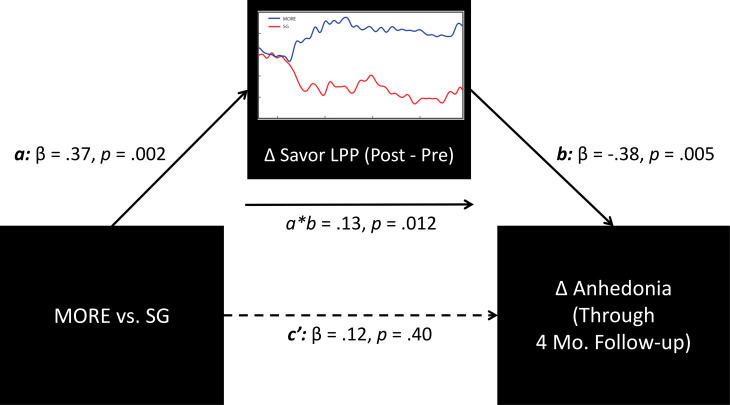
Patients treated with MORE demonstrated significantly increased LPP and SCL to natural reward cues and greater decreases in subjective anhedonia relative to those in the SG. The effect of MORE on reducing anhedonia was statistically mediated by increases in LPP response during savoring.
MORE enhances motivated attention to natural reward cues among chronic pain patients on LTOT, as evidenced by increased electrocortical and sympathetic nervous system responses. Given neurophysiological evidence of clinical target engagement, MORE may be an efficacious treatment for anhedonia among chronic opioid users, people with chronic pain, and those at risk for opioid use disorder.
长期阿片类药物治疗(LTOT)治疗慢性疼痛的神经精神药理学作用可能导致主观快感缺失,同时对自然奖赏的关注度降低。然而,目前尚无已知的有效治疗方法可用于治疗与慢性阿片类药物使用相关的快感缺失和奖赏缺陷。正念导向的康复增强(MORE)是一种新的行为干预措施,将正念训练与自然奖赏的享受相结合,可能对治疗 LTOT 中的快感缺失有一定效果。
接受 LTOT(慢性疼痛)的退伍军人(n = 63)被随机分配到 8 周的 MORE 或支持性团体(SG)心理治疗对照组。在 8 周的治疗组前后,我们评估了 MORE 对脑电图的晚正电位(LPP)和皮肤电导水平(SCL)的影响,以及对自然奖励线索的观看和上调反应(即享受)。然后,我们通过 4 个月的随访,检查这些神经生理效应是否与主观快感缺失的减少有关。
与 SG 相比,接受 MORE 治疗的患者对自然奖励线索的 LPP 和 SCL 显著增加,主观快感缺失显著减少。MORE 对快感缺失的治疗效果通过享受过程中 LPP 反应的增加而具有统计学意义。
MORE 增强了慢性疼痛患者 LTOT 对自然奖励线索的动机注意力,表现为皮质电反应和交感神经系统反应增加。鉴于临床靶点确证的神经生理学证据,MORE 可能是治疗慢性阿片类药物使用者、慢性疼痛患者和阿片类药物使用障碍风险人群快感缺失的有效治疗方法。