• 文献检索
  • 文档翻译
  • 深度研究
  • 学术资讯
  • Suppr Zotero 插件Zotero 插件
  • 邀请有礼
  • 套餐&价格
  • 历史记录
应用&插件
Suppr Zotero 插件Zotero 插件浏览器插件Mac 客户端Windows 客户端微信小程序
定价
高级版会员购买积分包购买API积分包
服务
文献检索文档翻译深度研究API 文档MCP 服务
关于我们
关于 Suppr公司介绍联系我们用户协议隐私条款
关注我们

Suppr 超能文献

核心技术专利:CN118964589B侵权必究
粤ICP备2023148730 号-1Suppr @ 2026

文献检索

告别复杂PubMed语法,用中文像聊天一样搜索,搜遍4000万医学文献。AI智能推荐,让科研检索更轻松。

立即免费搜索

文件翻译

保留排版,准确专业,支持PDF/Word/PPT等文件格式,支持 12+语言互译。

免费翻译文档

深度研究

AI帮你快速写综述,25分钟生成高质量综述,智能提取关键信息,辅助科研写作。

立即免费体验

社交媒体枪支所有权构建的开发与评估:计算推导与基准比较。

Development and Assessment of a Social Media-Based Construct of Firearm Ownership: Computational Derivation and Benchmark Comparison.

机构信息

Department of Health Management and Policy, McCourt School of Public Policy, Georgetown University, Washington, DC, United States.

Department of Computer Science, Massive Data Institute, Georgetown University, Washington, DC, United States.

出版信息

J Med Internet Res. 2023 Jun 13;25:e45187. doi: 10.2196/45187.

DOI:10.2196/45187
PMID:37310779
原文链接:https://pmc.ncbi.nlm.nih.gov/articles/PMC10365610/
Abstract

BACKGROUND

Gun violence research is characterized by a dearth of data available for measuring key constructs. Social media data may offer a potential opportunity to significantly reduce that gap, but developing methods for deriving firearms-related constructs from social media data and understanding the measurement properties of such constructs are critical precursors to their broader use.

OBJECTIVE

This study aimed to develop a machine learning model of individual-level firearm ownership from social media data and assess the criterion validity of a state-level construct of ownership.

METHODS

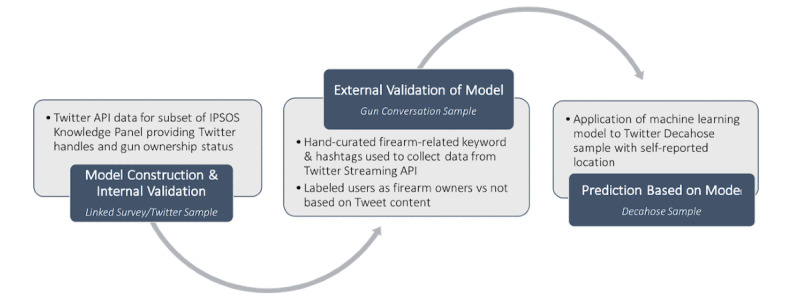
We used survey responses to questions on firearm ownership linked with Twitter data to construct different machine learning models of firearm ownership. We externally validated these models using a set of firearm-related tweets hand-curated from the Twitter Streaming application programming interface and created state-level ownership estimates using a sample of users collected from the Twitter Decahose application programming interface. We assessed the criterion validity of state-level estimates by comparing their geographic variance to benchmark measures from the RAND State-Level Firearm Ownership Database.

RESULTS

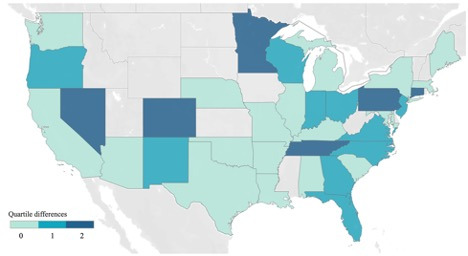
We found that the logistic regression classifier for gun ownership performs the best with an accuracy of 0.7 and an F-score of 0.69. We also found a strong positive correlation between Twitter-based estimates of gun ownership and benchmark ownership estimates. For states meeting a threshold requirement of a minimum of 100 labeled Twitter users, the Pearson and Spearman correlation coefficients are 0.63 (P<.001) and 0.64 (P<.001), respectively.

CONCLUSIONS

Our success in developing a machine learning model of firearm ownership at the individual level with limited training data as well as a state-level construct that achieves a high level of criterion validity underscores the potential of social media data for advancing gun violence research. The ownership construct is an important precursor for understanding the representativeness of and variability in outcomes that have been the focus of social media analyses in gun violence research to date, such as attitudes, opinions, policy stances, sentiments, and perspectives on gun violence and gun policy. The high criterion validity we achieved for state-level gun ownership suggests that social media data may be a useful complement to traditional sources of information on gun ownership such as survey and administrative data, especially for identifying early signals of changes in geographic patterns of gun ownership, given the immediacy of the availability of social media data, their continuous generation, and their responsiveness. These results also lend support to the possibility that other computationally derived, social media-based constructs may be derivable, which could lend additional insight into firearm behaviors that are currently not well understood. More work is needed to develop other firearms-related constructs and to assess their measurement properties.
https://cdn.ncbi.nlm.nih.gov/pmc/blobs/45a5/10365610/8a1055bc904a/jmir_v25i1e45187_fig2.jpg
https://cdn.ncbi.nlm.nih.gov/pmc/blobs/45a5/10365610/691e2ece3e23/jmir_v25i1e45187_fig1.jpg
https://cdn.ncbi.nlm.nih.gov/pmc/blobs/45a5/10365610/8a1055bc904a/jmir_v25i1e45187_fig2.jpg
https://cdn.ncbi.nlm.nih.gov/pmc/blobs/45a5/10365610/691e2ece3e23/jmir_v25i1e45187_fig1.jpg
https://cdn.ncbi.nlm.nih.gov/pmc/blobs/45a5/10365610/8a1055bc904a/jmir_v25i1e45187_fig2.jpg
摘要

背景

枪支暴力研究的特点是可用数据匮乏,难以衡量关键指标。社交媒体数据可能为缩小这一差距提供潜在机会,但开发从社交媒体数据中提取枪支相关指标的方法,并了解这些指标的测量特性,是广泛应用的关键前提。

目的

本研究旨在开发一种基于机器学习的个体枪支拥有量模型,并评估州级枪支拥有量的构念的效标效度。

方法

我们使用与枪支拥有情况相关的推特数据,链接到推特调查数据,构建不同的枪支拥有量机器学习模型。我们使用从推特流媒体应用程序接口中手工筛选的一组与枪支相关的推文,以及从推特大数据集应用程序接口中收集的用户样本,对这些模型进行了外部验证,并使用这些样本创建了州级枪支拥有量的估计值。我们通过比较基于推特的枪支拥有量估计值与 RAND 州级枪支拥有数据库的基准衡量标准,评估了州级估计值的效标效度。

结果

我们发现,用于枪支拥有的逻辑回归分类器表现最佳,准确率为 0.7,F 分数为 0.69。我们还发现,基于推特的枪支拥有量估计值与基准拥有量估计值之间存在很强的正相关关系。对于达到最低 100 个标记推特用户的阈值要求的州,皮尔逊和斯皮尔曼相关系数分别为 0.63(P<.001)和 0.64(P<.001)。

结论

我们成功地在有限的训练数据基础上开发了个体枪支拥有量的机器学习模型,以及达到高效标效度的州级构念,这凸显了社交媒体数据在推进枪支暴力研究方面的潜力。该拥有量构念是理解迄今为止社交媒体分析中枪支暴力研究的代表性和结果变异性的重要前提,例如态度、观点、政策立场、情绪以及对枪支暴力和枪支政策的看法。我们在州级枪支拥有量方面取得的高效标效度表明,社交媒体数据可能是对枪支拥有等传统信息源的有用补充,尤其是在识别枪支拥有地理模式变化的早期信号方面,因为社交媒体数据的即时可用性、持续生成性和响应性。这些结果也支持了其他基于计算的、社交媒体衍生的构念可能是可推导的可能性,这可能为目前尚未充分理解的枪支行为提供更多的见解。还需要进一步开发其他与枪支相关的构念,并评估其测量特性。

相似文献

1
Development and Assessment of a Social Media-Based Construct of Firearm Ownership: Computational Derivation and Benchmark Comparison.社交媒体枪支所有权构建的开发与评估:计算推导与基准比较。
J Med Internet Res. 2023 Jun 13;25:e45187. doi: 10.2196/45187.
2
Assessing Social Media Data as a Resource for Firearm Research: Analysis of Tweets Pertaining to Firearm Deaths.评估社交媒体数据作为枪支研究资源:关于枪支死亡相关推文的分析。
J Med Internet Res. 2022 Aug 25;24(8):e38319. doi: 10.2196/38319.
3
Characteristics of Gun Advertisements on Social Media: Systematic Search and Content Analysis of Twitter and YouTube Posts.社交媒体上枪支广告的特点:对推特和YouTube帖子的系统检索与内容分析
J Med Internet Res. 2020 Mar 27;22(3):e15736. doi: 10.2196/15736.
4
Youth gun carrying and household firearm ownership in 22 US states.22 个美国州的青年持枪和家庭拥有枪支情况。
J Community Psychol. 2022 Sep;50(8):3640-3658. doi: 10.1002/jcop.22861. Epub 2022 Apr 12.
5
Assessment of Reasons for Ownership and Attitudes About Policies Among Firearm Owners With and Without Children.评估有子女和无子女枪支拥有者的拥有原因和政策态度。
JAMA Netw Open. 2022 Jan 4;5(1):e2142995. doi: 10.1001/jamanetworkopen.2021.42995.
6
Impact of Firearm Availability and Gun Regulation on State Suicide Rates.枪支可得性与枪支管制对各州自杀率的影响。
Suicide Life Threat Behav. 2016 Dec;46(6):678-696. doi: 10.1111/sltb.12243. Epub 2016 Mar 21.
7
Violent Experiences and Patterns of Firearm Ownership From Childhood to Young Adulthood.从儿童期到青年期的暴力经历和枪支拥有模式。
JAMA Netw Open. 2023 Oct 2;6(10):e2336907. doi: 10.1001/jamanetworkopen.2023.36907.
8
Firearm suicides and homicides in the United States: regional variations and patterns of gun ownership.美国的枪支自杀与他杀:地区差异及枪支拥有模式
Soc Sci Med. 1998 May;46(9):1227-33. doi: 10.1016/s0277-9536(97)10051-x.
9
Jumping the gun: firearms and the mental health of Australians.操之过急:枪支与澳大利亚人的心理健康
Aust N Z J Psychiatry. 1996 Jun;30(3):370-81. doi: 10.3109/00048679609065001.
10
Publisher's note: Patterns of household gun ownership and firearm suicide among black men compared to white men.出版商按语:黑人群体与白人群体的家庭枪支拥有模式和枪支自杀比较。
Prev Med. 2022 Nov;164:107261. doi: 10.1016/j.ypmed.2022.107261. Epub 2022 Sep 19.

本文引用的文献

1
How Americans encounter guns: Mixed methods content analysis of YouTube and internet search data.美国人如何接触枪支:YouTube 和互联网搜索数据的混合方法内容分析。
Prev Med. 2022 Dec;165(Pt A):107258. doi: 10.1016/j.ypmed.2022.107258. Epub 2022 Sep 11.
2
Assessing Social Media Data as a Resource for Firearm Research: Analysis of Tweets Pertaining to Firearm Deaths.评估社交媒体数据作为枪支研究资源:关于枪支死亡相关推文的分析。
J Med Internet Res. 2022 Aug 25;24(8):e38319. doi: 10.2196/38319.
3
Survey of firearm injury victims suggests a role for social media in violence prevention programs.
Am J Emerg Med. 2022 Sep;59:187-188. doi: 10.1016/j.ajem.2022.05.006. Epub 2022 May 12.
4
Receptiveness and Responsiveness Toward Using Social Media for Safe Firearm Storage Outreach: Mixed Methods Study.社交媒体在安全枪支储存宣传方面的接受度和反应性:混合方法研究。
J Med Internet Res. 2021 Jun 18;23(6):e24458. doi: 10.2196/24458.
5
How Health Care Workers Wield Influence Through Twitter Hashtags: Retrospective Cross-sectional Study of the Gun Violence and COVID-19 Public Health Crises.医疗工作者如何通过推特标签施加影响:枪支暴力和 COVID-19 公共卫生危机的回顾性横断面研究。
JMIR Public Health Surveill. 2021 Jan 6;7(1):e24562. doi: 10.2196/24562.
6
Collateral Crises of Gun Preparation and the COVID-19 Pandemic: Infodemiology Study.枪支准备的附带危机与 COVID-19 大流行:信息流行病学研究。
JMIR Public Health Surveill. 2020 May 28;6(2):e19369. doi: 10.2196/19369.
7
Conversational topics of social media messages associated with state-level mental distress rates.社交媒体消息与州级精神痛苦率相关的会话主题。
J Ment Health. 2020 Apr;29(2):234-241. doi: 10.1080/09638237.2020.1739251. Epub 2020 Mar 30.
8
Characteristics of Gun Advertisements on Social Media: Systematic Search and Content Analysis of Twitter and YouTube Posts.社交媒体上枪支广告的特点:对推特和YouTube帖子的系统检索与内容分析
J Med Internet Res. 2020 Mar 27;22(3):e15736. doi: 10.2196/15736.
9
What demographic attributes do our digital footprints reveal? A systematic review.我们的数字足迹揭示了哪些人口统计属性?系统评价。
PLoS One. 2018 Nov 28;13(11):e0207112. doi: 10.1371/journal.pone.0207112. eCollection 2018.
10
Youth Gun Violence Prevention in a Digital Age.数字时代的青少年枪支暴力预防
Pediatrics. 2018 Apr;141(4). doi: 10.1542/peds.2017-2438. Epub 2018 Mar 1.