Dinari Fatemeh, Bahaadinbeigy Kambiz, Bassiri Somayyeh, Mashouf Esmat, Bastaminejad Saiyad, Moulaei Khadijeh
Medical Informatics Research Center, Institute for Futures Studies in Health Kerman University of Medical Sciences Kerman Iran.
Branch Artificial Intelligent Islamic Azad University Mashhad Mashhad Iran.
Health Sci Rep. 2023 Jun 12;6(6):e1330. doi: 10.1002/hsr2.1330. eCollection 2023 Jun.
Nursing reports are necessary for clinical communication and provide an accurate reflection of nursing assessments, care provided, changes in clinical status, and patient-related information to support the multidisciplinary team to provide individualized care. Nurses always face challenges in recording and documenting nursing reports. Speech recognition systems (SRS), as one of the documentation technologies, can play a potential role in recording medical reports. Therefore, this study seeks to identify the barriers, benefits, and facilitators of utilizing speech recognition technology in nursing reports.
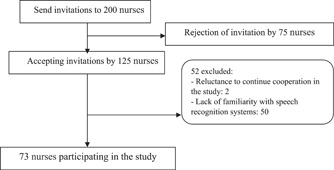
This cross-sectional was conducted through a researcher-made questionnaire in 2022. Invitations were sent to 200 ICU nurses working in the three educational hospitals of Imam Reza (AS), Qaem and Imam Zaman in Mashhad city (Iran), 125 of whom accepted our invitation. Finally, 73 nurses included the study based on inclusion and exclusion criteria. Data analysis was performed using SPSS 22.0.
According to the nurses, "paperwork reduction" (3.96, ±1.96), "performance improvement" (3.96, ±0.93), and "cost reduction" (3.95, ±1.07) were the most common benefits of using the SRS. "Lack of specialized, technical, and experienced staff to teach nurses how to work with speech recognition systems" (3.59, ±1.18), "insufficient training of nurses" (3.59, ±1.11), and "need to edit and control quality and correct documents" (3.59, ±1.03) were the most common barriers to using SRS. As well as "ability to fully review documentation processes" (3.62, ±1.13), "creation of integrated data in record documentation" (3.58, ±1.15), "possibility of error correction for nurses" (3.51, ±1.16) were the most common facilitators. There was no significant relationship between nurses' demographic information and the benefits, barriers, and facilitators.
By providing information on the benefits, barriers, and facilitators of using this technology, hospital managers, nursing managers, and information technology managers of healthcare centers can make more informed decisions in selecting and implementing SRS for nursing report documentation. This will help to avoid potential challenges that may reduce the efficiency, effectiveness, and productivity of the systems.
护理报告对于临床沟通至关重要,能准确反映护理评估、所提供的护理、临床状况变化以及患者相关信息,以支持多学科团队提供个性化护理。护士在记录和撰写护理报告时始终面临挑战。语音识别系统(SRS)作为一种记录技术,在记录医疗报告方面可发挥潜在作用。因此,本研究旨在确定在护理报告中使用语音识别技术的障碍、益处和促进因素。
本横断面研究于2022年通过研究者自制的问卷进行。向在伊朗马什哈德市伊玛目礼萨(AS)、卡伊姆和伊玛目扎曼这三家教学医院工作的200名重症监护室护士发出邀请,其中125人接受了邀请。最后,73名护士根据纳入和排除标准纳入研究。使用SPSS 22.0进行数据分析。
护士们认为,“减少文书工作”(3.96,±1.96)、“提高绩效”(3.96,±0.93)和“降低成本”(3.95,±1.07)是使用SRS最常见的益处。“缺乏专业、技术和经验丰富的人员来教导护士如何使用语音识别系统”(3.59,±1.18)、“护士培训不足”(3.59,±1.11)以及“需要编辑和控制质量并纠正文件”(3.59,±1.03)是使用SRS最常见的障碍。还有“能够全面审查记录流程”(3.62,±1.13)、“在记录文档中创建综合数据”(3.58,±1.15)、“护士纠错的可能性”(3.51,±1.16)是最常见的促进因素。护士的人口统计学信息与益处、障碍和促进因素之间无显著关系。
通过提供关于使用该技术的益处(3.96,±1.96)、障碍和促进因素的信息,医院管理人员、护理管理人员和医疗保健中心的信息技术管理人员在选择和实施用于护理报告记录的SRS时可以做出更明智的决策。这将有助于避免可能降低系统效率、有效性和生产力的潜在挑战。