Department of Maternal and Child Health, Gillings School of Global Public Health, The University of North Carolina at Chapel Hill.
Injury Prevention Research Center, The University of North Carolina at Chapel Hill.
JAMA Health Forum. 2023 Jun 2;4(6):e231422. doi: 10.1001/jamahealthforum.2023.1422.
Federal and state agencies granted temporary regulatory waivers to prevent disruptions in access to medication for opioid use disorder (MOUD) during the COVID-19 pandemic, including expanding access to telehealth for MOUD. Little is known about changes in MOUD receipt and initiation among Medicaid enrollees during the pandemic.
To examine changes in receipt of any MOUD, initiation of MOUD (in-person vs telehealth), and the proportion of days covered (PDC) with MOUD after initiation from before to after declaration of the COVID-19 public health emergency (PHE).
DESIGN, SETTING, AND PARTICIPANTS: This serial cross-sectional study included Medicaid enrollees aged 18 to 64 years in 10 states from May 2019 through December 2020. Analyses were conducted from January through March 2022.
Ten months before the COVID-19 PHE (May 2019 through February 2020) vs 10 months after the PHE was declared (March through December 2020).
Primary outcomes included receipt of any MOUD and outpatient initiation of MOUD via prescriptions and office- or facility-based administrations. Secondary outcomes included in-person vs telehealth MOUD initiation and PDC with MOUD after initiation.
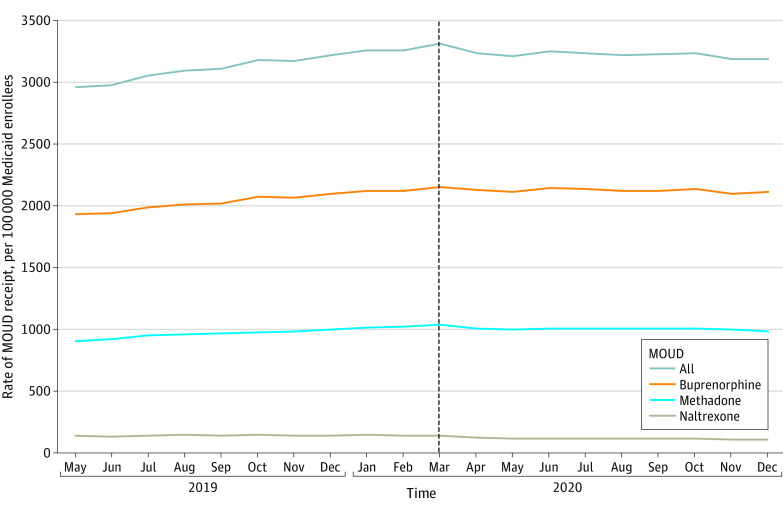
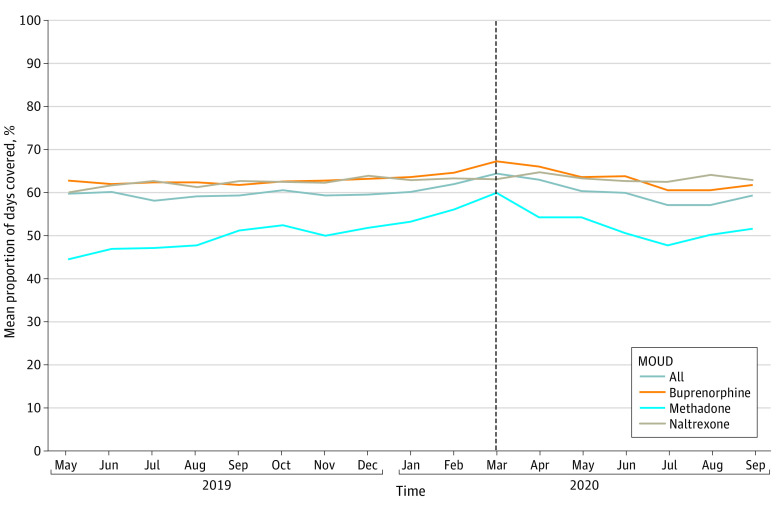
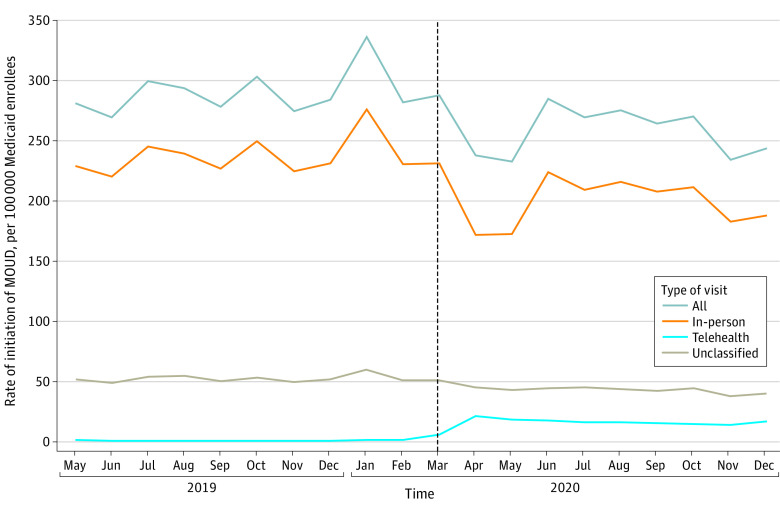
Among a total of 8 167 497 Medicaid enrollees before the PHE and 8 181 144 after the PHE, 58.6% were female in both periods and most enrollees were aged 21 to 34 years (40.1% before the PHE; 40.7% after the PHE). Monthly rates of MOUD initiation, representing 7% to 10% of all MOUD receipt, decreased immediately after the PHE primarily due to reductions in in-person initiations (from 231.3 per 100 000 enrollees in March 2020 to 171.8 per 100 000 enrollees in April 2020) that were partially offset by increases in telehealth initiations (from 5.6 per 100 000 enrollees in March 2020 to 21.1 per 100 000 enrollees in April 2020). Mean monthly PDC with MOUD in the 90 days after initiation decreased after the PHE (from 64.5% in March 2020 to 59.5% in September 2020). In adjusted analyses, there was no immediate change (odds ratio [OR], 1.01; 95% CI, 1.00-1.01) or change in the trend (OR, 1.00; 95% CI, 1.00-1.01) in the likelihood of receipt of any MOUD after the PHE compared with before the PHE. There was an immediate decrease in the likelihood of outpatient MOUD initiation (OR, 0.90; 95% CI, 0.85-0.96) and no change in the trend in the likelihood of outpatient MOUD initiation (OR, 0.99; 95% CI, 0.98-1.00) after the PHE compared with before the PHE.
In this cross-sectional study of Medicaid enrollees, the likelihood of receipt of any MOUD was stable from May 2019 through December 2020 despite concerns about potential COVID-19 pandemic-related disruptions in care. However, immediately after the PHE was declared, there was a reduction in overall MOUD initiations, including a reduction in in-person MOUD initiations that was only partially offset by increased use of telehealth.
在 COVID-19 大流行期间,联邦和州机构授予了临时监管豁免,以防止阿片类药物使用障碍 (MOUD) 药物的获取受到干扰,包括扩大 MOUD 的远程医疗服务。关于大流行期间医疗补助计划受保人 MOUD 接受和开始使用情况的变化知之甚少。
从宣告 COVID-19 公共卫生紧急事件 (PHE) 之前到之后,检查任何 MOUD 的接受、MOUD 的开始 (面对面与远程医疗) 以及开始 MOUD 后的 MOUD 覆盖天数 (PDC) 的变化。
设计、设置和参与者:这项连续的横断面研究包括 10 个州的 18 至 64 岁的医疗补助计划受保人,从 2019 年 5 月至 2020 年 12 月。分析于 2022 年 1 月至 3 月进行。
在 COVID-19 PHE 前的 10 个月 (2019 年 5 月至 2020 年 2 月) 与 PHE 宣布后的 10 个月 (2020 年 3 月至 12 月)。
主要结果包括任何 MOUD 的接受和通过处方和办公室/机构管理的 MOUD 的门诊开始。次要结果包括面对面与远程医疗 MOUD 开始以及开始后 MOUD 的 PDC。
在 PHE 前的总共 8167497 名医疗补助计划受保人和 PHE 后的 8181144 名受保人,两个时期的女性均占 58.6%,大多数受保人年龄在 21 至 34 岁之间 (PHE 前为 40.1%;PHE 后为 40.7%)。每月 MOUD 开始率,代表所有 MOUD 接受的 7%至 10%,在 PHE 后立即下降,主要是由于面对面开始减少(从 2020 年 3 月的每 10 万受保人 231.3 例降至 2020 年 4 月的每 10 万受保人 171.8 例),部分被远程医疗开始增加所抵消(从 2020 年 3 月的每 10 万受保人 5.6 例增加到 2020 年 4 月的每 10 万受保人 21.1 例)。开始后 90 天内 MOUD 的平均每月 PDC 在 PHE 后下降(从 2020 年 3 月的 64.5%降至 2020 年 9 月的 59.5%)。在调整后的分析中,与 PHE 前相比,PHE 后任何 MOUD 的接受率没有立即变化(优势比 [OR],1.01;95%CI,1.00-1.01)或趋势变化 (OR,1.00;95%CI,1.00-1.01)。与 PHE 前相比,PHE 后门诊 MOUD 开始的可能性立即下降 (OR,0.90;95%CI,0.85-0.96),但门诊 MOUD 开始的趋势没有变化 (OR,0.99;95%CI,0.98-1.00)。
在这项对医疗补助计划受保人的横断面研究中,尽管担心 COVID-19 大流行期间护理可能受到干扰,但从 2019 年 5 月至 2020 年 12 月,任何 MOUD 的接受率保持稳定。然而,在 PHE 宣布后,MOUD 的总体开始率下降,包括面对面 MOUD 开始率的下降,这仅部分被远程医疗使用的增加所抵消。