Department of Ophthalmology and Visual Sciences, Case Western Reserve University, Cleveland, OH, USA.
Department of Ophthalmology and Visual Sciences, Case Western Reserve University, Cleveland, OH, USA.
J Lipid Res. 2023 Jul;64(7):100401. doi: 10.1016/j.jlr.2023.100401. Epub 2023 Jun 15.
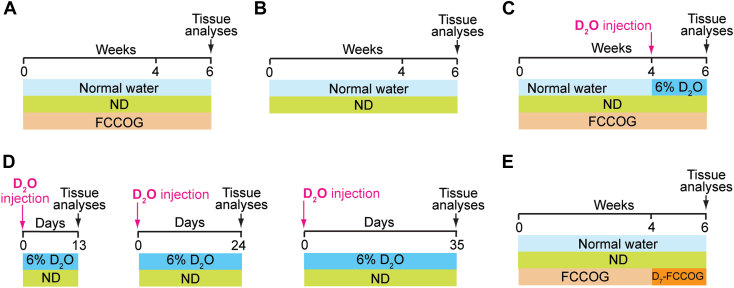
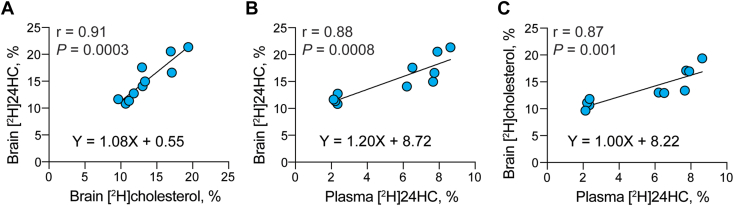
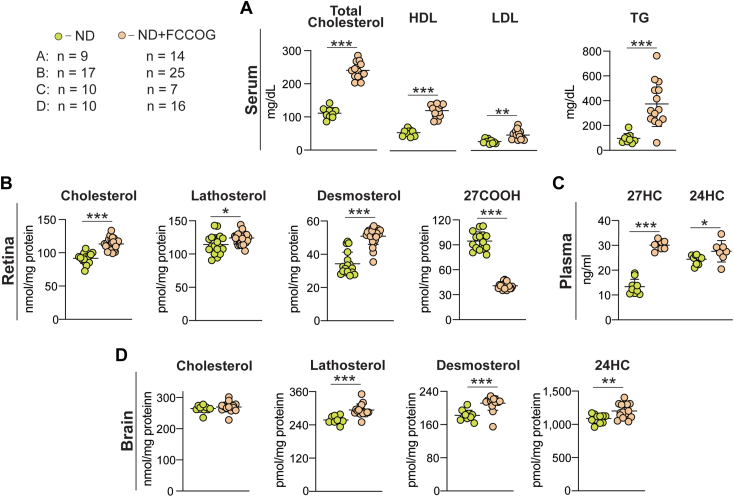
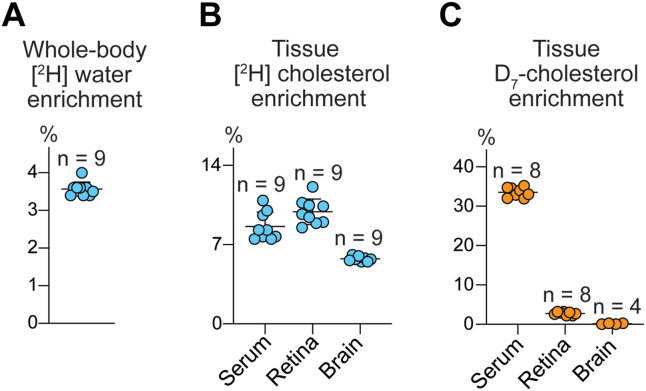
The retina and brain are separated from the systemic circulation by the anatomical barriers, which are permeable (the outer blood-retinal barrier) and impermeable (the blood-brain and inner blood-retina barriers) to cholesterol. Herein we investigated whether whole-body cholesterol maintenance affects cholesterol homeostasis in the retina and brain. We used hamsters, whose whole-body cholesterol handling is more similar to those in humans than in mice, and conducted separate administrations of deuterated water and deuterated cholesterol. We assessed the quantitative significance of the retinal and brain pathways of cholesterol input and compared the results with those from our previous studies in mice. The utility of the measurements in the plasma of deuterated 24-hydroxycholesterol, the major cholesterol elimination product from the brain, was investigated as well. We established that despite a sevenfold higher serum LDL to HDL ratio and other cholesterol-related differences, in situ biosynthesis remained the major source of cholesterol for hamster retina, although its quantitative significance was reduced to 53% as compared to 72%-78% in the mouse retina. In the brain, the principal pathway of cholesterol input was also the same, in situ biosynthesis, accounting for 94% of the total brain cholesterol input (96% in mice); the interspecies differences pertained to the absolute rates of the total cholesterol input and turnover. We documented the correlations between deuterium enrichments of the brain 24-hydroxycholesterol, brain cholesterol, and plasma 24-hydroxycholesterol, which suggested that deuterium enrichment of plasma 24-hydroxycholesteol could be an in vivo marker of cholesterol elimination and turnover in the brain.
视网膜和大脑通过解剖屏障与全身循环分离,这些屏障对胆固醇具有通透性(外血视网膜屏障)和非通透性(血脑和内血视网膜屏障)。在此,我们研究了全身胆固醇维持是否会影响视网膜和大脑中的胆固醇稳态。我们使用了仓鼠,其全身胆固醇处理与人类比与小鼠更相似,并分别进行了氘水和氘胆固醇的给药。我们评估了胆固醇输入的视网膜和脑途径的定量意义,并将结果与我们以前在小鼠中的研究结果进行了比较。我们还研究了血浆中氘代 24-羟胆固醇(大脑中胆固醇主要消除产物)测量的实用性。我们确定,尽管血清 LDL 与 HDL 的比值高 7 倍且存在其他与胆固醇相关的差异,但原位生物合成仍然是仓鼠视网膜胆固醇的主要来源,尽管其定量意义相对于小鼠视网膜中的 72%-78%降至 53%。在大脑中,胆固醇输入的主要途径也是原位生物合成,占总脑胆固醇输入的 94%(小鼠为 96%);种间差异与总胆固醇输入和周转率的绝对速率有关。我们记录了脑 24-羟胆固醇、脑胆固醇和血浆 24-羟胆固醇的氘丰度之间的相关性,这表明血浆 24-羟胆固醇的氘丰度可能是大脑中胆固醇消除和周转率的体内标志物。