Reed Eleanor B, Orbeta Shaina, Miao Bernadette A, Sitikov Albert, Chen Bohao, Levitan Irena, Solway Julian, Mutlu Gökhan M, Fang Yun, Mongin Alexander A, Dulin Nickolai O
Department of Medicine, Section of Pulmonary and Critical Care Medicine, The University of Chicago, Chicago, IL, USA.
Department of Neuroscience & Experimental Therapeutics, Albany Medical College, Albany, NY.
bioRxiv. 2023 Nov 9:2023.06.07.544093. doi: 10.1101/2023.06.07.544093.
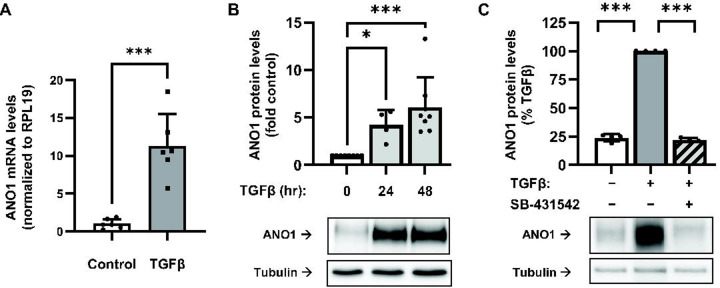
Idiopathic pulmonary fibrosis (IPF) is a devastating disease characterized by progressive scarring of the lungs and resulting in deterioration in lung function. Transforming growth factor-beta (TGF-β) is one of the most established drivers of fibrotic processes. TGF-β promotes transformation of tissue fibroblasts to myofibroblasts, a key finding in the pathogenesis of pulmonary fibrosis. We report here that TGF-β robustly upregulates the expression of the calcium-activated chloride channel Anoctamin-1 (ANO1) in human lung fibroblasts (HLF) at mRNA and protein levels. ANO1 is readily detected in fibrotic areas of IPF lungs in the same area with smooth muscle alpha-actin (SMA)-positive myofibroblasts. TGF-β-induced myofibroblast differentiation (determined by the expression of SMA, collagen-1 and fibronectin) is significantly inhibited by a specific ANO1 inhibitor, T16A-A01, or by siRNA-mediated ANO1 knockdown. T16A-A01 and ANO1 siRNA attenuate pro-fibrotic TGF-β signaling, including activation of RhoA pathway and AKT, without affecting initial Smad2 phosphorylation. Mechanistically, TGF-β treatment of HLF results in a significant increase in intracellular chloride levels, which is prevented by T16A-A01 or by ANO1 knockdown. The downstream mechanism involves the chloride-sensing "with-no-lysine (K)" kinase (WNK1). WNK1 siRNA significantly attenuates TGF-β-induced myofibroblast differentiation and signaling (RhoA pathway and AKT), whereas the WNK1 kinase inhibitor WNK463 is largely ineffective. Together, these data demonstrate that (i) ANO1 is a TGF-β-inducible chloride channel that contributes to increased intracellular chloride concentration in response to TGF-β; and (ii) ANO1 mediates TGF-β-induced myofibroblast differentiation and fibrotic signaling in a manner dependent on WNK1 protein, but independent of WNK1 kinase activity.
特发性肺纤维化(IPF)是一种破坏性疾病,其特征是肺部进行性瘢痕形成并导致肺功能恶化。转化生长因子-β(TGF-β)是纤维化过程中最确定的驱动因素之一。TGF-β促进组织成纤维细胞向肌成纤维细胞转化,这是肺纤维化发病机制中的一个关键发现。我们在此报告,TGF-β在mRNA和蛋白质水平上强烈上调人肺成纤维细胞(HLF)中钙激活氯离子通道Anoctamin-1(ANO1)的表达。在IPF肺的纤维化区域中,ANO1与平滑肌α-肌动蛋白(SMA)阳性的肌成纤维细胞在同一区域很容易被检测到。特异性ANO1抑制剂T16A-A01或siRNA介导的ANO1敲低可显著抑制TGF-β诱导的肌成纤维细胞分化(由SMA、胶原蛋白-1和纤连蛋白的表达决定)。T16A-A01和ANO1 siRNA减弱促纤维化的TGF-β信号传导,包括RhoA途径和AKT的激活,而不影响初始的Smad2磷酸化。从机制上讲,TGF-β处理HLF会导致细胞内氯离子水平显著升高,而T16A-A01或ANO1敲低可阻止这种升高。下游机制涉及氯离子感应的“无赖氨酸(K)”激酶(WNK1)。WNK1 siRNA显著减弱TGF-β诱导的肌成纤维细胞分化和信号传导(RhoA途径和AKT),而WNK1激酶抑制剂WNK463在很大程度上无效。总之,这些数据表明:(i)ANO1是一种TGF-β诱导的氯离子通道,可导致细胞内氯离子浓度因TGF-β而升高;(ii)ANO1以依赖WNK1蛋白但独立于WNK1激酶活性的方式介导TGF-β诱导的肌成纤维细胞分化和纤维化信号传导。