Wilcox Hannah, Carr Charles, Seney Shannon, Reid Gregor, Burton Jeremy P
Department of Microbiology and Immunology, University of Western Ontario, 1151 Richmond St, London, ON N6A 3K7, Canada.
Canadian Centre for Human Microbiome and Probiotics, LHRI, 268 Grosvenor St. London, ON, N6A 4V2 Canada.
FEMS Microbes. 2020 Nov 6;1(1):xtaa007. doi: 10.1093/femsmc/xtaa007. eCollection 2020 Sep.
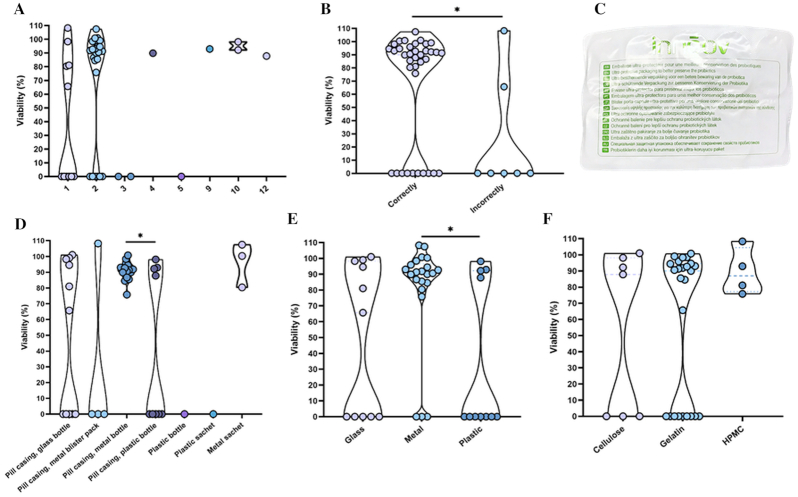
The popularity of using probiotics has surged, since they became widely accepted as safe and help improve general health. Inevitably, some of these products are used after expiration when microbial cell viability is below the recommended effective dose. Given that probiotics must be live microorganisms administered in adequate amounts, the aim of this study was to measure viability in expired products and assess how packaging and storage conditions impact efficacy, if at all. Thirty-three expired probiotic products were evaluated, of which 26 were stored in conditions recommended by the manufacturer. The viable microbial cells were enumerated and representative isolates identified by 16S and internally transcribed spacer rRNA gene sequencing. While the products had a mean past expiration time of 11.32 (1-22) years, 22 still had viable contents, and 5 were within or above the original product cell count claim. Product formulation and the number of species present did not appear to impact the stability of the products. However, overall packaging type, storage conditions and time since expiry were found to affect viability. All products with viable cells had the strain stipulated on the label. Despite some selected probiotic products retaining viability past their expiry date (indicating long-term storage is possible), the total counts were mostly well below that required for efficacious use as recommended by the manufacturer. Consuming expired probiotics may not yield the benefits for which they were designed.
由于益生菌被广泛认为是安全的且有助于改善总体健康状况,其使用的普及程度激增。不可避免地,其中一些产品在过期后仍被使用,此时微生物细胞活力低于推荐的有效剂量。鉴于益生菌必须是足量施用的活微生物,本研究的目的是测量过期产品中的活力,并评估包装和储存条件对功效的影响(如果有影响的话)。对33种过期益生菌产品进行了评估,其中26种是按照制造商推荐的条件储存的。对存活的微生物细胞进行计数,并通过16S和内转录间隔区rRNA基因测序鉴定代表性分离株。虽然这些产品的平均过期时间为11.32(1 - 22)年,但仍有22种产品含有存活成分,5种产品的细胞计数在原始产品声称范围内或以上。产品配方和所含物种数量似乎不会影响产品的稳定性。然而,总体包装类型、储存条件和过期后的时间被发现会影响活力。所有含有存活细胞的产品都含有标签上规定的菌株。尽管一些选定的益生菌产品在过期后仍保持活力(表明可能可以长期储存),但总数大多远低于制造商推荐的有效使用所需数量。食用过期益生菌可能无法产生其预期的益处。