Department of Paediatrics, Yokohama City University Graduate School of Medicine, 3-9 Fukuura, Kanazawa-Ku, Yokohama, Kanagawa, 236-0004, Japan.
Department of Paediatrics, Nagasaki University Hospital, Nagasaki, Japan.
Sci Rep. 2023 Jun 19;13(1):9890. doi: 10.1038/s41598-023-36308-9.
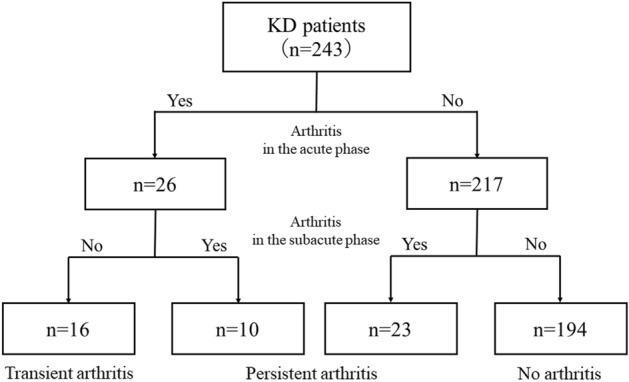
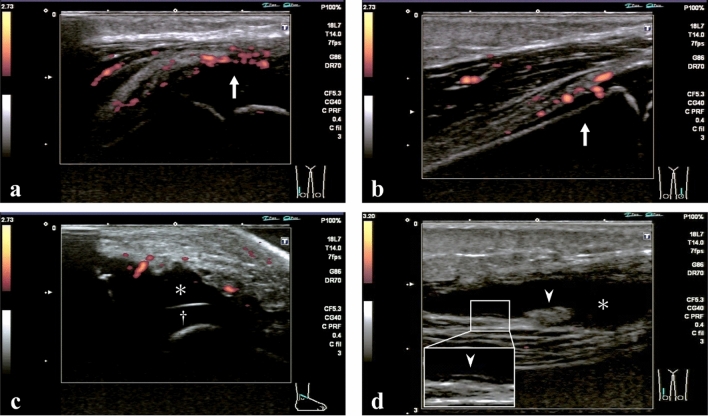
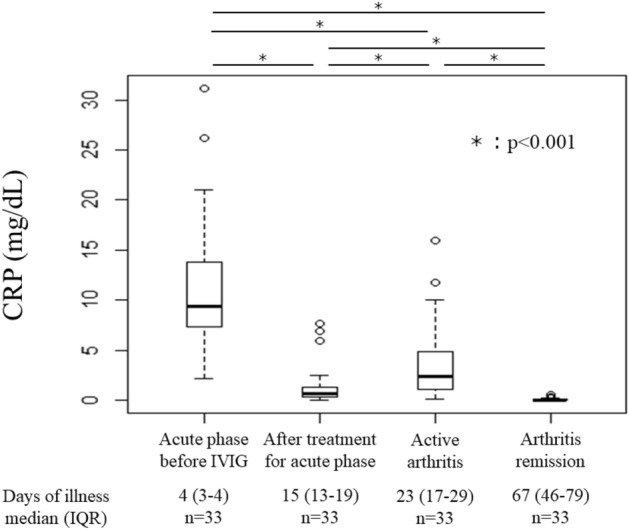
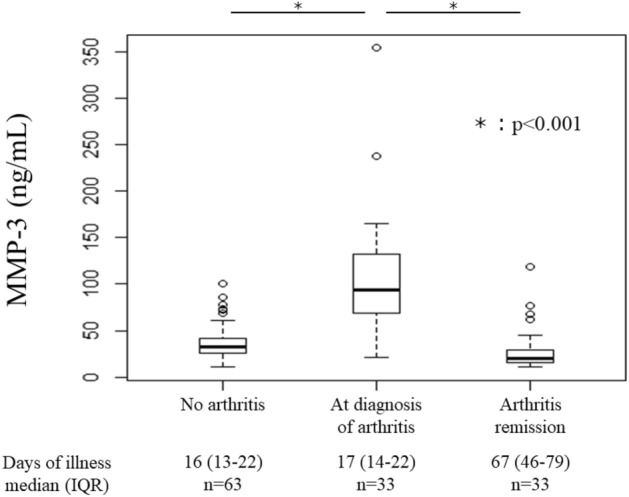
Arthritis is one complication of Kawasaki disease (KD); however, the clinical features of arthritis in KD have not been well clarified. We retrospectively investigated the characteristics of persistent arthritis beyond the subacute phase of KD. In this cohort, 49 of 243 patients (20%) developed arthritis, with 33 patients (14%) experiencing persistent arthritis. Among these 33 patients, 31 (94%) had complete KD. Thirty (91%) were resistant to first intravenous immunoglobulin, and 15 (45%) required additional infliximab. Five patients (15%) developed coronary artery lesions, and 24 (73%) had oligoarthritis, mainly in large lower-extremity joints. Twenty-four patients (73%) complained of arthralgia. At arthritis onset, 16 patients (48%) presented with fever, including recurrent fever in 10 patients. Serum C-reactive protein concentration in patients with active arthritis significantly increased compared with after acute KD treatment (2.4 vs. 0.7 mg/dL, p < 0.001). Serum matrix metalloproteinase-3, a biomarker of arthritis, was significantly higher in patients with active arthritis than in remission (93.7 vs. 20.3 ng/mL, p < 0.001). Thirty (91%) and 14 (42%) patients, respectively, were treated with non-steroidal anti-inflammatory drugs and prednisolone, and they completely recovered. To summarize, persistent arthritis is a common complication in refractory KD, and adequate diagnosis and treatment are necessary.
关节炎是川崎病(KD)的一种并发症;然而,KD 关节炎的临床特征尚未得到充分阐明。我们回顾性调查了 KD 亚急性期后持续性关节炎的特征。在该队列中,243 例患者中有 49 例(20%)发生关节炎,其中 33 例(14%)为持续性关节炎。在这 33 例患者中,31 例(94%)患有完全性 KD。30 例(91%)对首次静脉注射免疫球蛋白耐药,15 例(45%)需要额外使用英夫利昔单抗。5 例(15%)发生冠状动脉病变,24 例(73%)为少关节炎,主要累及大下肢关节。24 例(73%)诉有关节痛。关节炎发作时,16 例(48%)伴有发热,其中 10 例为反复发热。与急性 KD 治疗后相比,活动性关节炎患者的血清 C 反应蛋白浓度显著升高(2.4 比 0.7 mg/dL,p<0.001)。活动性关节炎患者的血清基质金属蛋白酶-3(关节炎的生物标志物)显著高于缓解期(93.7 比 20.3 ng/mL,p<0.001)。分别有 30(91%)和 14(42%)例患者接受非甾体抗炎药和泼尼松龙治疗,他们完全康复。总之,持续性关节炎是难治性 KD 的常见并发症,需要充分诊断和治疗。