• 文献检索
  • 文档翻译
  • 深度研究
  • 学术资讯
  • Suppr Zotero 插件Zotero 插件
  • 邀请有礼
  • 套餐&价格
  • 历史记录
应用&插件
Suppr Zotero 插件Zotero 插件浏览器插件Mac 客户端Windows 客户端微信小程序
定价
高级版会员购买积分包购买API积分包
服务
文献检索文档翻译深度研究API 文档MCP 服务
关于我们
关于 Suppr公司介绍联系我们用户协议隐私条款
关注我们

Suppr 超能文献

核心技术专利:CN118964589B侵权必究
粤ICP备2023148730 号-1Suppr @ 2026

文献检索

告别复杂PubMed语法,用中文像聊天一样搜索,搜遍4000万医学文献。AI智能推荐,让科研检索更轻松。

立即免费搜索

文件翻译

保留排版,准确专业,支持PDF/Word/PPT等文件格式,支持 12+语言互译。

免费翻译文档

深度研究

AI帮你快速写综述,25分钟生成高质量综述,智能提取关键信息,辅助科研写作。

立即免费体验

东非抗菌药物耐药背景下的患者治疗路径研究

Unravelling patient pathways in the context of antibacterial resistance in East Africa.

机构信息

School of Geography and Sustainable Development, University of St. Andrews, St Andrews, KY16 9AL, UK.

Makerere University, Kampala, Uganda.

出版信息

BMC Infect Dis. 2023 Jun 19;23(1):414. doi: 10.1186/s12879-023-08392-9.

DOI:10.1186/s12879-023-08392-9
PMID:37337134
原文链接:https://pmc.ncbi.nlm.nih.gov/articles/PMC10278291/
Abstract

BACKGROUND

A key factor driving the development and maintenance of antibacterial resistance (ABR) is individuals' use of antibiotics (ABs) to treat illness. To better understand motivations and context for antibiotic use we use the concept of a patient treatment-seeking pathway: a treatment journey encompassing where patients go when they are unwell, what motivates their choices, and how they obtain antibiotics. This paper investigates patterns and determinants of patient treatment-seeking pathways, and how they intersect with AB use in East Africa, a region where ABR-attributable deaths are exceptionally high.

METHODS

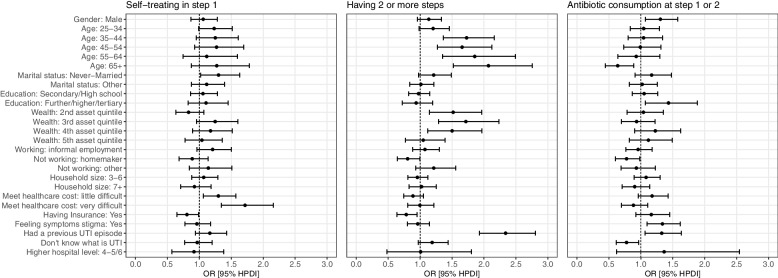
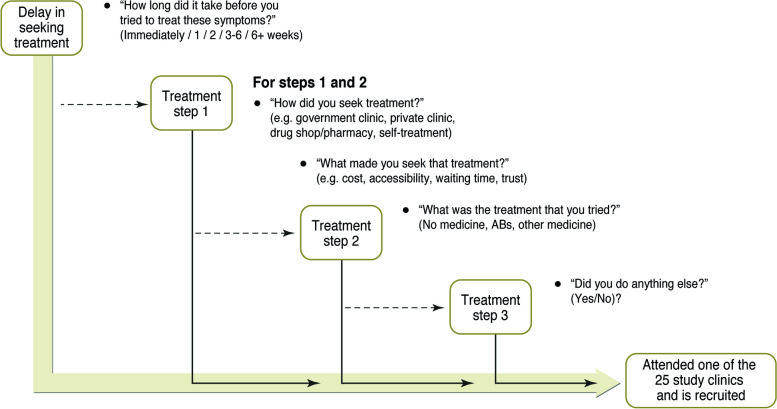
The Holistic Approach to Unravelling Antibacterial Resistance (HATUA) Consortium collected quantitative data from 6,827 adult outpatients presenting with urinary tract infection (UTI) symptoms in Kenya, Tanzania, and Uganda between February 2019- September 2020, and conducted qualitative in-depth patient interviews with a subset (n = 116). We described patterns of treatment-seeking visually using Sankey plots and explored explanations and motivations using mixed-methods. Using Bayesian hierarchical regression modelling, we investigated the associations between socio-demographic, economic, healthcare, and attitudinal factors and three factors related to ABR: self-treatment as a first step, having a multi-step treatment pathway, and consuming ABs.

RESULTS

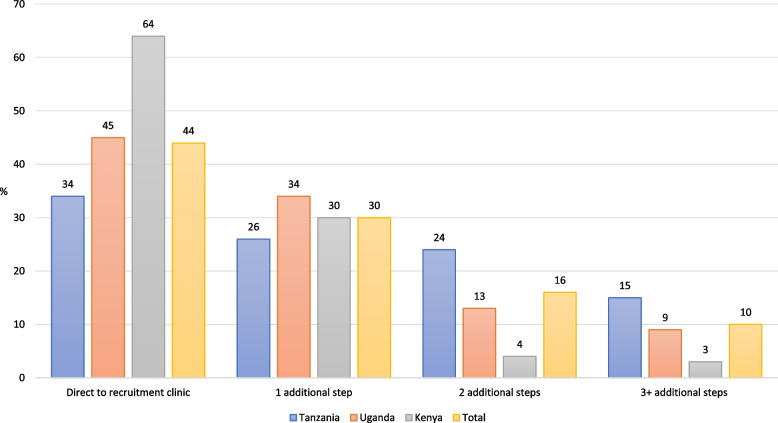
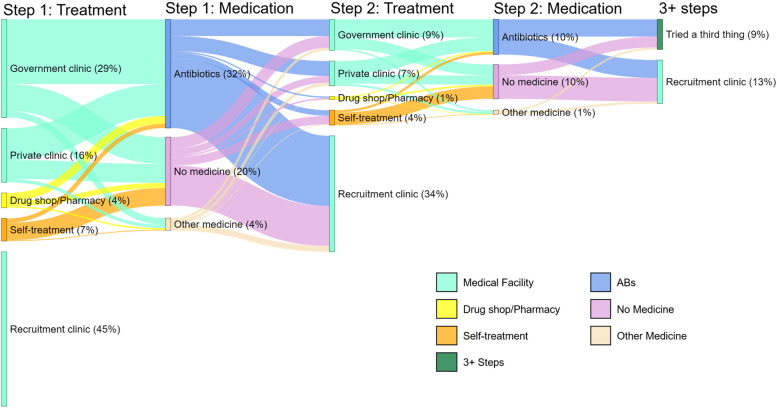
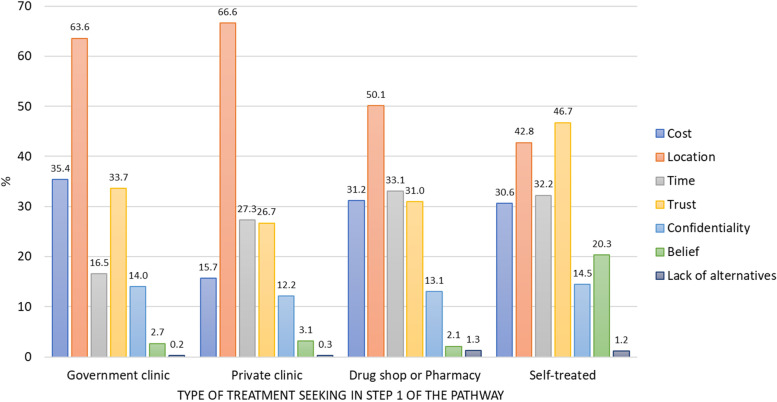
Although most patients (86%) sought help from medical facilities in the first instance, many (56%) described multi-step, repetitive treatment-seeking pathways, which further increased the likelihood of consuming ABs. Higher socio-economic status patients were more likely to consume ABs and have multi-step pathways. Reasons for choosing providers (e.g., cost, location, time) were conditioned by wider structural factors such as hybrid healthcare systems and AB availability.

CONCLUSION

There is likely to be a reinforcing cycle between complex, repetitive treatment pathways, AB consumption and ABR. A focus on individual antibiotic use as the key intervention point in this cycle ignores the contextual challenges patients face when treatment seeking, which include inadequate access to diagnostics, perceived inefficient public healthcare and ease of purchasing antibiotics without prescription. Pluralistic healthcare landscapes may promote more complex treatment seeking and therefore inappropriate AB use. We recommend further attention to healthcare system factors, focussing on medical facilities (e.g., accessible diagnostics, patient-doctor interactions, information flows), and community AB access points (e.g., drug sellers).

摘要

背景

导致抗菌药物耐药性(ABR)产生和持续存在的一个关键因素是个体使用抗生素(ABs)治疗疾病。为了更好地了解抗生素使用的动机和背景,我们采用了患者治疗寻求途径的概念:一种治疗过程,包括患者在不适时去何处、是什么促使他们做出选择以及他们如何获得抗生素。本文研究了东非地区(该地区因 ABR 导致的死亡人数异常高)患者治疗寻求途径的模式和决定因素,以及它们与 AB 使用的关系。

方法

“剖析抗菌药物耐药性的整体方法(HATUA)”联盟于 2019 年 2 月至 2020 年 9 月期间,在肯尼亚、坦桑尼亚和乌干达收集了 6827 名患有尿路感染(UTI)症状的成年门诊患者的定量数据,并对其中一部分(n=116)进行了深入的定性患者访谈。我们使用 Sankey 图直观地描述了治疗寻求模式,并使用混合方法探索了解释和动机。使用贝叶斯分层回归模型,我们调查了社会人口统计学、经济、医疗保健和态度因素与三个与 ABR 相关的因素(作为第一步的自我治疗、多步骤治疗途径和使用 AB)之间的关联。

结果

尽管大多数患者(86%)首先寻求医疗机构的帮助,但许多患者(56%)描述了多步骤、重复的治疗寻求途径,这进一步增加了使用 AB 的可能性。较高社会经济地位的患者更有可能使用 AB 并采用多步骤途径。选择提供者的原因(例如,成本、位置、时间)受到混合医疗体系和 AB 可用性等更广泛的结构性因素的影响。

结论

复杂、重复的治疗途径、AB 消耗和 ABR 之间可能存在强化循环。将重点放在个体抗生素使用作为这一循环中的关键干预点上,忽略了患者在寻求治疗时面临的背景挑战,这些挑战包括诊断不足、对公共医疗保健效率低下的看法以及无需处方购买抗生素的便利性。多元化的医疗保健格局可能会促进更复杂的治疗寻求和因此不适当的 AB 使用。我们建议进一步关注医疗体系因素,重点关注医疗机构(例如,可及的诊断、医患互动、信息流)和社区 AB 接触点(例如,药店)。
https://cdn.ncbi.nlm.nih.gov/pmc/blobs/1911/10278291/abb65f5d2536/12879_2023_8392_Fig5_HTML.jpg
https://cdn.ncbi.nlm.nih.gov/pmc/blobs/1911/10278291/384382e3b028/12879_2023_8392_Fig1_HTML.jpg
https://cdn.ncbi.nlm.nih.gov/pmc/blobs/1911/10278291/d53ed69f7b8c/12879_2023_8392_Fig2_HTML.jpg
https://cdn.ncbi.nlm.nih.gov/pmc/blobs/1911/10278291/6434de6bda09/12879_2023_8392_Fig3_HTML.jpg
https://cdn.ncbi.nlm.nih.gov/pmc/blobs/1911/10278291/eb1de41e0a4b/12879_2023_8392_Fig4_HTML.jpg
https://cdn.ncbi.nlm.nih.gov/pmc/blobs/1911/10278291/abb65f5d2536/12879_2023_8392_Fig5_HTML.jpg
https://cdn.ncbi.nlm.nih.gov/pmc/blobs/1911/10278291/384382e3b028/12879_2023_8392_Fig1_HTML.jpg
https://cdn.ncbi.nlm.nih.gov/pmc/blobs/1911/10278291/d53ed69f7b8c/12879_2023_8392_Fig2_HTML.jpg
https://cdn.ncbi.nlm.nih.gov/pmc/blobs/1911/10278291/6434de6bda09/12879_2023_8392_Fig3_HTML.jpg
https://cdn.ncbi.nlm.nih.gov/pmc/blobs/1911/10278291/eb1de41e0a4b/12879_2023_8392_Fig4_HTML.jpg
https://cdn.ncbi.nlm.nih.gov/pmc/blobs/1911/10278291/abb65f5d2536/12879_2023_8392_Fig5_HTML.jpg

相似文献

1
Unravelling patient pathways in the context of antibacterial resistance in East Africa.东非抗菌药物耐药背景下的患者治疗路径研究
BMC Infect Dis. 2023 Jun 19;23(1):414. doi: 10.1186/s12879-023-08392-9.
2
Treatment seeking behaviours, antibiotic use and relationships to multi-drug resistance: A study of urinary tract infection patients in Kenya, Tanzania and Uganda.就医行为、抗生素使用及其与多重耐药性的关系:肯尼亚、坦桑尼亚和乌干达尿路感染患者的研究
medRxiv. 2023 Mar 20:2023.03.04.23286801. doi: 10.1101/2023.03.04.23286801.
3
Treatment seeking behaviours, antibiotic use and relationships to multi-drug resistance: A study of urinary tract infection patients in Kenya, Tanzania and Uganda.寻求治疗行为、抗生素使用及其与多重耐药性的关系:肯尼亚、坦桑尼亚和乌干达尿路感染患者的研究
PLOS Glob Public Health. 2024 Feb 16;4(2):e0002709. doi: 10.1371/journal.pgph.0002709. eCollection 2024.
4
Protocol for an interdisciplinary cross-sectional study investigating the social, biological and community-level drivers of antimicrobial resistance (AMR): Holistic Approach to Unravel Antibacterial Resistance in East Africa (HATUA).一项跨学科横断面研究的方案,旨在调查抗生素耐药性(AMR)的社会、生物和社区层面驱动因素:东非抗菌药物耐药性研究的整体方法(HATUA)。
BMJ Open. 2021 Mar 8;11(3):e041418. doi: 10.1136/bmjopen-2020-041418.
5
The role of multidimensional poverty in antibiotic misuse: a mixed-methods study of self-medication and non-adherence in Kenya, Tanzania, and Uganda.多维贫困在抗生素滥用中的作用:肯尼亚、坦桑尼亚和乌干达自我用药和不遵医嘱的混合方法研究。
Lancet Glob Health. 2023 Jan;11(1):e59-e68. doi: 10.1016/S2214-109X(22)00423-5.
6
Intersecting social and environmental determinants of multidrug-resistant urinary tract infections in East Africa beyond antibiotic use.东非地区除抗生素使用外,多重耐药性尿路感染的社会和环境决定因素的交集。
Nat Commun. 2024 Oct 31;15(1):9418. doi: 10.1038/s41467-024-53253-x.
7
Treatment seeking and antibiotic use for urinary tract infection symptoms in the time of COVID-19 in Tanzania and Uganda.坦桑尼亚和乌干达在 COVID-19 期间治疗尿路症状和抗生素使用情况。
J Glob Health. 2024 Jan 19;14:05007. doi: 10.7189/jogh.14.05007.
8
'The disease isn't listening to the drug': The socio-cultural context of antibiotic use for viral respiratory infections in rural Uganda.“疾病不听从药物”:乌干达农村地区病毒性呼吸道感染抗生素使用的社会文化背景。
Glob Public Health. 2019 May;14(5):750-763. doi: 10.1080/17441692.2018.1542017. Epub 2018 Nov 8.
9
A qualitative inquiry of access to and quality of primary healthcare in seven communities in East and West Africa (SevenCEWA): perspectives of stakeholders, healthcare providers and users.东非和西非七个社区获得和提供初级卫生保健的质量的定性研究(SevenCEWA):利益相关者、卫生保健提供者和使用者的观点。
BMC Fam Pract. 2021 Feb 25;22(1):45. doi: 10.1186/s12875-021-01394-z.
10
Drivers of inappropriate use of antibiotics among community members in low- and middle-income countries: a systematic review of qualitative studies.低收入和中等收入国家社区成员抗生素使用不当的驱动因素:定性研究的系统评价
BMC Public Health. 2025 Feb 20;25(1):705. doi: 10.1186/s12889-025-21553-6.

引用本文的文献

1
Exploring the association between multi-dimensional poverty and antibiotic resistance: findings from a mixed-methods study in Pakistan.探索多维贫困与抗生素耐药性之间的关联:巴基斯坦一项混合方法研究的结果
Lancet Reg Health Southeast Asia. 2025 Aug 27;41:100656. doi: 10.1016/j.lansea.2025.100656. eCollection 2025 Oct.
2
A methodological review of patient healthcare-seeking journeys from symptom onset to receipt of care.对患者从症状出现到接受治疗的就医过程的方法学综述。
BMJ Glob Health. 2025 May 16;10(5):e016978. doi: 10.1136/bmjgh-2024-016978.
3
The social burden of antimicrobial resistance: what is it, how can we measure it, and why does it matter?

本文引用的文献

1
The feasibility analysis of integrating community-based health insurance schemes into the national health insurance scheme in Uganda.乌干达将社区医疗保险计划融入国家医疗保险计划的可行性分析。
PLoS One. 2023 Apr 14;18(4):e0284246. doi: 10.1371/journal.pone.0284246. eCollection 2023.
2
Antibiotic dispensing practices during COVID-19 and implications for antimicrobial resistance (AMR): parallel mystery client studies in Uganda and Tanzania.新冠疫情期间的抗生素配药做法及其对抗微生物药物耐药性(AMR)的影响:乌干达和坦桑尼亚的平行神秘客户研究。
Antimicrob Resist Infect Control. 2023 Feb 11;12(1):10. doi: 10.1186/s13756-022-01199-4.
3
抗菌素耐药性的社会负担:它是什么,我们如何衡量它,以及为何它至关重要?
JAC Antimicrob Resist. 2025 Mar 10;7(2):dlae208. doi: 10.1093/jacamr/dlae208. eCollection 2025 Apr.
4
Intersecting social and environmental determinants of multidrug-resistant urinary tract infections in East Africa beyond antibiotic use.东非地区除抗生素使用外,多重耐药性尿路感染的社会和环境决定因素的交集。
Nat Commun. 2024 Oct 31;15(1):9418. doi: 10.1038/s41467-024-53253-x.
5
Healthcare as a driver, reservoir and amplifier of antimicrobial resistance: opportunities for interventions.医疗保健是抗菌药物耐药性的驱动因素、储存库和放大器:干预的机会。
Nat Rev Microbiol. 2024 Oct;22(10):636-649. doi: 10.1038/s41579-024-01076-4. Epub 2024 Jul 24.
6
"Arming half-baked people with weapons!" Information enclaving among professionals and the need for a care-centred model for antibiotic use information in Uganda, Tanzania and Malawi.“武装半吊子的人!” 乌干达、坦桑尼亚和马拉维专业人员之间的信息隔离以及对抗生素使用信息采取以关怀为中心模式的必要性。
Glob Health Action. 2024 Dec 31;17(1):2322839. doi: 10.1080/16549716.2024.2322839. Epub 2024 Mar 5.
7
Predominance of multidrug-resistant bacteria causing urinary tract infections among symptomatic patients in East Africa: a call for action.东非有症状患者中引起尿路感染的多重耐药菌占主导地位:呼吁采取行动。
JAC Antimicrob Resist. 2024 Feb 14;6(1):dlae019. doi: 10.1093/jacamr/dlae019. eCollection 2024 Feb.
8
Treatment seeking behaviours, antibiotic use and relationships to multi-drug resistance: A study of urinary tract infection patients in Kenya, Tanzania and Uganda.寻求治疗行为、抗生素使用及其与多重耐药性的关系:肯尼亚、坦桑尼亚和乌干达尿路感染患者的研究
PLOS Glob Public Health. 2024 Feb 16;4(2):e0002709. doi: 10.1371/journal.pgph.0002709. eCollection 2024.
9
Treatment seeking and antibiotic use for urinary tract infection symptoms in the time of COVID-19 in Tanzania and Uganda.坦桑尼亚和乌干达在 COVID-19 期间治疗尿路症状和抗生素使用情况。
J Glob Health. 2024 Jan 19;14:05007. doi: 10.7189/jogh.14.05007.
10
A Narrative Review of Recent Antibiotic Prescribing Practices in Ambulatory Care in Tanzania: Findings and Implications.坦桑尼亚门诊护理中近期抗生素处方实践的叙述性综述:发现与启示
Medicina (Kaunas). 2023 Dec 18;59(12):2195. doi: 10.3390/medicina59122195.
The role of multidimensional poverty in antibiotic misuse: a mixed-methods study of self-medication and non-adherence in Kenya, Tanzania, and Uganda.
多维贫困在抗生素滥用中的作用:肯尼亚、坦桑尼亚和乌干达自我用药和不遵医嘱的混合方法研究。
Lancet Glob Health. 2023 Jan;11(1):e59-e68. doi: 10.1016/S2214-109X(22)00423-5.
4
Experiences of urinary tract infection: A systematic review and meta-ethnography.尿路感染的经历:一项系统综述与元民族志研究
Neurourol Urodyn. 2022 Mar;41(3):724-739. doi: 10.1002/nau.24884. Epub 2022 Feb 3.
5
Global burden of bacterial antimicrobial resistance in 2019: a systematic analysis.2019 年全球细菌对抗菌药物耐药性的负担:系统分析。
Lancet. 2022 Feb 12;399(10325):629-655. doi: 10.1016/S0140-6736(21)02724-0. Epub 2022 Jan 19.
6
Antibiotic stories: a mixed-methods, multi-country analysis of household antibiotic use in Malawi, Uganda and Zimbabwe.抗生素故事:马拉维、乌干达和津巴布韦三国家庭抗生素使用的混合方法、多国分析。
BMJ Glob Health. 2021 Nov;6(11). doi: 10.1136/bmjgh-2021-006920.
7
Availability of essential diagnostics in ten low-income and middle-income countries: results from national health facility surveys.十个低收入和中等收入国家基本诊断服务的可及性:国家卫生机构调查结果
Lancet Glob Health. 2021 Nov;9(11):e1553-e1560. doi: 10.1016/S2214-109X(21)00442-3. Epub 2021 Oct 6.
8
Understanding antibiotic use: practices, structures and networks.了解抗生素使用情况:实践、结构与网络
JAC Antimicrob Resist. 2021 Oct 4;3(4):dlab150. doi: 10.1093/jacamr/dlab150. eCollection 2021 Dec.
9
Optimising antimicrobial use in humans - review of current evidence and an interdisciplinary consensus on key priorities for research.优化人类抗菌药物使用——当前证据综述及研究重点的跨学科共识
Lancet Reg Health Eur. 2021 Jun 29;7:100161. doi: 10.1016/j.lanepe.2021.100161. eCollection 2021 Aug.
10
Dispensing Antibiotics without Prescription at Community Pharmacies and Accredited Drug Dispensing Outlets in Tanzania: A Cross-Sectional Study.坦桑尼亚社区药房和经认可的药品零售点无处方配药情况:一项横断面研究
Antibiotics (Basel). 2021 Aug 23;10(8):1025. doi: 10.3390/antibiotics10081025.