
新冠病毒感染后出现呼吸困难的幸存者的运动反应和心理健康症状
Exercise responses and mental health symptoms in COVID-19 survivors with dyspnoea.
作者信息
Milne Kathryn M, Cowan Juthaporn, Schaeffer Michele R, Voduc Nha, Corrales-Medina Vicente, Lavoie Kim L, Chirinos Julio A, Puyat Joseph H, Abdallah Sara J, Guenette Jordan A
机构信息
Centre for Heart Lung Innovation, The University of British Columbia and Providence Research, St Paul's Hospital, Vancouver, BC, Canada.
Division of Respiratory Medicine, The University of British Columbia, Vancouver, BC, Canada.
出版信息
ERJ Open Res. 2023 Jun 19;9(3). doi: 10.1183/23120541.00606-2022. eCollection 2023 May.
OBJECTIVES
Dyspnoea is a common persistent symptom post-coronavirus disease 2019 (COVID-19) illness. However, the mechanisms underlying dyspnoea in the post-COVID-19 syndrome remain unclear. The aim of our study was to examine dyspnoea quality and intensity, burden of mental health symptoms, and differences in exercise responses in people with and without persistent dyspnoea following COVID-19.
METHODS
49 participants with mild-to-critical COVID-19 were included in this cross-sectional study 4 months after acute illness. Between-group comparisons were made in those with and without persistent dyspnoea (defined as modified Medical Research Council dyspnoea score ≥1). Participants completed standardised dyspnoea and mental health symptom questionnaires, pulmonary function tests, and incremental cardiopulmonary exercise testing.
RESULTS
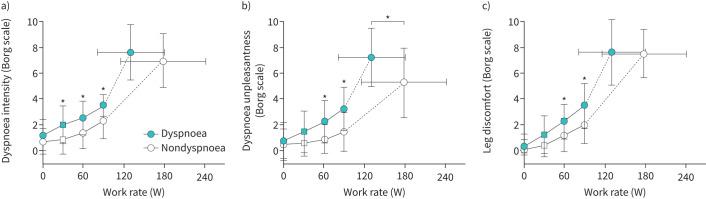
Exertional dyspnoea intensity and unpleasantness were increased in the dyspnoea group. The dyspnoea group described dyspnoea qualities of suffocating and tightness at peak exercise (p<0.05). Ventilatory equivalent for carbon dioxide ('/') nadir was higher (32±5 28±3, p<0.001) and anaerobic threshold was lower (41±12 49±11% predicted maximum oxygen uptake, p=0.04) in the dyspnoea group, indicating ventilatory inefficiency and deconditioning in this group. The dyspnoea group experienced greater symptoms of anxiety, depression and post-traumatic stress (all p<0.05). A subset of participants demonstrated gas-exchange and breathing pattern abnormalities suggestive of dysfunctional breathing.
CONCLUSIONS
People with persistent dyspnoea following COVID-19 experience a specific dyspnoea quality phenotype. Dyspnoea post-COVID-19 is related to abnormal pulmonary gas exchange and deconditioning and is linked to increased symptoms of anxiety, depression and post-traumatic stress.
目的
呼吸困难是2019冠状病毒病(COVID-19)后常见的持续症状。然而,COVID-19后综合征中呼吸困难的潜在机制仍不清楚。我们研究的目的是检查COVID-19后有持续性呼吸困难和无持续性呼吸困难的人群在呼吸困难的性质和强度、心理健康症状负担以及运动反应方面的差异。
方法
49名患有轻至重症COVID-19的参与者在急性疾病4个月后纳入了这项横断面研究。对有和无持续性呼吸困难(定义为改良医学研究委员会呼吸困难评分≥1)的参与者进行组间比较。参与者完成标准化的呼吸困难和心理健康症状问卷、肺功能测试以及递增式心肺运动测试。
结果
呼吸困难组的运动性呼吸困难强度和不适感增加。呼吸困难组描述在运动峰值时呼吸困难的性质为窒息感和紧绷感(p<0.05)。呼吸困难组的二氧化碳通气当量(升/分)最低点更高(32±5对28±3,p<0.001),无氧阈值更低(41±12对49±11%预计最大摄氧量,p=0.04),表明该组通气效率低下和身体机能下降。呼吸困难组出现更严重的焦虑、抑郁和创伤后应激症状(均p<0.05)。一部分参与者表现出气体交换和呼吸模式异常,提示存在功能失调性呼吸。
结论
COVID-19后有持续性呼吸困难的人群经历了特定的呼吸困难性质表型。COVID-19后的呼吸困难与异常的肺气体交换和身体机能下降有关,并且与焦虑、抑郁和创伤后应激症状增加有关。



 Zotero 插件