Department of Orthopaedic Surgery, Chang Gung Memorial Hospital, Linkou Medical Center, No. 5, Fusing St., Gueishan Dist., Taoyuan City, 333423, Taiwan (ROC).
Bone and Joint Research Center, Chang Gung Memorial Hospital, Linkou Medical Center, Taoyuan City, Taiwan (ROC).
Arch Orthop Trauma Surg. 2023 Oct;143(10):6209-6217. doi: 10.1007/s00402-023-04953-4. Epub 2023 Jun 22.
Varus collapse followed by osteosynthesis for distal femoral fractures with conventional implants has been well documented but is seldom mentioned in fractures managed with locking plates. The purpose of this study was to assess the incidence of varus collapse after treating complex supra-intercondylar fractures of the distal femur (AO type C3) using a Single Plate (SP) or Double Plate (DP) fixation technique.
We retrospectively reviewed 357 patients with distal femoral fractures who were treated at our hospital between 2006 and 2017. After excluding cases of infection, malignancy, periprosthetic fracture, revision surgery, pediatric fracture, and extra-articular fracture, 54 patients were included in the study. All demographic data and radiological and clinical outcomes were reviewed and analyzed.
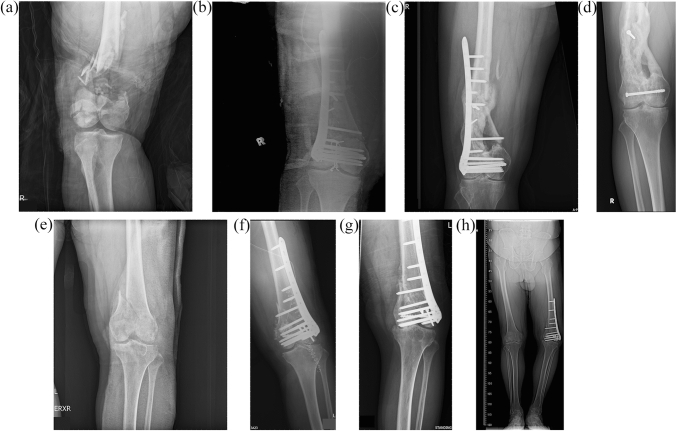
There were 54 patients enrolled into this study with age from 15 to 85 years old (mean 41.6, SD = 19.9), and 32 of them were open fractures (59%). The patients were further divided into either an SP (n = 15) or a DP group (n = 39). Demographics, including age, sex, injury severity score, and open fracture type, were all compatible between the two groups. The overall nonunion rate was 25.9% (n = 14; 6 from the SP and 8 from the DP group; p = 0.175). The varus collapse rate was 9.3% (n = 5; 4 from the SP and 1 from the DP group (p = 0.018).
The varus collapse rate after osteosynthesis with a single lateral locking plate could be as high as 26.7% in AO type C3 fractures of the distal femur, which would be decreased to 2.6% by adding a medial buttress plate. Surgeons should consider DP fixation to avoid varus collapse in severely comminuted complete intra-articular fractures of the distal femur.
使用传统植入物治疗股骨远端骨折的内翻塌陷和接骨术已有充分的文献记载,但在使用锁定板治疗骨折时很少提及。本研究的目的是评估使用单钢板(SP)或双钢板(DP)固定技术治疗复杂的股骨远端髁上骨折(AO 分型 C3)后内翻塌陷的发生率。
我们回顾性分析了 2006 年至 2017 年在我院治疗的 357 例股骨远端骨折患者。排除感染、恶性肿瘤、假体周围骨折、翻修手术、儿童骨折和关节外骨折后,共纳入 54 例患者进行研究。回顾和分析所有患者的人口统计学数据、影像学和临床结果。
本研究共纳入 54 例患者,年龄 15 至 85 岁(平均 41.6,标准差 19.9),其中 32 例为开放性骨折(59%)。患者进一步分为 SP 组(n=15)和 DP 组(n=39)。两组患者的年龄、性别、损伤严重程度评分和开放性骨折类型均无统计学差异。总的骨不连率为 25.9%(n=14;6 例来自 SP 组,8 例来自 DP 组;p=0.175)。内翻塌陷率为 9.3%(n=5;4 例来自 SP 组,1 例来自 DP 组;p=0.018)。
在 AO 分型 C3 型股骨远端骨折中,使用单外侧锁定钢板进行接骨术的内翻塌陷率高达 26.7%,而通过添加内侧支撑钢板,塌陷率可降低至 2.6%。对于严重粉碎性完全关节内股骨远端骨折,外科医生应考虑 DP 固定以避免内翻塌陷。