Department of Epidemiology and Preventive Medicine, School of Public Health and Preventive Medicine, Faculty of Medicine, Nursing and Health Sciences, Monash University, Melbourne, Australia.
Research Center for Child Mental Development, Hamamatsu University School of Medicine, Hamamatsu, Japan.
Sci Rep. 2023 Jun 22;13(1):10183. doi: 10.1038/s41598-023-36048-w.
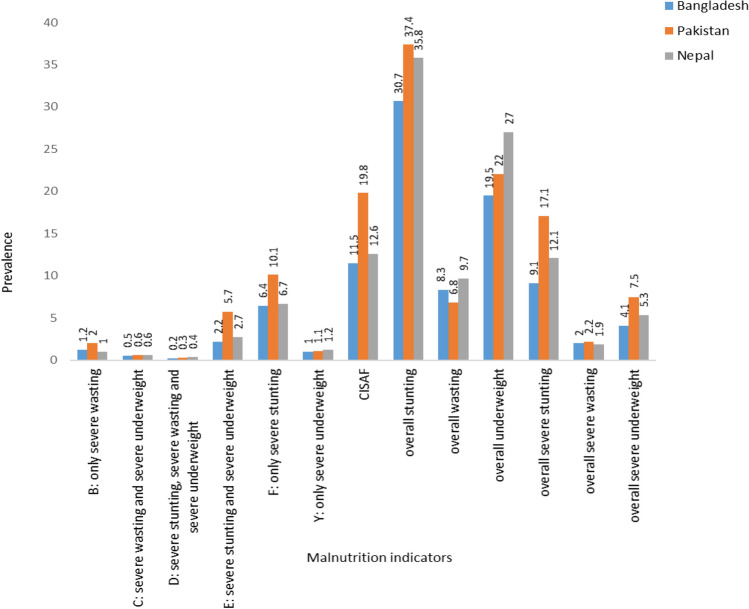
Despite economic growth and poverty reduction, under-5 child undernutrition is still rampant in South Asian countries. This study explored the prevalence and risk factors of severe undernutrition among under-5 children in Bangladesh, Pakistan, and Nepal for comparison using the Composite Index of Severe Anthropometric Failure. We utilised information on under-5 children from recent Demographic Health Surveys. We used multilevel logistic regression models for data analysis. The prevalence of severe undernutrition among under-5 children was around 11.5%, 19.8%, and 12.6% in Bangladesh, Pakistan, and Nepal, respectively. Children from the lowest socioeconomic quintile, and children born with low birth weight were key factors associated with severe undernutrition in these countries. The factors, parental education, maternal nutritional status, antenatal and postnatal care, and birth order were not homogeneous in explaining the determinants of child severe undernutrition across the countries. Our results suggest that the poorest households, and low birth weight of children have significant effects on severe undernutrition among under-5 children in these countries, which should be considered to formulate an evidence-based strategy to reduce severe undernutrition in South Asia.
尽管经济增长和减贫取得了进展,但南亚国家 5 岁以下儿童的营养不足问题仍然很严重。本研究使用严重营养不良综合指标,比较了孟加拉国、巴基斯坦和尼泊尔 5 岁以下儿童严重营养不良的流行情况和危险因素。我们利用了最近的人口健康调查中有关 5 岁以下儿童的数据。我们使用多水平逻辑回归模型进行数据分析。孟加拉国、巴基斯坦和尼泊尔 5 岁以下儿童严重营养不良的患病率分别约为 11.5%、19.8%和 12.6%。来自社会经济地位最低五分位数的儿童和出生体重较低的儿童是这些国家严重营养不良的主要相关因素。在解释这些国家儿童严重营养不良的决定因素方面,父母教育、母亲营养状况、产前和产后护理以及出生顺序等因素并不相同。研究结果表明,最贫困家庭和儿童低出生体重对这些国家 5 岁以下儿童严重营养不良有重大影响,在制定基于证据的战略以减少南亚严重营养不良问题时应予以考虑。