Memorial Sloan Kettering Cancer Center, 1275 York Avenue, New York, NY, 10065, USA.
Department of Thoracic Oncology, Airway Research Center North, German Center for Lung Research, LungenClinic Grosshansdorf, Grosshansdorf, Germany.
J Hematol Oncol. 2023 Jun 24;16(1):66. doi: 10.1186/s13045-023-01464-y.
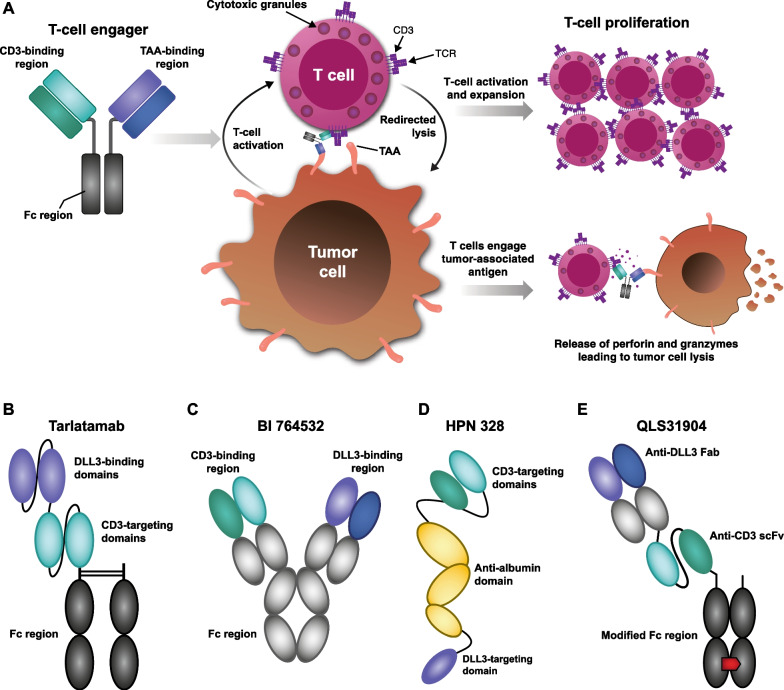
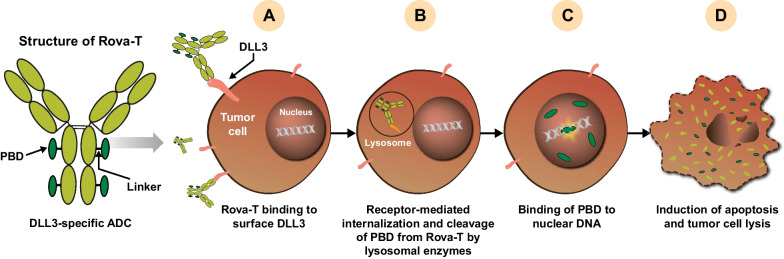
Small cell lung cancer (SCLC) is an aggressive neuroendocrine carcinoma with a poor prognosis. Initial responses to standard-of-care chemo-immunotherapy are, unfortunately, followed by rapid disease recurrence in most patients. Current treatment options are limited, with no therapies specifically approved as third-line or beyond. Delta-like ligand 3 (DLL3), a Notch inhibitory ligand, is an attractive therapeutic target because it is overexpressed on the surface of SCLC cells with minimal to no expression on normal cells. Several DLL3-targeted therapies are being developed for the treatment of SCLC and other neuroendocrine carcinomas, including antibody-drug conjugates (ADCs), T-cell engager (TCE) molecules, and chimeric antigen receptor (CAR) therapies. First, we discuss the clinical experience with rovalpituzumab tesirine (Rova-T), a DLL3-targeting ADC, the development of which was halted due to a lack of efficacy in phase 3 studies, with a view to understanding the lessons that can be garnered for the rapidly evolving therapeutic landscape in SCLC. We then review preclinical and clinical data for several DLL3-targeting agents that are currently in development, including the TCE molecules-tarlatamab (formerly known as AMG 757), BI 764532, and HPN328-and the CAR T-cell therapy AMG 119. We conclude with a discussion of the future challenges and opportunities for DLL3-targeting therapies, including the utility of DLL3 as a biomarker for patient selection and disease progression, and the potential of rational combinatorial approaches that can enhance efficacy.
小细胞肺癌(SCLC)是一种侵袭性神经内分泌癌,预后较差。不幸的是,大多数患者在接受标准护理化疗免疫治疗后,最初会有反应,但随后疾病会迅速复发。目前的治疗选择有限,没有专门批准用于三线或以上治疗的疗法。Delta-like 配体 3(DLL3)是一种 Notch 抑制配体,是一种有吸引力的治疗靶点,因为它在 SCLC 细胞表面过度表达,而在正常细胞中几乎没有表达。目前正在开发几种针对 SCLC 和其他神经内分泌癌的 DLL3 靶向疗法,包括抗体药物偶联物(ADC)、T 细胞衔接器(TCE)分子和嵌合抗原受体(CAR)疗法。首先,我们讨论了 DLL3 靶向 ADC 药物 rovalpituzumab tesirine(Rova-T)的临床经验,由于在 3 期研究中缺乏疗效,该药物的开发已停止,以期了解在 SCLC 快速发展的治疗领域中可以吸取的教训。然后,我们回顾了目前正在开发的几种 DLL3 靶向药物的临床前和临床数据,包括 TCE 分子-tarlatamab(以前称为 AMG 757)、BI 764532 和 HPN328,以及 CAR T 细胞疗法 AMG 119。最后,我们讨论了 DLL3 靶向疗法的未来挑战和机遇,包括 DLL3 作为患者选择和疾病进展的生物标志物的效用,以及可以提高疗效的合理组合方法的潜力。