Norwegian Institute for Nature Research, Torgarden, PO Box 5685, 7485, Trondheim, Norway.
Department of Zoology, University of Otago, PO Box 56, Dunedin, 9054, New Zealand.
Oecologia. 2024 Feb;204(2):377-387. doi: 10.1007/s00442-023-05408-8. Epub 2023 Jun 26.
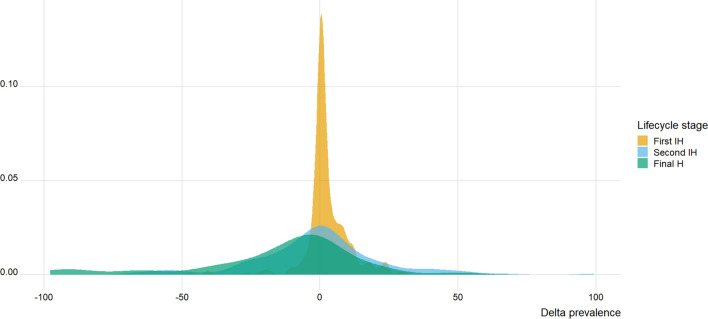
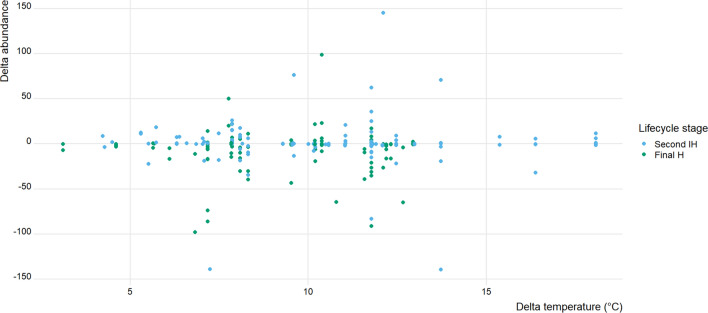
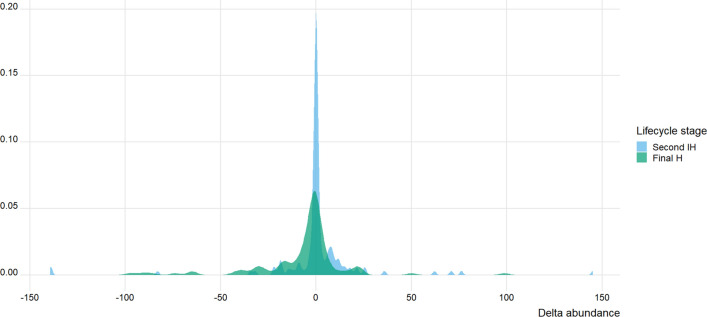
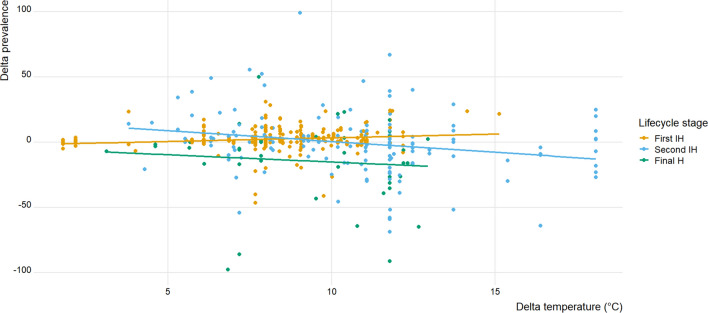
Seasonal changes in environmental conditions drive phenology, i.e., the annual timing of biological events ranging from the individual to the ecosystem. Phenological patterns and successional abundance cycles have been particularly well studied in temperate freshwater systems, showing strong and predictable synchrony with seasonal changes. However, seasonal successional changes in the abundance of parasites or their infection levels in aquatic hosts have not yet been shown to follow universal patterns. Here, using a compilation of several hundred estimates of spring-to-summer changes in infection by trematodes in their intermediate and definitive hosts, spanning multiple species and habitats, we test for general patterns of seasonal (temperature) driven changes in infection levels. The data include almost as many decreases in infection levels from spring to summer as there are increases, across different host types. Our results reveal that the magnitude of the spring-to-summer change in temperature had a weak positive effect on the concurrent change in prevalence of infection in first intermediate hosts, but no effect on the change in prevalence or abundance of infection in second intermediate or definitive hosts. This was true across habitat types and host taxa, indicating no universal effect of seasonal temperature increase on trematode infections. This surprising variation across systems suggests a predominance of idiosyncratic and species-specific responses in trematode infection levels, at odds with any clear phenological or successional pattern. We discuss possible reasons for the minimal and variable effect of seasonal temperature regimes, and emphasise the challenges this poses for predicting ecosystem responses to future climate change.
季节环境条件的变化驱动着物候学,即生物事件的年度时间安排,从个体到生态系统不等。物候模式和演替丰度循环在温带淡水系统中得到了特别深入的研究,它们与季节变化具有强烈而可预测的同步性。然而,水生宿主中寄生虫的丰度或其感染水平的季节性演替变化尚未显示出遵循普遍模式。在这里,我们使用了数百个关于吸虫在其中间宿主和终末宿主中从春季到夏季感染水平变化的估计值的汇编,涵盖了多个物种和生境,以检验感染水平随季节性(温度)变化的一般模式。这些数据包括在不同宿主类型中,从春季到夏季感染水平下降的次数几乎与增加的次数一样多。我们的结果表明,春季到夏季温度变化的幅度对第一中间宿主感染流行率的同期变化有微弱的正向影响,但对第二中间宿主或终末宿主的感染流行率或丰度变化没有影响。这在不同的生境类型和宿主分类群中都是如此,表明季节性温度升高对吸虫感染没有普遍影响。这种跨系统的惊人变化表明,吸虫感染水平的特异性和物种特异性反应占主导地位,与任何明显的物候或演替模式不一致。我们讨论了季节性温度变化的最小和可变影响的可能原因,并强调了这对预测未来气候变化对生态系统的影响所带来的挑战。