Pesterfield Christopher, Rogerson Michael
University of Bristol, Howard House, Queens Avenue, BS8 1SD Bristol, UK.
Surrey Business School, University Of Surrey, Alexander Fleming Rd, Guildford, GU2 7XH UK.
J Bus Ethics. 2023 Jun 7:1-17. doi: 10.1007/s10551-023-05455-4.
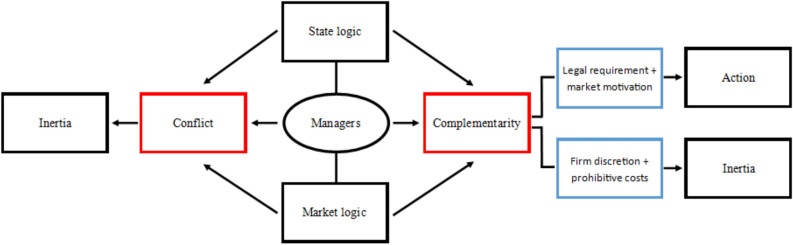
There is a growing understanding that modern slavery is a phenomenon 'hidden in plain sight' in the home countries of multinational firms. Yet, business scholarship on modern slavery has so far focussed on product supply chains. To address this, we direct attention to the various institutional pressures on the UK construction industry, and managers of firms within it, around modern slavery risk for on-site labour. Based on a unique data set of 30 in-depth interviews with construction firm managers and directors, we identify two institutional logics as being integral to explaining how these companies have responded to the Modern Slavery Act: a market logic and a state logic. While the institutional logics literature largely assumes that institutional complexity will lead to a conciliation of multiple logics, we find both complementarity and continued conflict in the logics in our study. Though we identify conciliation between aspects of the market logic and the state logic, conflict remains as engagement with actions which could potentially address modern slavery is limited by the trade-offs between the two logics.
人们越来越认识到,现代奴隶制是一种在跨国公司母国“显而易见却又被忽视”的现象。然而,迄今为止,关于现代奴隶制的商业学术研究主要集中在产品供应链上。为了解决这一问题,我们将注意力转向英国建筑业及其内部企业的管理者所面临的各种制度压力,这些压力围绕着现场劳动力的现代奴隶制风险。基于对建筑公司经理和董事进行的30次深度访谈所形成的独特数据集,我们确定了两种制度逻辑,它们对于解释这些公司如何应对《现代奴隶制法案》至关重要:一种市场逻辑和一种国家逻辑。虽然制度逻辑文献大多假定制度复杂性将导致多种逻辑的调和,但我们在研究中发现这些逻辑既有互补性又存在持续冲突。尽管我们确定了市场逻辑和国家逻辑各方面之间的调和,但冲突依然存在,因为在两种逻辑之间的权衡限制了对可能解决现代奴隶制问题的行动的参与。