Ricci Marina, Evangelista Alessandro, Di Roma Annalisa, Fiorentino Michele
Department of Mechanics, Mathematics, and Management, Polytechnic University of Bari, Via Orabona, 4, Bari, Italy.
Department of Architecture, Construction and Design, Polytechnic University of Bari, Via Orabona, 4, Bari, Italy.
Virtual Real. 2023 May 16:1-16. doi: 10.1007/s10055-023-00806-y.
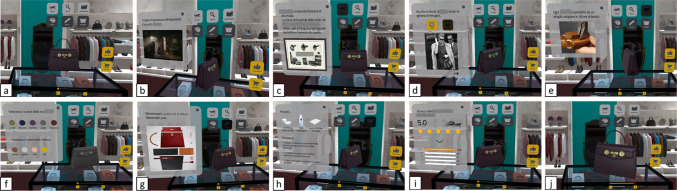
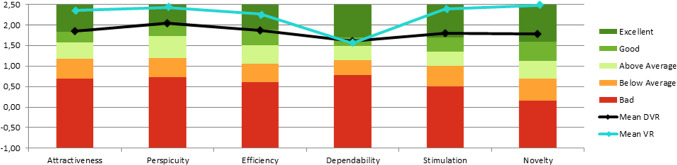
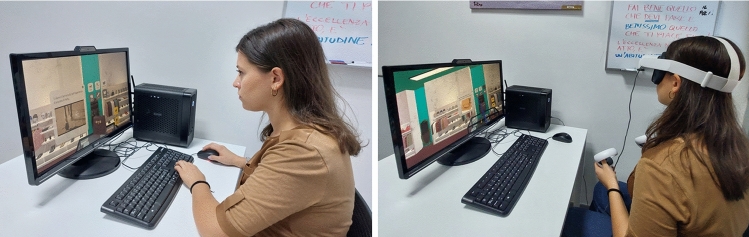
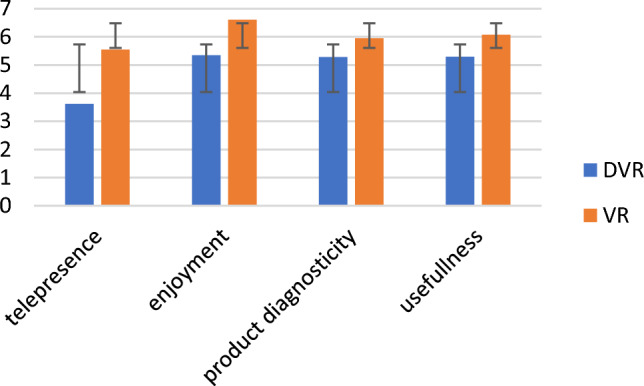
With the high growth and prosperity of e-commerce, the retail industry needs to explore new technologies that improve digital shopping experiences. In the current technological scenario, Virtual Reality (VR) emerges as a tool and an opportunity for enhancing shopping activities, especially for the fashion industry. This study explores whether using Immersive Virtual Reality (IVR) technologies enhances the shopping experience in the fashion industry compared to Desktop Virtual Reality (DVR). A within-subject experiment was carried out involving a sample of 60 participants who completed a simulated shopping experience. In the first mode (DVR), a desktop computer setup was used to test the shopping experience using a mouse and keyboard for navigation. The second mode (IVR) exploited a Head-Mounted Display (HMD), and controllers, that allowed navigation while seated on a workstation to avoid sickness. Participants had to find a bag in the virtual shop and explore its features until they were ready to purchase it. Post-hoc measures of time duration of the shopping experience, hedonic and utilitarian values, user experience, and cognitive load were compared. Results showed that participants experienced higher hedonism and utilitarianism in the IVR shop compared to DVR. The cognitive load was comparable in both modes, while user experience was higher in IVR. In addition, the time duration of the shopping experience was higher in IVR, where users stayed immersed and enjoyed it for longer. This study has implications for fashion industry research, as the use of IVR can potentially lead to novel shopping patterns by enhancing the shopping experience.
The online version contains supplementary material available at 10.1007/s10055-023-00806-y.
随着电子商务的高速发展与繁荣,零售业需要探索能够改善数字购物体验的新技术。在当前的技术背景下,虚拟现实(VR)作为一种工具和机遇出现,可提升购物活动,尤其是对时尚行业而言。本研究探讨了与桌面虚拟现实(DVR)相比,使用沉浸式虚拟现实(IVR)技术是否能提升时尚行业的购物体验。进行了一项受试者内实验,涉及60名参与者的样本,他们完成了一次模拟购物体验。在第一种模式(DVR)中,使用台式计算机设置,通过鼠标和键盘进行导航来测试购物体验。第二种模式(IVR)使用头戴式显示器(HMD)和控制器,参与者坐在工作站上进行导航以避免不适。参与者必须在虚拟商店中找到一个包并探索其特征,直到他们准备购买。比较了购物体验的时间持续、享乐和功利价值、用户体验以及认知负荷的事后测量结果。结果表明,与DVR相比,参与者在IVR商店中体验到更高的享乐主义和功利主义。两种模式下的认知负荷相当,而IVR中的用户体验更高。此外,IVR中购物体验的时间持续更长,用户在其中沉浸并享受的时间更长。本研究对时尚行业研究具有启示意义,因为使用IVR有可能通过提升购物体验带来新的购物模式。
在线版本包含可在10.1007/s10055-023-008 / y获取的补充材料。