
使用炸弹风险诱导任务评估情境框架效应对风险规避的影响。
Contextual framing effects on risk aversion assessed using the bomb risk elicitation task.
作者信息
Hermanns Benedicta, Kokot Johanna
机构信息
University of Hamburg, Mittelweg 177, Hamburg, 20148, Germany.
Hamburg Center for Health Economics, Esplanade 36, Hamburg, 20354, Germany.
出版信息
Econ Lett. 2023 Jun 20:111227. doi: 10.1016/j.econlet.2023.111227.
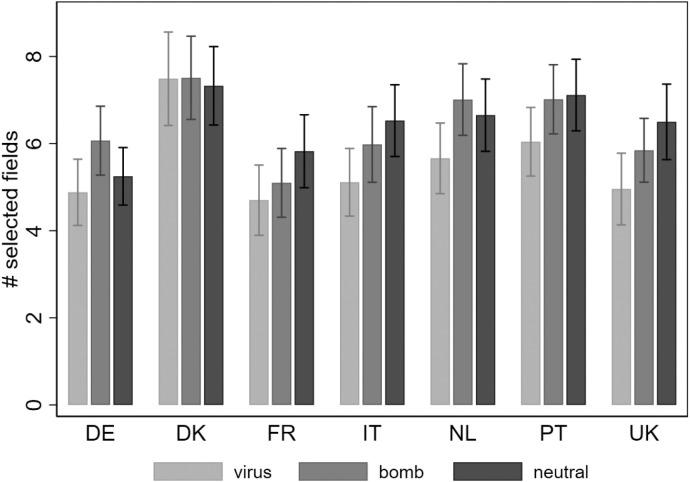
We examine the impact of framing on individuals' risk-taking behavior in the context of health risks during the coronavirus outbreak. We elicit risk attitudes from a sample of 3,385 individuals across seven European countries using an incentivized decision-making task. Participants are randomly assigned to one of three versions of the task: one involving the risk of a bomb explosion, one involving the risk of contracting an infectious disease, and one involving opening an empty box. We find that the framing of the task significantly affects risk-taking behavior, with participants exhibiting greater risk aversion in the health task than in the bomb or neutral task. This framing effect is observed in the majority of the countries studied.
我们研究了在新冠疫情期间健康风险背景下,框架效应(framing)对个体冒险行为的影响。我们通过一项有激励的决策任务,从七个欧洲国家的3385名个体样本中引出风险态度。参与者被随机分配到任务的三个版本之一:一个涉及炸弹爆炸风险,一个涉及感染传染病风险,另一个涉及打开一个空盒子。我们发现,任务的框架显著影响冒险行为,参与者在健康任务中表现出比在炸弹或中性任务中更大的风险厌恶。在大多数所研究的国家中都观察到了这种框架效应。


 Zotero 插件