Southern Nevada Water Authority (SNWA), P.O. Box 99954, Las Vegas, Nevada 89193-9954, United States.
Hampton Roads Sanitation District, P.O. Box 5911, Virginia Beach, Virginia 23471-0911, United States.
Environ Sci Technol. 2023 Nov 28;57(47):18393-18409. doi: 10.1021/acs.est.3c00538. Epub 2023 Jun 26.
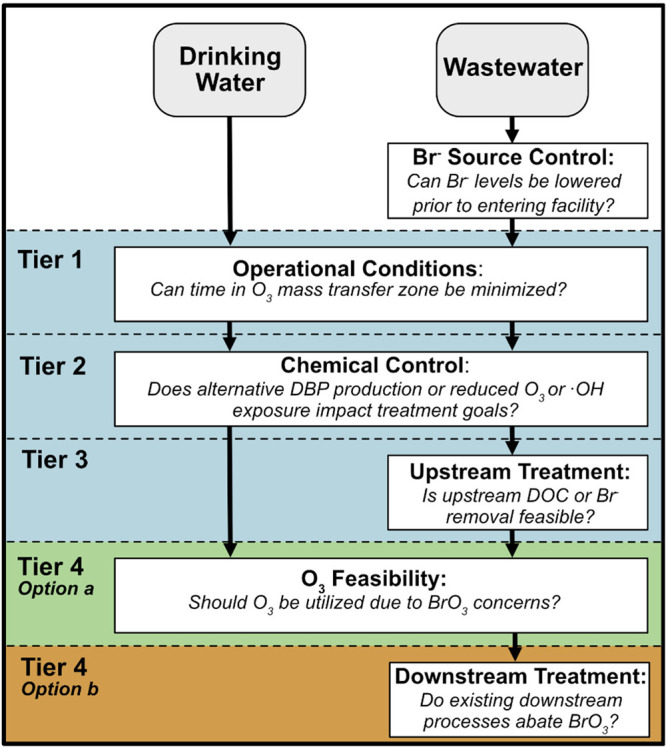
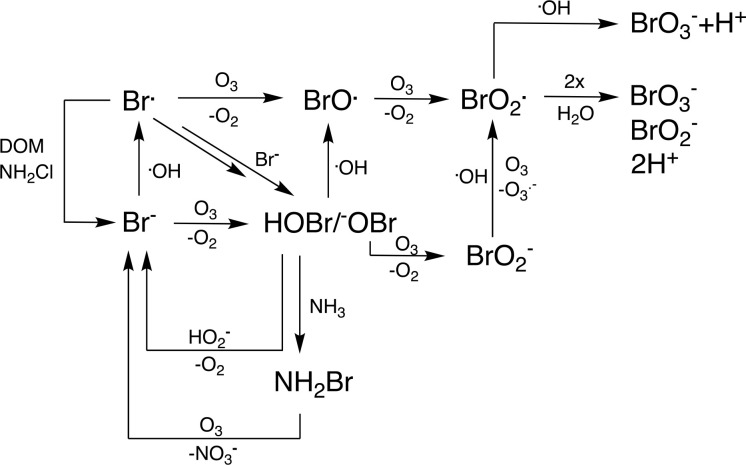
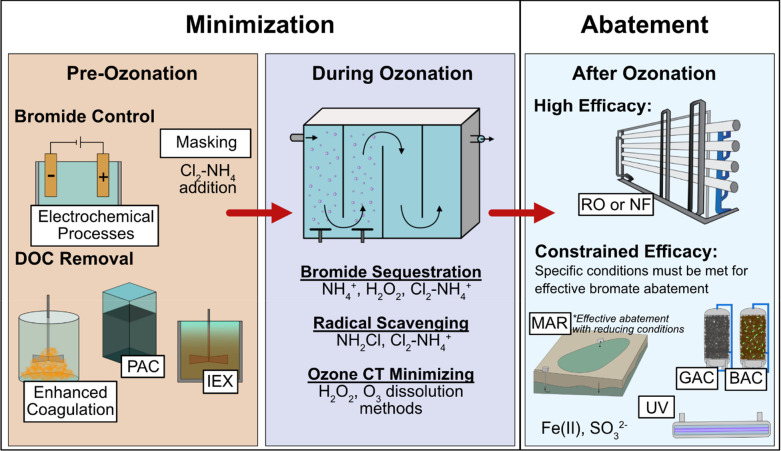
Ozone is a commonly applied disinfectant and oxidant in drinking water and has more recently been implemented for enhanced municipal wastewater treatment for potable reuse and ecosystem protection. One drawback is the potential formation of bromate, a possible human carcinogen with a strict drinking water standard of 10 μg/L. The formation of bromate from bromide during ozonation is complex and involves reactions with both ozone and secondary oxidants formed from ozone decomposition, i.e., hydroxyl radical. The underlying mechanism has been elucidated over the past several decades, and the extent of many parallel reactions occurring with either ozone or hydroxyl radicals depends strongly on the concentration, type of dissolved organic matter (DOM), and carbonate. On the basis of mechanistic considerations, several approaches minimizing bromate formation during ozonation can be applied. Removal of bromate after ozonation is less feasible. We recommend that bromate control strategies be prioritized in the following order: (1) control bromide discharge at the source and ensure optimal ozone mass-transfer design to minimize bromate formation, (2) minimize bromate formation during ozonation by chemical control strategies, such as ammonium with or without chlorine addition or hydrogen peroxide addition, which interfere with specific bromate formation steps and/or mask bromide, (3) implement a pretreatment strategy to reduce bromide and/or DOM prior to ozonation, and (4) assess the suitability of ozonation altogether or utilize a downstream treatment process that may already be in place, such as reverse osmosis, for post-ozone bromate abatement. A one-size-fits-all approach to bromate control does not exist, and treatment objectives, such as disinfection and micropollutant abatement, must also be considered.
臭氧是一种常用于饮用水消毒和氧化的消毒剂,最近也被用于强化城市废水处理,以实现饮用水再利用和生态系统保护。其缺点之一是可能形成溴酸盐,一种可能的人类致癌物,其饮用水标准严格限制在 10μg/L。在臭氧氧化过程中,溴化物形成溴酸盐的过程很复杂,涉及与臭氧和臭氧分解形成的次级氧化剂(即羟基自由基)的反应。过去几十年,人们已经阐明了这一潜在机制,许多与臭氧或羟基自由基发生的平行反应的程度强烈取决于浓度、溶解有机物(DOM)的类型和碳酸盐。基于机制考虑,可以采用几种方法来最大限度地减少臭氧氧化过程中溴酸盐的形成。臭氧氧化后去除溴酸盐的可行性较低。我们建议按照以下优先顺序实施溴酸盐控制策略:(1)从源头控制溴化物排放,并确保最佳的臭氧传质设计,以最大限度地减少溴酸盐的形成,(2)通过化学控制策略,如添加铵盐(无论是否添加氯)或添加过氧化氢,来最小化臭氧氧化过程中溴酸盐的形成,这些策略会干扰特定的溴酸盐形成步骤和/或掩蔽溴化物,(3)在臭氧氧化前实施预处理策略,以减少溴化物和/或 DOM,(4)评估臭氧氧化的适用性,或利用已经存在的下游处理工艺(如反渗透)来去除臭氧氧化后的溴酸盐。不存在一种适用于所有情况的溴酸盐控制方法,并且还必须考虑处理目标,如消毒和去除微量污染物。