Clinical Pharmacology and Quantitative Pharmacology, Clinical Pharmacology and Safety Sciences, AstraZeneca, One MedImmune Way, Gaithersburg, MD, 20878, USA.
Late Stage Development, Oncology R&D, AstraZeneca, Cambridge, UK.
Cancer Chemother Pharmacol. 2023 Aug;92(2):141-150. doi: 10.1007/s00280-023-04555-2. Epub 2023 Jun 27.
Adavosertib is a small-molecule, ATP-competitive inhibitor of Wee1 kinase. Molecularly targeted oncology agents have the potential to increase the risk of cardiovascular events, including prolongation of QT interval and associated cardiac arrhythmias. This study investigated the effect of adavosertib on the QTc interval in patients with advanced solid tumors.
Eligible patients were ≥ 18 years of age with advanced solid tumors for which no standard therapy existed. Patients received adavosertib 225 mg twice daily on days 1-2 at 12-h intervals and once on day 3. Patients underwent digital 12-lead electrocardiogram and pharmacokinetic assessments pre-administration and time-matched assessments during the drug administration period. The relationship between maximum plasma drug concentration (C) and baseline-adjusted corrected QT interval by Fridericia (QTcF) was estimated using a prespecified linear mixed-effects model.
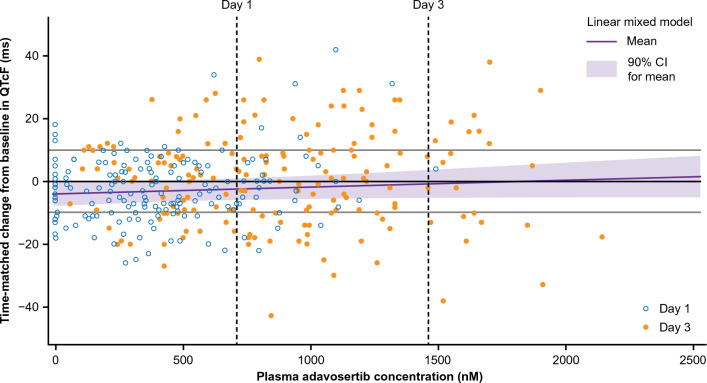
Twenty-one patients received adavosertib. Concentration-QT modeling of ΔQTcF and the upper limit of the 90% confidence interval corresponding to the geometric mean of C observed on days 1 and 3 were below the threshold for regulatory concern (not > 10 ms). No significant relationship between ΔQTcF (vs baseline) and adavosertib concentration was identified (P = 0.27). Pharmacokinetics and the adverse event (AE) profile were consistent with previous studies at this dose. Eleven (52.4%) patients experienced 17 treatment-related AEs in total, including diarrhea and nausea (both reported in six [28.6%] patients), vomiting (reported in two [9.5%] patients), anemia, decreased appetite, and constipation (all reported in one [4.8%] patient).
Adavosertib does not have a clinically important effect on QTc prolongation.
GOV: NCT03333824.
Adavosertib 是一种小分子、ATP 竞争性 Wee1 激酶抑制剂。分子靶向肿瘤药物有可能增加心血管事件的风险,包括 QT 间期延长和相关的心律失常。本研究旨在探讨 Adavosertib 对晚期实体瘤患者 QT 间期的影响。
符合条件的患者为年龄≥18 岁、患有晚期实体瘤且无标准治疗方法的患者。患者接受 Adavosertib 225mg,每日两次,在 12 小时间隔内于第 1-2 天服用,第 3 天仅服用一次。患者在给药前和给药期间进行数字 12 导联心电图和药代动力学评估。使用预设的线性混合效应模型,估算最大血浆药物浓度 (C) 与 Fridericia 校正 QT 间期 (QTcF) 的最大差值与基线的关系。
21 例患者接受了 Adavosertib 治疗。ΔQTcF 的浓度-QT 模型和与第 1 天和第 3 天观察到的 C 的几何平均值相对应的 90%置信区间上限均低于监管关注的阈值(不>10ms)。未发现 ΔQTcF(与基线相比)与 Adavosertib 浓度之间存在显著关系(P=0.27)。该剂量的药代动力学和不良事件(AE)特征与之前的研究一致。共有 11 名(52.4%)患者总共出现了 17 次与治疗相关的 AE,包括腹泻和恶心(均在 6 名患者[28.6%]中报告)、呕吐(在 2 名患者[9.5%]中报告)、贫血、食欲下降和便秘(均在 1 名患者[4.8%]中报告)。
Adavosertib 对 QTc 延长没有临床重要影响。
GOV:NCT03333824。