Khater Safaa I, Almanaa Taghreed N, Fattah Doaa M Abdel, Khamis Tarek, Seif Mona M, Dahran Naief, Alqahtani Leena S, Metwally Mohamed M M, Mostafa Mahmoud, Albedair Raghad A, Helal Azza I, Alosaimi Manal, Mohamed Amany Abdel-Rahman
Department of Biochemistry, Faculty of Veterinary Medicine, Zagazig University, Zagazig 44511, Egypt.
Department of Botany and Microbiology, College of Science, King Saud University, Riyadh 11451, Saudi Arabia.
Antioxidants (Basel). 2023 Jun 5;12(6):1220. doi: 10.3390/antiox12061220.
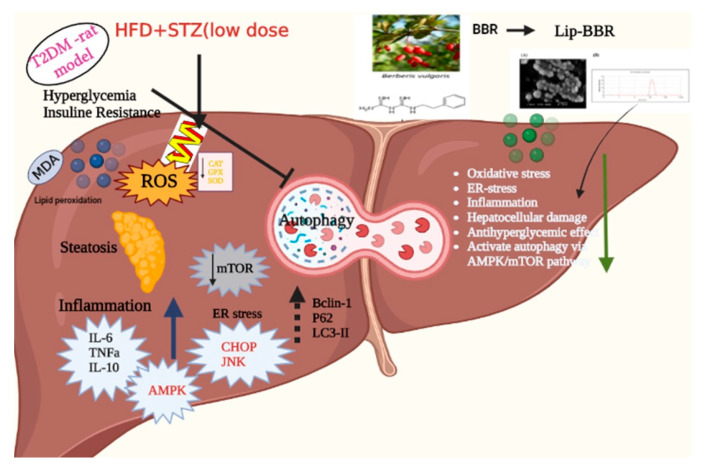
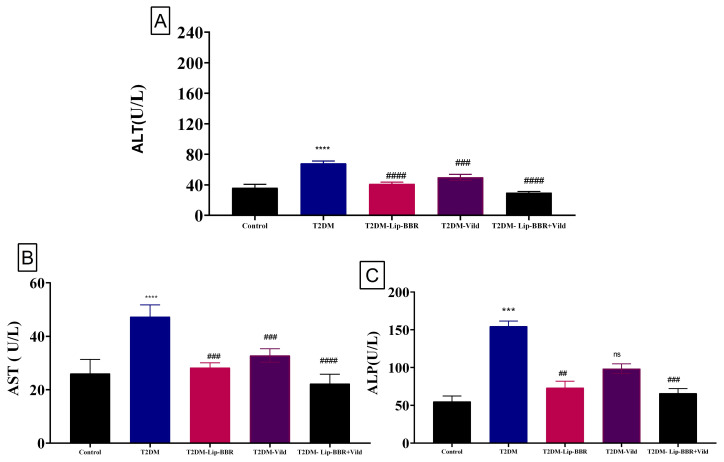
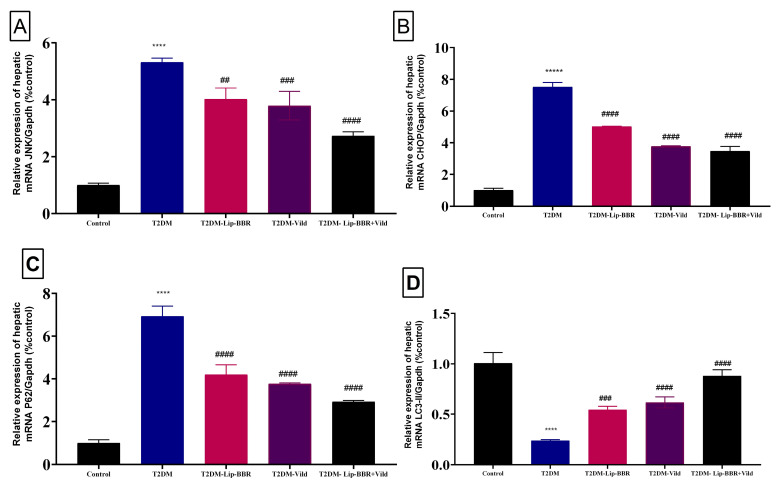
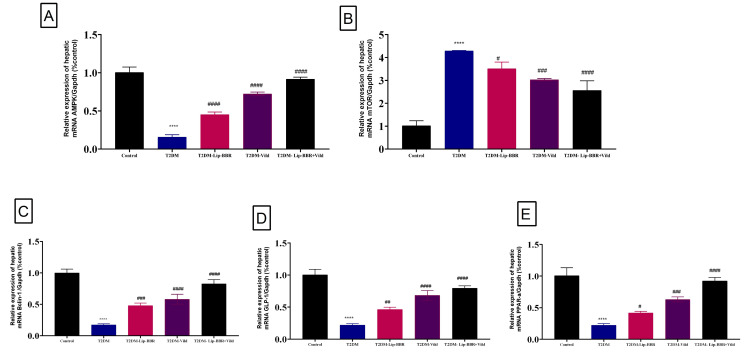
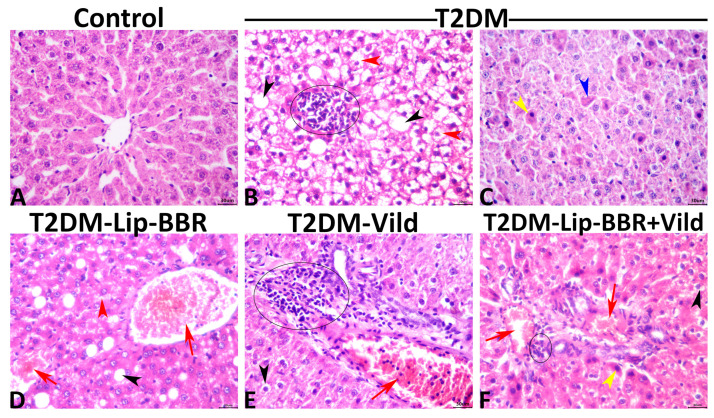
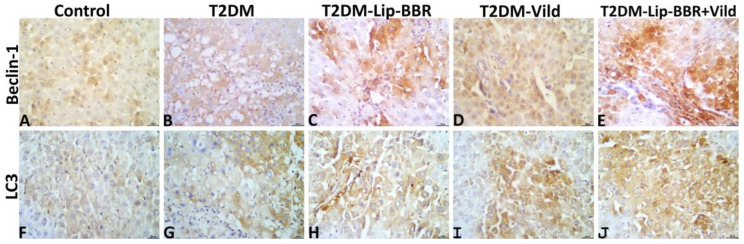
In the advanced stages of type 2 diabetes mellitus (T2DM), diabetic liver damage is a common complication that can devastate a patient's quality of life. The present study investigated the ability of liposomal berberine (Lip-BBR) to aid in ameliorating hepatic damage and steatosis, insulin homeostasis, and regulating lipid metabolism in type 2 diabetes (T2DM) and the possible pathways by which it does so. Liver tissue microarchitectures and immunohistochemical staining were applied during the study. The rats were divided into a control non-diabetic group and four diabetic groups, which are the T2DM, T2DM-Lip-BBR (10 mg/kg b.wt), T2DM-Vildagliptin (Vild) (10 mg/kg b.wt), and T2DM-BBR-Vild (10 mg/kg b.wt + Vild (5 mg/kg b.wt) groups. The findings demonstrated that Lip-BBR treatment could restore liver tissue microarchitectures, reduce steatosis and liver function, and regulate lipid metabolism. Moreover, Lip-BBR treatment promoted autophagy via the activation of LC3-II and Bclin-1 proteins and activated the AMPK/mTOR pathway in the liver tissue of T2DM rats. Lip-BBR also activated the GLP-1 expression, which stimulated insulin biosynthesis. It decreased the endoplasmic reticulum stress by limiting the CHOP, JNK expression, oxidative stress, and inflammation. Collectively, Lip-BBR ameliorated diabetic liver injury in a T2DM rat model with its promotion activity of AMPK/mTOR-mediated autophagy and limiting ER stress.
在2型糖尿病(T2DM)的晚期,糖尿病性肝损伤是一种常见的并发症,会严重影响患者的生活质量。本研究调查了脂质体黄连素(Lip-BBR)改善2型糖尿病(T2DM)肝损伤和脂肪变性、胰岛素稳态以及调节脂质代谢的能力及其可能的作用途径。研究过程中采用了肝脏组织微观结构和免疫组织化学染色方法。将大鼠分为非糖尿病对照组和四个糖尿病组,即T2DM组、T2DM-Lip-BBR(10mg/kg体重)组、T2DM-维格列汀(Vild)(10mg/kg体重)组和T2DM-BBR-Vild(10mg/kg体重 + Vild(5mg/kg体重))组。研究结果表明,Lip-BBR治疗可恢复肝脏组织微观结构,减轻脂肪变性和肝功能损害,并调节脂质代谢。此外,Lip-BBR治疗通过激活LC3-II和Bcl in-1蛋白促进自噬,并激活T2DM大鼠肝脏组织中的AMPK/mTOR通路。Lip-BBR还激活GLP-1表达,刺激胰岛素生物合成。它通过限制CHOP、JNK表达、氧化应激和炎症来减轻内质网应激。总体而言,Lip-BBR通过促进AMPK/mTOR介导的自噬和减轻内质网应激,改善了T2DM大鼠模型中的糖尿病性肝损伤。