Windus Louisa C E, Matigian Nicholas, Avery Vicky M
Discovery Biology, Centre for Cellular Phenomics, Griffith University, Nathan, QLD 4111, Australia.
QCIF Facility for Advanced Bioinformatics, Institute for Molecular Bioscience, The University of Queensland, Brisbane, QLD 4072, Australia.
Biology (Basel). 2023 Jun 15;12(6):861. doi: 10.3390/biology12060861.
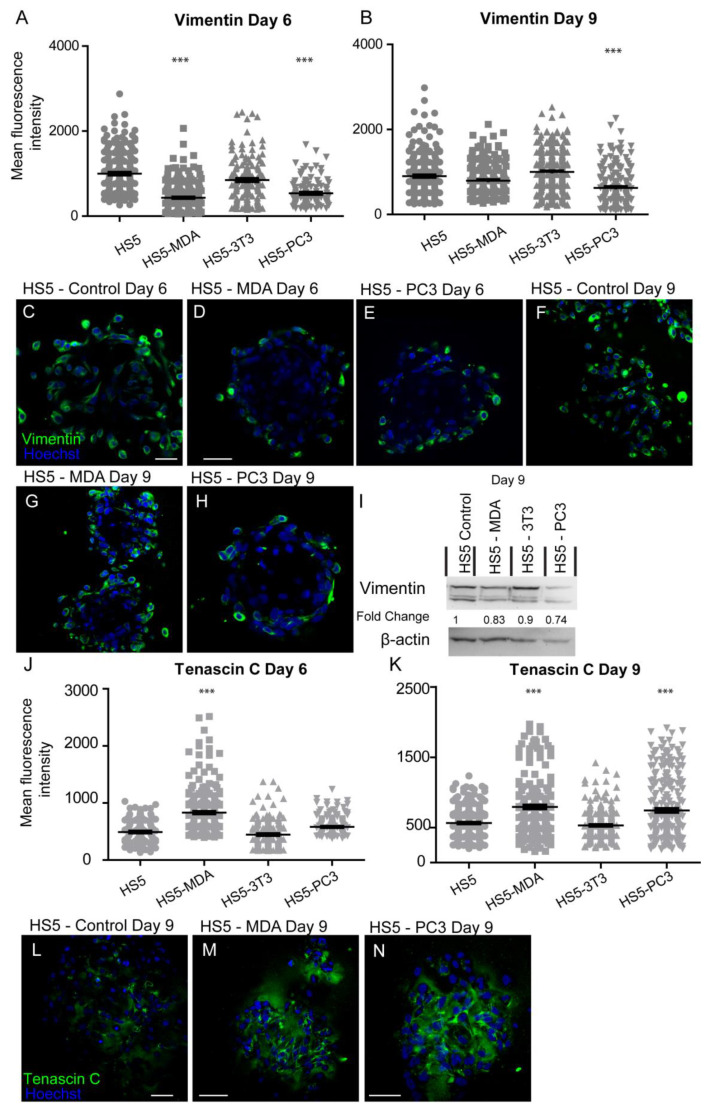
A dynamic interplay between prostate cancer (PCa) cells and reactive bone stroma modulates the growth of metastases within the bone microenvironment. Of the stromal cells, metastasis-associated fibroblasts (MAFs) are known to contribute but are the least studied cell type in PCa tumour progression. It is the aim of the current study to establish a biologically relevant 3D in vitro model that mimics the cellular and molecular profiles of MAFs found in vivo. Using 3D in vitro cell culture models, the bone-derived fibroblast cell line, HS-5, was treated with conditioned media from metastatic-derived PCa cell lines, PC3 and MDA-PCa 2b, or mouse-derived fibroblasts 3T3. Two corresponding reactive cell lines were propagated: HS5-PC3 and HS5-MDA, and evaluated for alterations in morphology, phenotype, cellular behaviour, plus protein and genomic profiles. HS5-PC3 and HS5-MDA displayed distinct alterations in expression levels of N-Cadherin, non-functional E-Cadherin, alpha-smooth muscle actin (α-SMA), Tenascin C, and vimentin, along with transforming growth factor receptor expression (TGF β R1 and R2), consistent with subpopulations of MAFs reported in vivo. Transcriptomic analysis revealed a reversion of HS5-PC3 towards a metastatic phenotype with an upregulation in pathways known to regulate cancer invasion, proliferation, and angiogenesis. The exploitation of these engineered 3D models could help further unravel the novel biology regulating metastatic growth and the role fibroblasts play in the colonisation process.
前列腺癌细胞与反应性骨基质之间的动态相互作用调节了骨微环境中转移灶的生长。在基质细胞中,转移相关成纤维细胞(MAFs)已知有作用,但在前列腺癌肿瘤进展中是研究最少的细胞类型。本研究的目的是建立一个生物学相关的三维体外模型,以模拟体内发现的MAFs的细胞和分子特征。使用三维体外细胞培养模型,将骨源成纤维细胞系HS-5用来自转移性前列腺癌细胞系PC3和MDA-PCa 2b或小鼠成纤维细胞3T3的条件培养基处理。培养出两个相应的反应性细胞系:HS5-PC3和HS5-MDA,并对其形态、表型、细胞行为以及蛋白质和基因组特征的改变进行评估。HS5-PC3和HS5-MDA在N-钙黏蛋白、无功能的E-钙黏蛋白、α-平滑肌肌动蛋白(α-SMA)、腱生蛋白C和波形蛋白的表达水平以及转化生长因子受体表达(TGFβR1和R2)方面表现出明显改变,这与体内报道的MAFs亚群一致。转录组分析显示HS5-PC3向转移表型逆转,已知调节癌症侵袭、增殖和血管生成的途径上调。利用这些工程化的三维模型有助于进一步揭示调节转移生长的新生物学机制以及成纤维细胞在定植过程中所起的作用。