Avancini Greta, Menilli Luca, Visentin Adele, Milani Celeste, Mastrotto Francesca, Moret Francesca
Department of Biology, University of Padova, Via Ugo Bassi 58/B, 35131 Padova, Italy.
Department of Pharmaceutical and Pharmacological Sciences, University of Padova, Via F. Marzolo 5, 35131 Padova, Italy.
Pharmaceutics. 2023 Jun 4;15(6):1654. doi: 10.3390/pharmaceutics15061654.
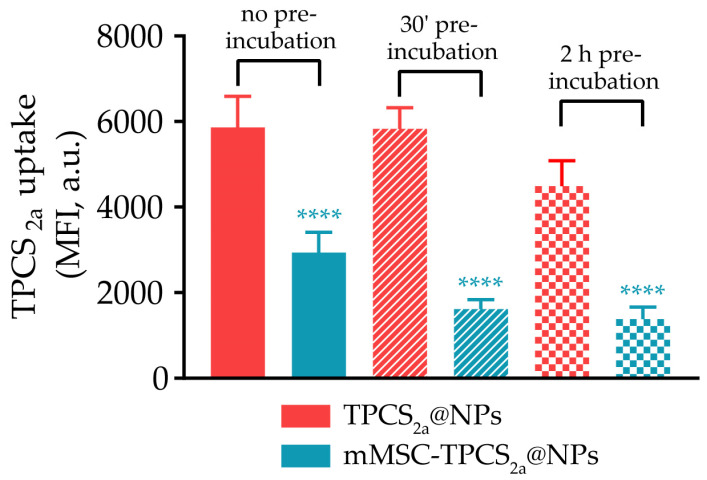
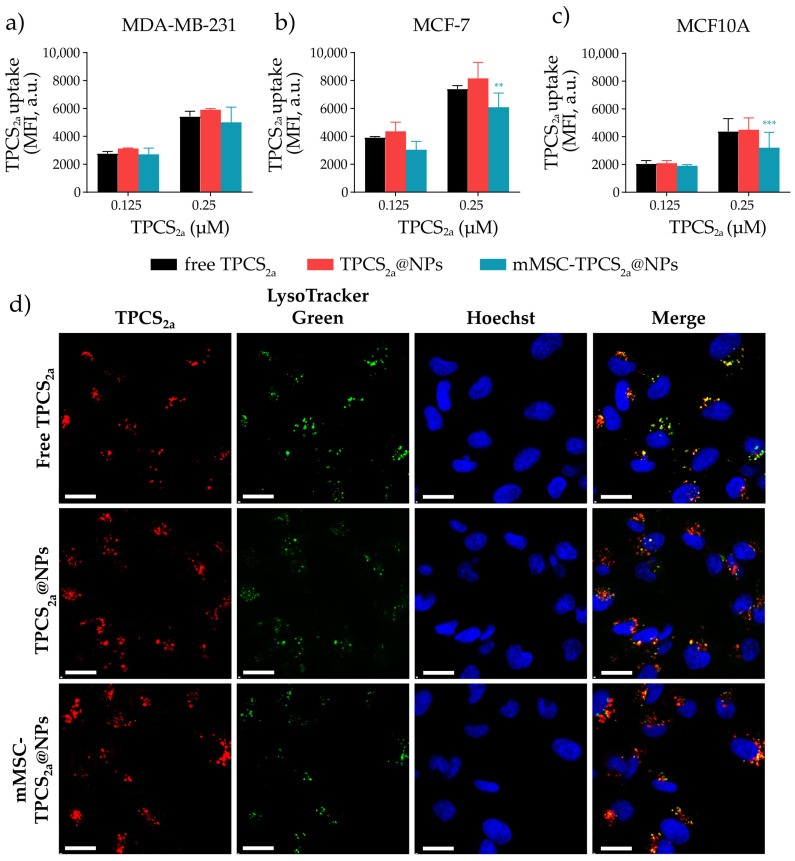
Despite substantial improvements in breast cancer (BC) treatment there is still an urgent need to find alternative treatment options to improve the outcomes for patients with advanced-stage disease. Photodynamic therapy (PDT) is gaining a lot of attention as a BC therapeutic option because of its selectivity and low off-target effects. However, the hydrophobicity of photosensitizers (PSs) impairs their solubility and limits the circulation in the bloodstream, thus representing a major challenge. The use of polymeric nanoparticles (NPs) to encapsulate the PS may represent a valuable strategy to overcome these issues. Herein, we developed a novel biomimetic PDT nanoplatform (NPs) based on a polymeric core of poly(lactic-co-glycolic)acid (PLGA) loaded with the PS meso-tetraphenylchlorin disulfonate (TPCS). TPCS@NPs of 98.89 ± 18.56 nm with an encapsulation efficiency percentage (EE%) of 81.9 ± 7.92% were obtained and coated with mesenchymal stem cells-derived plasma membranes (mMSCs) (mMSC-TPCS@NPs, size of 139.31 ± 12.94 nm). The mMSC coating armed NPs with biomimetic features to impart long circulation times and tumor-homing capabilities. In vitro, biomimetic mMSC-TPCS@NPs showed a decrease in macrophage uptake of 54% to 70%, depending on the conditions applied, as compared to uncoated TPCS@NPs. Both NP formulations efficiently accumulated in MCF7 and MDA-MB-231 BC cells, while the uptake was significantly lower in normal breast epithelial MCF10A cells with respect to tumor cells. Moreover, encapsulation of TPCS in mMSC-TPCS@NPs effectively prevents its aggregation, ensuring efficient singlet oxygen (O) production after red light irradiation, which resulted in a considerable in vitro anticancer effect in both BC cell monolayers (IC < 0.15 µM) and three-dimensional spheroids.
尽管乳腺癌(BC)治疗有了显著改善,但仍迫切需要寻找替代治疗方案,以改善晚期疾病患者的治疗效果。光动力疗法(PDT)因其选择性和低脱靶效应,作为一种BC治疗选择正受到广泛关注。然而,光敏剂(PSs)的疏水性会损害其溶解性并限制其在血流中的循环,因此这是一个重大挑战。使用聚合物纳米颗粒(NPs)封装PS可能是克服这些问题的一种有价值的策略。在此,我们基于负载有PS中-四苯基氯二磺酸酯(TPCS)的聚乳酸-乙醇酸共聚物(PLGA)聚合物核,开发了一种新型仿生PDT纳米平台(NPs)。获得了粒径为98.89±18.56 nm、包封率(EE%)为81.9±7.92%的TPCS@NPs,并用间充质干细胞衍生的质膜(mMSCs)进行包被(mMSC-TPCS@NPs,粒径为139.31±12.94 nm)。mMSC包被使NPs具有仿生特性,从而赋予其较长的循环时间和肿瘤归巢能力。在体外,与未包被的TPCS@NPs相比,仿生mMSC-TPCS@NPs根据所应用的条件,巨噬细胞摄取减少了54%至70%。两种NP制剂都能有效地在MCF7和MDA-MB-231 BC细胞中积累,而正常乳腺上皮MCF10A细胞的摄取相对于肿瘤细胞显著降低。此外,将TPCS封装在mMSC-TPCS@NPs中可有效防止其聚集,确保在红光照射后产生高效的单线态氧(O),这在BC细胞单层(IC<0.15 µM)和三维球体中均产生了显著的体外抗癌效果。