Zhang Guicai, Ran Yunling, Jiang Ping, Pei Haihua
School of Petroleum Engineering, China University of Petroleum (East China), Qingdao 266580, China.
Polymers (Basel). 2023 Jun 13;15(12):2665. doi: 10.3390/polym15122665.
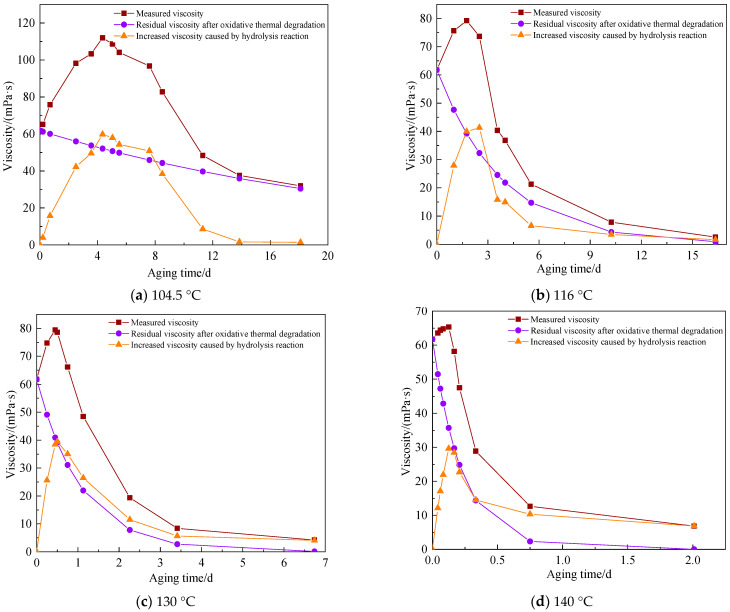
As a temperature-resistant and salt-resistant polymer, acrylamide and 2-acrylamide-2-methylpropane sulfonic acid (abbreviated as AM-AMPS) copolymer is currently widely used in drilling, water control and oil production stabilization, enhanced oil recovery and other fields, but its stability under high temperature has been less studied. The degradation process of the AM-AMPS copolymer solution was studied by measuring viscosity, the degree of hydrolysis, and weight-average molecular weight at different temperatures and aging time. During the high-temperature aging process, the viscosity of the AM-AMPS copolymer saline solution first increases and then decreases. The combined action of the hydrolysis reaction and the oxidative thermal degradation leads to the change of the viscosity of the AM-AMPS copolymer saline solution. The hydrolysis reaction of the AM-AMPS copolymer mainly affects the structural viscosity of its saline solution through intramolecular and intermolecular electrostatic interactions, while the oxidative thermal degradation mainly reduces its molecular weight by breaking the main chain of the copolymer molecules, reducing the viscosity of the AM-AMPS copolymer saline solution. The content of AM and AMPS groups in the AM-AMPS copolymer solution at various temperatures and aging time was analyzed using liquid nuclear magnetic resonance carbon spectroscopy, demonstrating that the hydrolysis reaction rate constant of AM groups was significantly higher than that of AMPS groups. The contribution values of hydrolysis reaction and oxidative thermal degradation of the AM-AMPS copolymer at different aging time to viscosity were quantitatively calculated at temperatures ranging from 104.5 °C to 140 °C. It was determined that the higher the heat treatment temperature, the smaller the contribution of hydrolysis reaction to viscosity, while the bigger the contribution of oxidative thermal degradation to the viscosity of the AM-AMPS copolymer solution.
作为一种抗温耐盐聚合物,丙烯酰胺与2-丙烯酰胺基-2-甲基丙磺酸(简称AM-AMPS)共聚物目前广泛应用于钻井、控水稳油、提高采收率等领域,但其在高温下的稳定性研究较少。通过测量不同温度和老化时间下的粘度、水解度和重均分子量,研究了AM-AMPS共聚物溶液的降解过程。在高温老化过程中,AM-AMPS共聚物盐水溶液的粘度先升高后降低。水解反应和氧化热降解的共同作用导致了AM-AMPS共聚物盐水溶液粘度的变化。AM-AMPS共聚物的水解反应主要通过分子内和分子间的静电相互作用影响其盐水溶液的结构粘度,而氧化热降解主要通过断裂共聚物分子的主链降低其分子量,从而降低AM-AMPS共聚物盐水溶液的粘度。利用液体核磁共振碳谱分析了不同温度和老化时间下AM-AMPS共聚物溶液中AM和AMPS基团的含量,结果表明AM基团的水解反应速率常数明显高于AMPS基团。在104.5℃至140℃的温度范围内,定量计算了AM-AMPS共聚物在不同老化时间下的水解反应和氧化热降解对粘度的贡献值。结果表明,热处理温度越高,水解反应对粘度的贡献越小,而氧化热降解对AM-AMPS共聚物溶液粘度的贡献越大。