Kallakas Heikko, Kattamanchi Tanuj, Kilumets Catherine, Tarasova Elvira, Krasnou Illia, Savest Natalja, Ahmadian Iman, Kers Jaan, Krumme Andres
Laboratory of Wood Technology, Department of Materials and Environmental Technology, School of Engineering, Tallinn University of Technology, Ehitajate tee 5, 19086 Tallinn, Estonia.
Laboratory of Biopolymer Technology, Department of Materials and Environmental Technology, School of Engineering, Tallinn University of Technology, Ehitajate tee 5, 19086 Tallinn, Estonia.
Polymers (Basel). 2023 Jun 14;15(12):2677. doi: 10.3390/polym15122677.
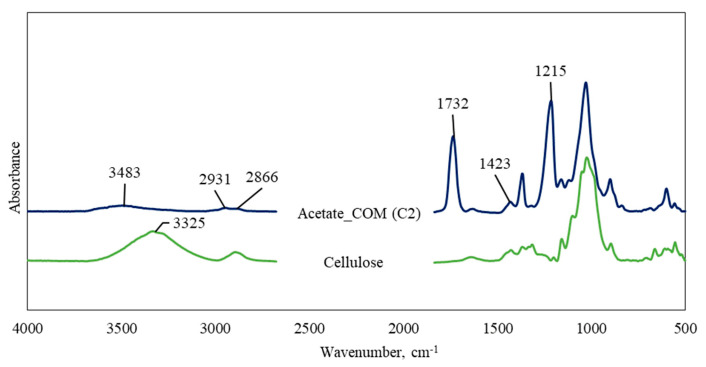
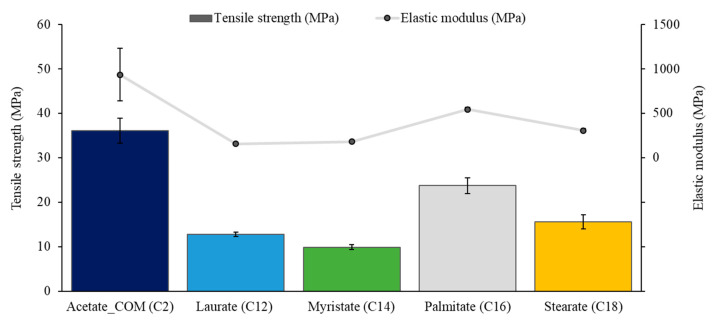
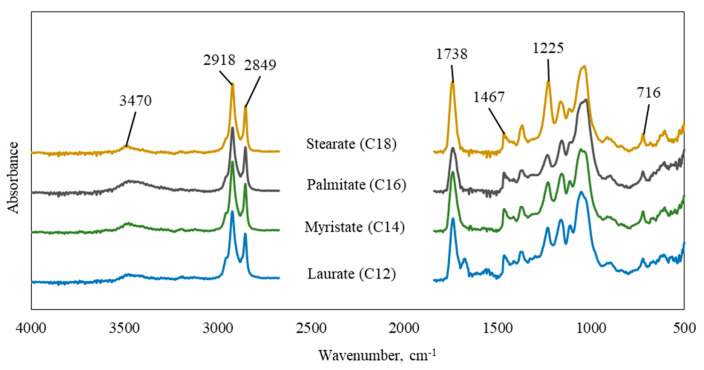
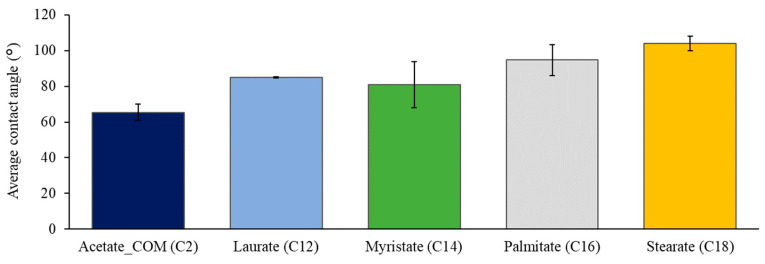
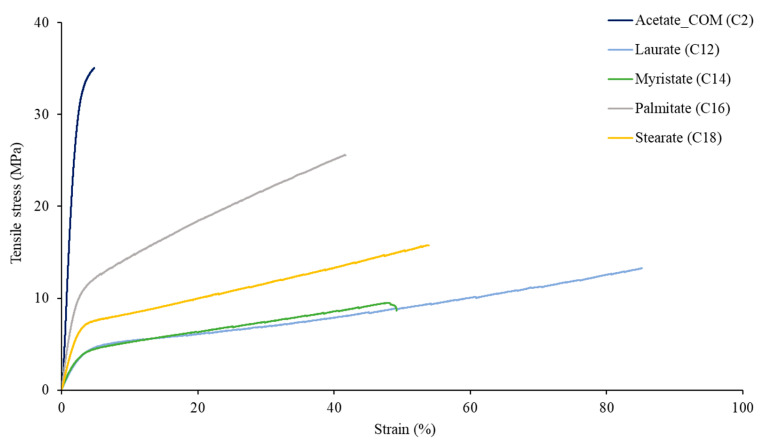
Thermoplastic cellulose esters are promising materials for bioplastic packaging. For that usage, it is important to understand their mechanical and surface wettability properties. In this study, a series of cellulose esters are prepared, such as laurate, myristate, palmitate, and stearate. The aim of the study is to investigate the tensile and surface wettability properties of the synthesized cellulose fatty acid esters to understand their suitability as a bioplastic packaging material. Cellulose fatty acid esters are first synthesized from microcrystalline cellulose (MCC), then dissolved in pyridine solution, and after the solvent cast into thin films. The cellulose fatty acid ester acylation process is characterized by the FTIR method. Cellulose esters hydrophobicity is evaluated with contact angle measurements. The mechanical properties of the films are tested with the tensile test. For all the synthesized films, FTIR provides clear evidence of acylation by showing the presence of characteristic peaks. Films' mechanical properties are comparable to those of generally used plastics such as LDPE and HDPE. Furthermore, it appears that with an increase in the side-chain length, the water barrier properties showed improvement. These results show that they could potentially be suitable materials for films and packaging materials.
热塑性纤维素酯是用于生物塑料包装的很有前景的材料。对于该用途而言,了解它们的机械性能和表面润湿性很重要。在本研究中,制备了一系列纤维素酯,如月桂酸酯、肉豆蔻酸酯、棕榈酸酯和硬脂酸酯。该研究的目的是研究合成的纤维素脂肪酸酯的拉伸性能和表面润湿性,以了解它们作为生物塑料包装材料的适用性。纤维素脂肪酸酯首先由微晶纤维素(MCC)合成,然后溶解在吡啶溶液中,之后将溶剂浇铸成薄膜。纤维素脂肪酸酯的酰化过程通过傅里叶变换红外光谱(FTIR)法进行表征。通过接触角测量评估纤维素酯的疏水性。用拉伸试验测试薄膜的机械性能。对于所有合成薄膜,FTIR通过显示特征峰的存在提供了酰化的明确证据。薄膜的机械性能与诸如低密度聚乙烯(LDPE)和高密度聚乙烯(HDPE)等常用塑料的机械性能相当。此外,似乎随着侧链长度的增加,阻水性能有所改善。这些结果表明,它们可能是适用于薄膜和包装材料的潜在材料。