Kawasaki Ryohei, Sakata Asuka, Hosoda Chihiro, Harada Suguru, Soeda Tetsuhiro, Nishida Yukiko, Matsumoto Naoki, Tatsumi Kohei, Nogami Keiji, Yoshimura Yasushi, Shima Midori
Medicinal Biology of Thrombosis and Hemostasis, Nara Medical University, 840 Shijo-Cho, Kashihara, Nara, 634-8521, Japan.
Product Research Department, Medical Affairs Division, Chugai Pharmaceutical Co., Ltd., Yokohama, Japan.
Thromb J. 2023 Jun 28;21(1):70. doi: 10.1186/s12959-023-00511-5.
In patients with hemophilia (PwH), bleeding often occurs in joints and muscles, and early detection of hemorrhage is important to prevent the onset and progression of mobility impairment. Complex-Image analysis such as ultrasonography, computed tomography, and magnetic resonance imaging are used to detect bleeding. On the other hand, no simple and rapid method to detect the active bleeding has been reported. Local inflammatory responses occur when blood leaks from damaged vessels, and the temperature at the site of active bleeding could be expected to increase in these circumstances, leading to an increase in surrounding skin temperature. Therefore, the purpose of this study was to investigate whether the measurement of skin temperature using infrared thermography (IRT) can be used as a diagnostic aid to detect active bleeding.
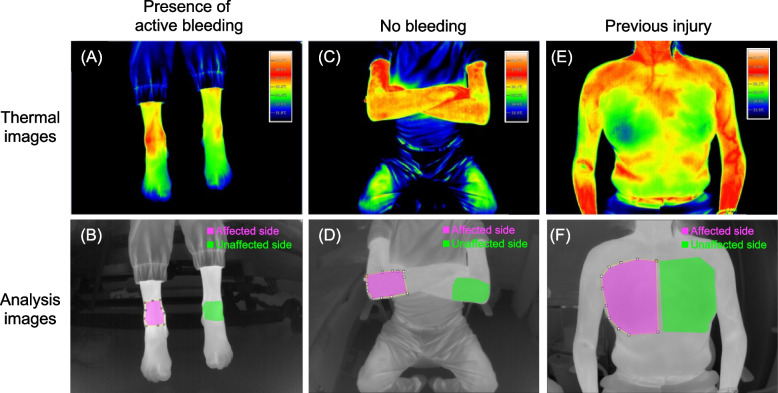
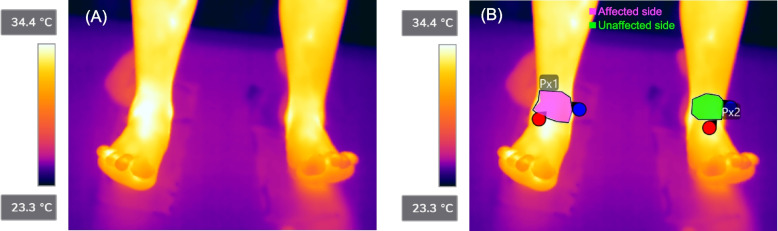
Fifteen PwH (from 6 to 82 years old) complaining of discomfort such as pain were examined. Thermal images were obtained simultaneously at the affected sides and comparable unaffected sides. The average skin temperature of the affected side and of the unaffected side were measured. The temperature differences were calculated by subtracting the average skin temperature at the unaffected side from the affected side.
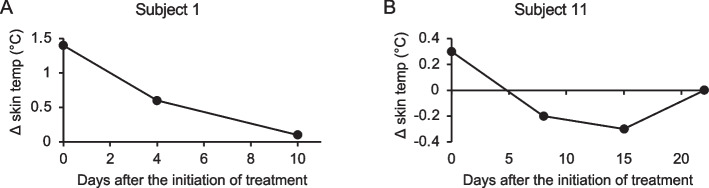
In eleven cases with active bleeding, the skin temperature at the affected side was more than 0.3 °C higher (0.3 °C to 1.4 °C) compared to the unaffected side. In two cases without active bleeding, there were no significant differences in skin temperature between the affected and unaffected sides. In two cases with previous rib or thumb bone fracture, the skin temperature at the affected side was 0.3 °C or 0.4 °C lower than that of the unaffected side, respectively. In two cases with active bleeding in which longitudinal evaluation was conducted, the difference in skin temperature decreased after hemostatic treatment.
The analysis of skin temperature deference using IRT was a useful supportive tool to readily assess musculoskeletal abnormalities and bleeding in PwH as well as to determine the success of the hemostatic treatment.
在血友病患者中,出血常发生于关节和肌肉,早期发现出血对于预防运动功能障碍的发生和进展至关重要。超声、计算机断层扫描和磁共振成像等复杂图像分析方法用于检测出血。另一方面,尚未有简单快速检测活动性出血的方法报道。当血液从受损血管渗漏时会发生局部炎症反应,在这种情况下,活动性出血部位的温度可能会升高,导致周围皮肤温度升高。因此,本研究的目的是探讨使用红外热成像(IRT)测量皮肤温度是否可作为检测活动性出血的辅助诊断方法。
对15例主诉疼痛等不适的血友病患者(年龄6至82岁)进行检查。在患侧和相对的未受影响侧同时获取热图像。测量患侧和未受影响侧的平均皮肤温度。通过用患侧平均皮肤温度减去未受影响侧平均皮肤温度来计算温度差。
在11例活动性出血病例中,患侧皮肤温度比未受影响侧高0.3℃以上(0.3℃至1.4℃)。在2例无活动性出血的病例中,患侧和未受影响侧的皮肤温度无显著差异。在2例既往有肋骨或拇指骨折的病例中,患侧皮肤温度分别比未受影响侧低0.3℃或0.4℃。在2例进行纵向评估的活动性出血病例中,止血治疗后皮肤温度差异减小。
使用IRT分析皮肤温度差异是一种有用的辅助工具,可方便地评估血友病患者的肌肉骨骼异常和出血情况,以及确定止血治疗的效果。