Melchiorre Daniela, Manetti Mirko, Matucci-Cerinic Marco
Section of Internal Medicine, Department of Experimental and Clinical Medicine, University of Florence, 50134 Florence, Italy.
Department of Geriatric Medicine, Division of Rheumatology, Azienda Ospedaliero-Universitaria Careggi 50134 Florence, Italy.
J Clin Med. 2017 Jun 25;6(7):63. doi: 10.3390/jcm6070063.
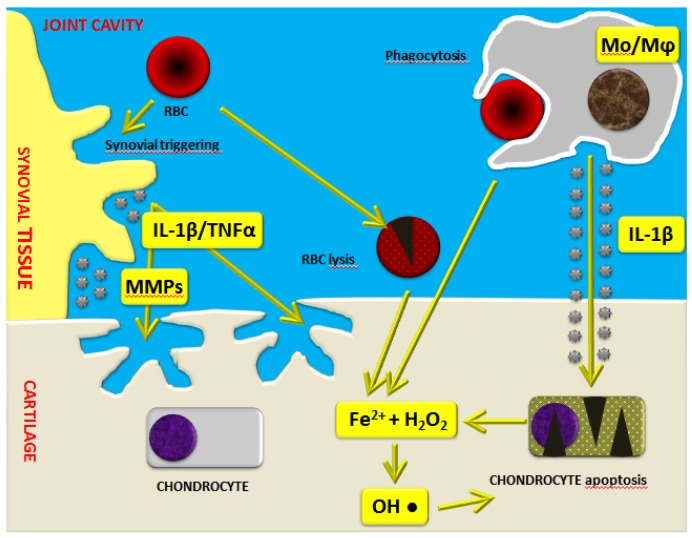
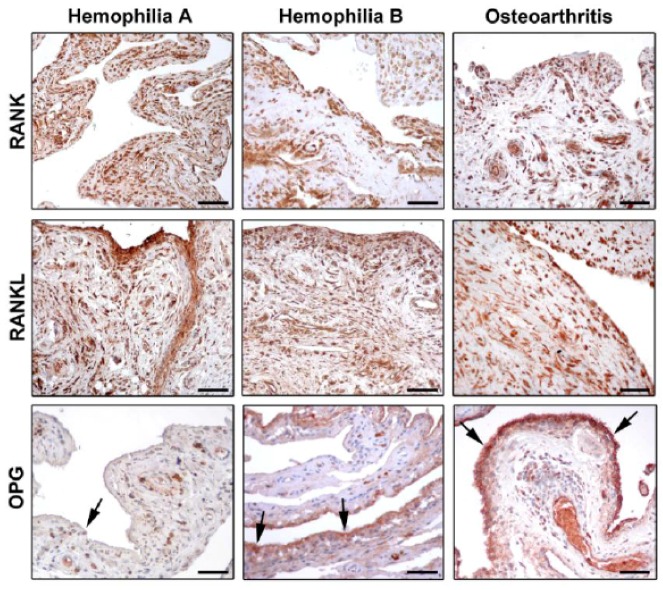
Spontaneous joint bleeding and repeated hemarthroses lead to hemophilic arthropathy-a debilitating disease with a significant negative impact on mobility and quality of life. Iron, cytokines, and angiogenic growth factors play a pivotal role in the onset of the inflammatory process that involves the synovial tissue, articular cartilage, and subchondral bone, with early damages and molecular changes determining the perpetuation of a chronic inflammatory condition. Synovitis is one of the earliest complications of hemarthrosis, and is characterized by synovial hypertrophy, migration of inflammatory cells, and a high degree of neo-angiogenesis with subsequent bleeding. The pathogenic mechanisms and molecular pathways by which blood in the joint cavity causes articular cartilage and subchondral bone destruction have yet to be fully elucidated. Both cytokines and matrix metalloproteinases and hydroxyl radicals may induce chondrocyte apoptosis. Members of the tumor necrosis factor receptor superfamily (such as the molecular triad: osteoprotegerin-OPG; receptor activator of nuclear factor κB-RANK; RANK ligand-RANKL) seem instead to play a major role in the inflammatory process. These pathogenic processes interact with each other and ultimately lead to a fibrotic joint and the disabling condition characteristic of hemophilic arthropathy.
自发性关节出血和反复关节积血会导致血友病性关节病——一种使人衰弱的疾病,对活动能力和生活质量有重大负面影响。铁、细胞因子和血管生成生长因子在涉及滑膜组织、关节软骨和软骨下骨的炎症过程的发生中起关键作用,早期损伤和分子变化决定了慢性炎症状态的持续存在。滑膜炎是关节积血最早出现的并发症之一,其特征为滑膜肥大、炎症细胞迁移以及高度的新生血管形成并伴有随后的出血。关节腔内的血液导致关节软骨和软骨下骨破坏的致病机制和分子途径尚未完全阐明。细胞因子、基质金属蛋白酶和羟基自由基都可能诱导软骨细胞凋亡。相反,肿瘤坏死因子受体超家族的成员(如分子三联体:骨保护素-OPG;核因子κB受体激活剂-RANK;RANK配体-RANKL)似乎在炎症过程中起主要作用。这些致病过程相互作用,最终导致关节纤维化和血友病性关节病特有的致残状况。