Department of Pharmacy, Beijing Tiantan Hospital, Capital Medical University, Beijing, China.
Department of Clinical Pharmacology, School of Pharmaceutical Sciences, Capital Medical University, Beijing, China.
Front Endocrinol (Lausanne). 2023 Jun 13;14:1170127. doi: 10.3389/fendo.2023.1170127. eCollection 2023.
Glucagon-like peptide-1 receptor agonists (GLP-1RAs) have been widely used in treating type 2 diabetes mellitus (T2DM) and obesity in adults, but scientific research about the indication in children and adolescents is scarce. The current study aims to explore the prescriptions of GLP-1RAs in children and adolescents in China and to evaluate its rationality.
GLP-1RA prescriptions of children and adolescents were retrospectively obtained from the Hospital Prescription Analysis Cooperative Project. The study extracted information on patient's demographic characteristics, monotherapy and combination therapy of GLP-1RAs, and trends in GLP-1RA usage from 2016 to 2021. The rationality of GLP-1RA prescriptions was comprehensively assessed based on the indications approved by China National Medical Products Administration (NMPA), the U.S. Food and Drug Administration (FDA), European Medicines Agency (EMA), Pharmaceuticals and Medical Devices Agency (PMDA), and published randomized controlled trials (RCTs).
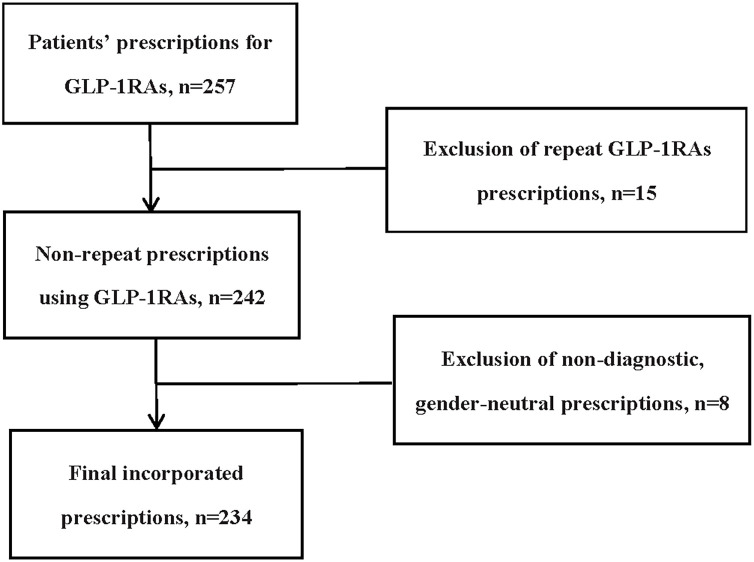
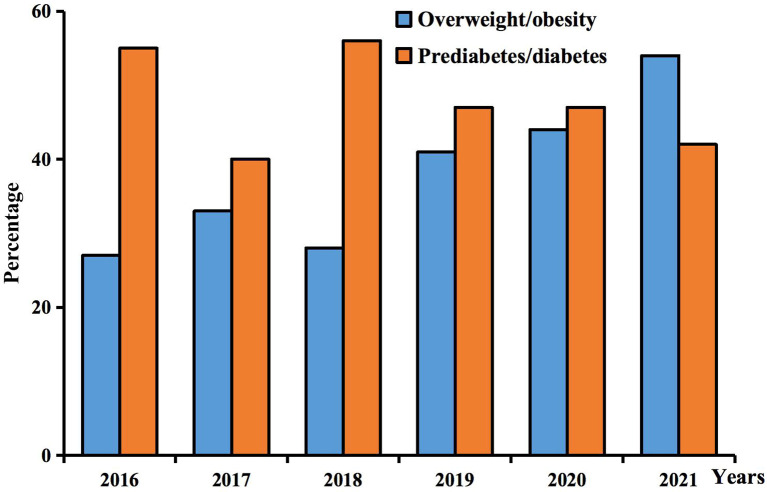
A total of 234 prescriptions from 46 hospitals were included, with a median age of 17 years old. The majority of patients were diagnosed with overweight/obesity or prediabetes/diabetes, accounting for 43.59% and 46.15%, respectively. There were 88 patients on GLP-1RA monotherapy. GLP-1RAs plus metformin was the most common combination therapy (38.89%). 12.39% of patients were found a co-administration with orlistat. The share of overweight/obesity prescriptions increased from 27% in 2016 to 54% in 2021, whereas prediabetes/diabetes prescriptions declined from 55% to 42%. The prescriptions were divided into appropriate and questionable groups according to the diagnosis, and the potentially questionable prescription was related to age ( = 0.017), department visited ( = 0.002), and any hospitalization ( < 0.001).
This study described the prescribing of GLP-1RAs in children and adolescents. Our findings indicated that the utilization of GLP-1RAs has increased from 2016 to 2021. There was a strong basis for administering GLP-1RAs in overweight/obesity and prediabetes/diabetes, whereas the evidence was insufficient in other conditions. It is crucial to demand robust and sustained efforts to enhance the awareness of the safety of utilization of GLP-1RAs in children and adolescents.
胰高血糖素样肽-1 受体激动剂(GLP-1RAs)已广泛用于治疗成人 2 型糖尿病(T2DM)和肥胖症,但儿童和青少年适应症的科学研究却很少。本研究旨在探讨中国儿童和青少年 GLP-1RA 的处方情况,并评估其合理性。
通过医院处方分析合作项目回顾性获取儿童和青少年 GLP-1RA 的处方。本研究从 2016 年至 2021 年,提取了患者人口统计学特征、GLP-1RA 单药和联合治疗以及 GLP-1RA 使用趋势等信息。根据中国国家药品监督管理局(NMPA)、美国食品和药物管理局(FDA)、欧洲药品管理局(EMA)、日本医药品医疗器械综合机构(PMDA)批准的适应症以及已发表的随机对照试验(RCTs),综合评估 GLP-1RA 处方的合理性。
共纳入 46 家医院的 234 份处方,中位年龄为 17 岁。大多数患者被诊断为超重/肥胖或糖尿病前期/糖尿病,分别占 43.59%和 46.15%。88 名患者接受 GLP-1RA 单药治疗。GLP-1RA 联合二甲双胍是最常见的联合治疗(38.89%)。有 12.39%的患者同时使用奥利司他。超重/肥胖症处方的比例从 2016 年的 27%增加到 2021 年的 54%,而糖尿病前期/糖尿病的处方比例从 55%下降到 42%。根据诊断将处方分为适当和可疑两组,潜在可疑处方与年龄( = 0.017)、就诊科室( = 0.002)和任何住院情况( < 0.001)有关。
本研究描述了儿童和青少年 GLP-1RA 的处方情况。我们的研究结果表明,2016 年至 2021 年 GLP-1RA 的使用率有所增加。在超重/肥胖和糖尿病前期/糖尿病中使用 GLP-1RA 有充分的依据,而在其他情况下证据不足。迫切需要加强对儿童和青少年 GLP-1RA 使用安全性的认识,并持续做出努力。